
Megawatt Chargers: Alpitronic and Milence Team Up
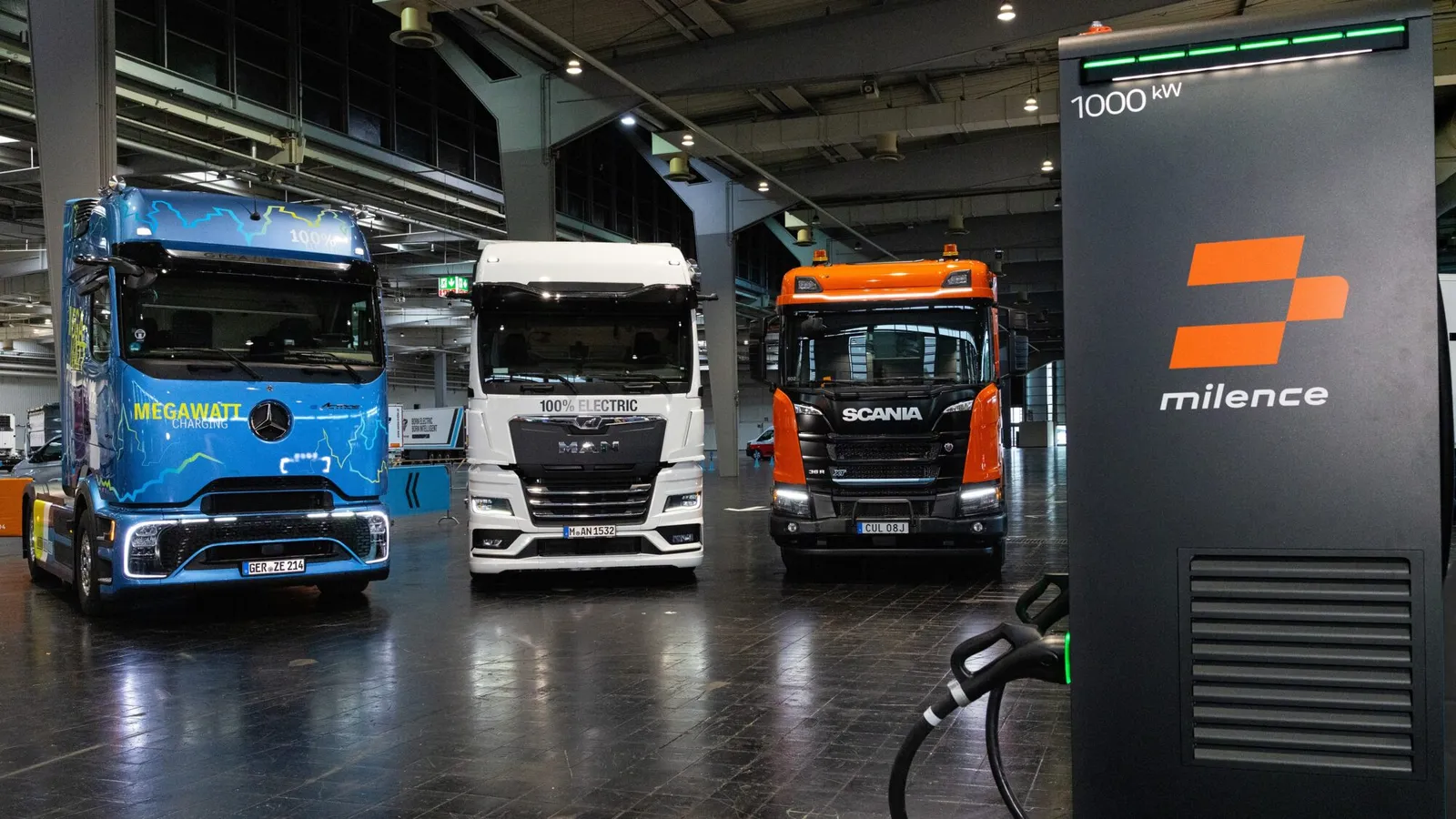
Alpitronic and Milence aim to jointly establish Megawatt charging stations for electric trucks along Europe’s freight transport corridors. At IAA Transportation, trucks from Daimler, MAN, and Scania were charged to 80 percent or full using MCS during driver breaks.
Advertisement
Alpitronic, a South Tyrolean manufacturer of charging stations, and Milence, an operator of truck charging networks, plan to work more closely together in the future to build megawatt-level charging stations for heavy electric trucks. The two companies have signed a Memorandum of Understanding outlining a long-term strategic partnership. The agreement was announced at the IAA Transportation in Hanover, where Milence, along with several truck manufacturers, also demonstrated its Megawatt Charging System (MCS).
The goal of this collaboration is to expand charging infrastructure along key European freight transport routes at the same pace as the increase in electric trucks. The partners have not yet specified any particular locations, numbers of stations, or investment amounts.
HYC1000 for depots and highways
The technical foundation is Alpitronic’s HYC1000 charging system. It can be combined with various output units: A new depot dispenser allows commercial vehicles to be charged on the company premises, for example overnight. With an MCS dispenser, the system can deliver up to 1,000 kW at a single charging point. This is intended to serve both charging during the legally required 30 to 45 minute driving breaks and longer stays in the depot.
Alpitronic emphasizes that public charging on the road and private charging in depots need to work closely together so that freight companies can plan their electric trucks economically. The company, founded in 2009, claims to have installed more than 125,000 charging points worldwide, where approximately 223 million charging sessions have taken place to date.
The partners also cite the recently more volatile diesel prices as an argument for making the switch. Those who drive electric are less dependent on imported fossil fuels and thus less affected by price fluctuations, making transportation costs more predictable.
Advertisement
MCS demonstration with three truck manufacturers
On the press day of IAA Transportation, Milence, together with Daimler Truck, MAN Truck & Bus, and Scania, demonstrated trucks from these three manufacturers using MCS. According to the participants, the batteries were charged to 80 percent or fully within a regular driver break of 30 to 45 minutes. The focus was on interoperability between vehicles from different brands and the charging station.
The demo station consisted of an Alpitronic HYC1000 with a charging capacity of up to 1,000 kW and a battery storage system of the Pixii PowerBase XLP type with a capacity of up to 1 MW and 2 MWh. This combination is intended to demonstrate how megawatt-level charging can be implemented even in locations with limited grid connections.
According to MAN, it has been equipping MCS standardly for customers who want to use the technology early on since July. With the eTGX, daily driving distances of over 1,000 kilometers are possible while maintaining the same working time as a diesel truck. Mercedes-Benz Trucks cites the eActros 600 as proof of its viability for long-haul transportation. Scania states that 1,000 amperes and 750 kW currently form the basis of this standard, with potential to exceed 3 MW in the future. Additionally, they already meet the latest requirements for cybersecurity between vehicles and charging stations.
Expansion of the charging network as a bottleneck
Milence, a joint venture from the trucking industry, currently operates nearly 40 charging parks in nine markets. By the end of 2027, the network is set to expand to 70 locations, more than half of which will be equipped with MCS technology. In the long term, the company aims to establish charging parks along all major TEN-T corridors in Europe, starting with a focus on 15 markets.
The automotive industry association (VDA) clarified how large the gap still is. CEO Jürgen Mindel estimated that around 35,000 publicly accessible MCS charging points are needed in Europe by 2030. Currently, there are only 730 charging stations across the EU with over 350 kW capacity, all designated for heavy commercial vehicles. Therefore, the VDA calls for political priority to be given to expanding charging stations and power grids. Anja van Niersen, head of Milence, also considers the technology ready for use and urges accelerating its deployment along freight transport corridors.
Advertisement