
The Mazda EZ-60 is equipped with LiDAR and NOA. The CX-6e reflects the brand’s ambitions in China.
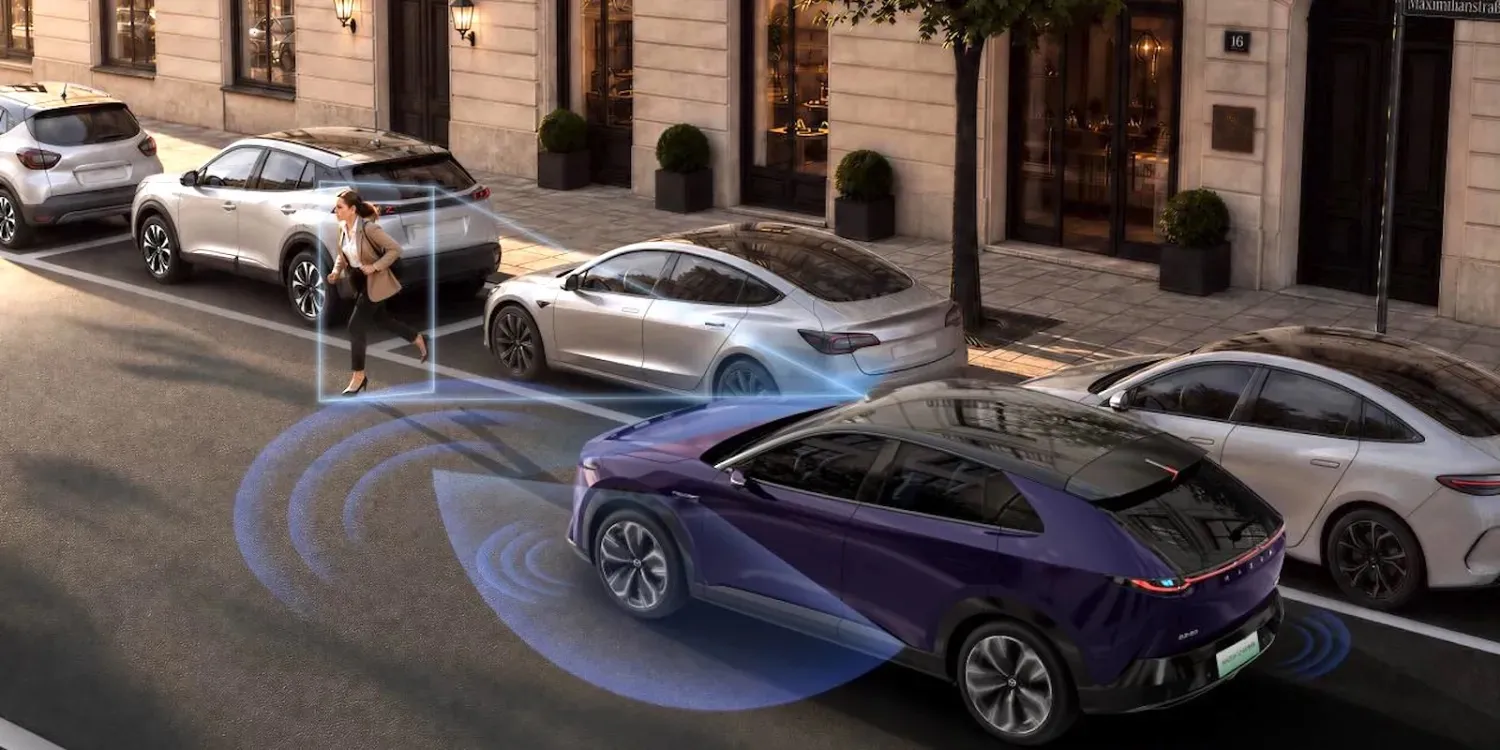
On September 27, 2026, Changan Mazda unveiled the EZ-60 Laser Edition, the Chinese counterpart to Mazda’s CX-6e available in Europe. This electric SUV is equipped with LiDAR, 26 additional sensors, and an L2 driving system that handles highways, urban areas, and automatic parking. It remains a driver-assistance system rather than an autonomous vehicle.
The EZ-60 and CX-6e are the second electric vehicles developed by Mazda in collaboration with Changan. At the same time, it is the first model from this partnership ready for sale outside of China as well.
LiDAR, 11 cameras, and navigation-driven driving
The Laser Edition package includes LiDAR, 11 HD cameras, 12 ultrasonic sensors, and 3 millimeter-wave radars. The car is designed to detect vehicles, cyclists, and pedestrians even in poor visibility conditions.
On the highway, the system operates within a range of 0-130 km/h. It can change lanes, avoid obstacles, exit and re-enter the expressway, as well as handle entrances to service areas. It makes decisions based on the route stored in the navigation system.
In urban areas, the EZ-60 uses Tencent’s navigation to determine routes at specific traffic lanes. Mazda handles vehicles approaching from the front, construction detours, and narrow streets. An OTA update is planned to add the ability to follow another vehicle while traveling in a convoy.
The manufacturer describes this as an advanced L2 level along with NOA, which stands for Navigation on Autopilot. The driver remains responsible for driving at all times. In China, Tesla uses a similarly cautious naming convention, where the feature known in the U.S. as Full Self-Driving is called Tesla Assisted Driving.
Braking to 110 km/h and CATARC certification
The AEB system is designed to stop the car in front of a stationary obstacle at speeds up to 110 km/h. For a pedestrian on the road, the limit is 90 km/h, while for pedestrians and cyclists crossing the road it’s 60 km/h.
In the event of a pedestrian or vehicle suddenly appearing behind an obstacle, the system must react at speeds up to 50 km/h. Mazda also combines AEB with AES. As the manufacturer explains, “if the car cannot stop, it will simultaneously assist in turning to avoid the obstacle.” Such claims sound impressive, but true effectiveness can only be proven through independent road tests.
The EZ-60 Laser Edition has undergone 11 approved high-risk tests, including driving on narrow mountain roads and nighttime driving on highways in rain. The model has received the TOP Intelligence Intelligent Safety Challenge certification issued by China’s CATARC institute.
The basic technology remains unchanged. A 190 kW, or 258 HP, engine powers the rear, generating around 290 Nm of torque. The LFP battery has a capacity of 77.94 kWh, and the claimed range is 600 km according to Chinese data, so it should not be directly compared to WLTP results.
The Laser Edition is aimed at the Chinese market, and Mazda has not linked this release to the European update for the CX-6e. The advantage of the EZ-60 might lie not in the LiDAR itself but in the integration of sensors with Tencent’s navigation system. Would you prefer such a setup in the European CX-6e, or a simpler system based on cameras and radars?
LovEV Newsletter
Want more content like this?
Sign up — we’ll send you a weekly summary once the newsletter starts.