
Over 1,000 km of range and almost half the price of a Xiaomi YU7: this is the new Chinese SUV that’s sparking another price war
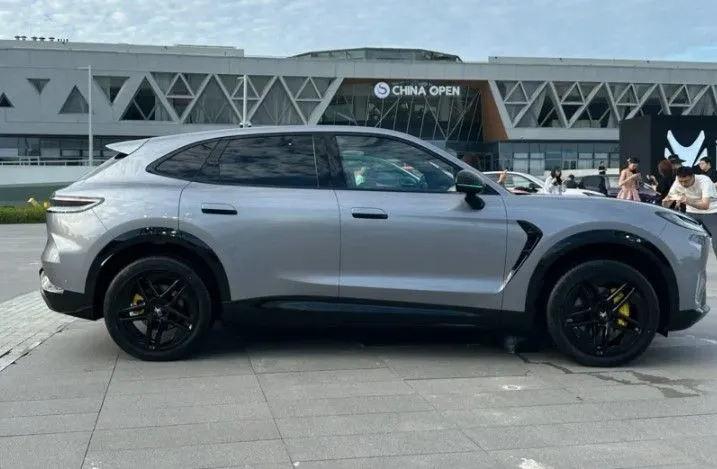
The price war in China’s electric vehicle market is intensifying once again. Arcfox, known in Europe for BAIC’s attempt to import its vehicles through Ferrol port, has just launched the Alpha T7, a SUV over 5 meters long that offers both electric and range-extender versions, extensive technological features, and an 800-volt platform. All of this comes at a starting price of 132,800 yuan, a figure that keeps it well below models like the Xiaomi YU7.
The launch took place on September 16, and the initial response has been particularly impressive. According to Arcfox, the Alpha T7 received over 30,000 confirmed orders in its first hour of availability, having already surpassed 60,000 pre-orders during the presale phase. The brand offers nine different configurations, four with range extenders and five electric versions.
The price is also one of the main selling points of this new model. The range starts at 132,800 yuan for the Alpha T7 1315 Plus with a range extender and goes up to 168,800 yuan for the electric 715 Ultra Qiankun. For models with range extenders, prices range from 132,800 to 163,800 yuan, while electric versions start at 135,800 yuan and reach up to 168,800 yuan.
To put these figures in context, the standard version of the Xiaomi YU7 currently costs 233,500 yuan in China, while the YU7 Long Range version retails for 253,500 yuan. This means the entry-level Arcfox Alpha T7 costs between 43% and 48% less, depending on which Xiaomi model it’s compared to. It’s not exactly half the price, but it’s very close in a segment where both offer large-sized bodies and high levels of technology.
Over 1,100 kilometers of range with an extender
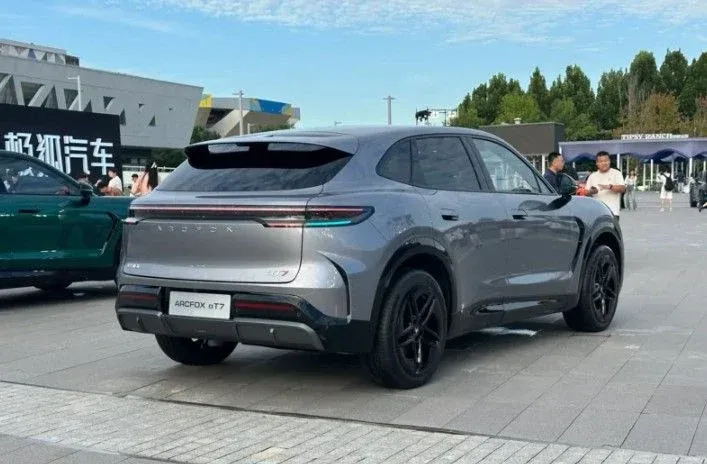
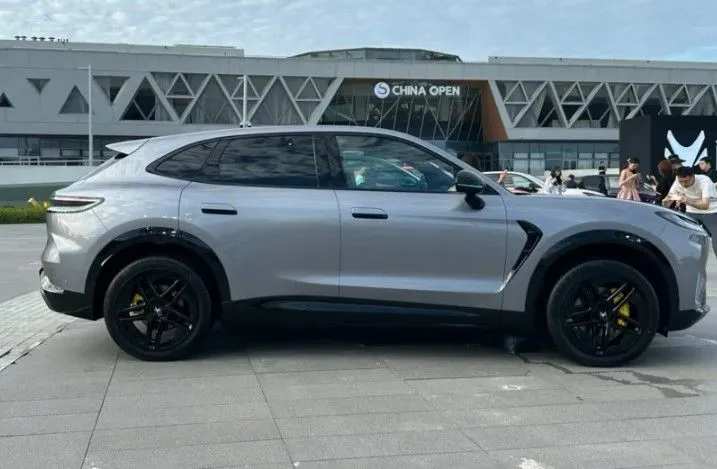
The Alpha T7 features a five-seater SUV design with a quite stylish silhouette. Its dimensions are 5.02 meters in length, 1.996 meters in width, and 1.685 meters in height, with a wheelbase of 3,040 mm. With these specs, Arcfox enters the realm of large SUVs directly, though its sloping rear roof aims to give it a more dynamic appearance.
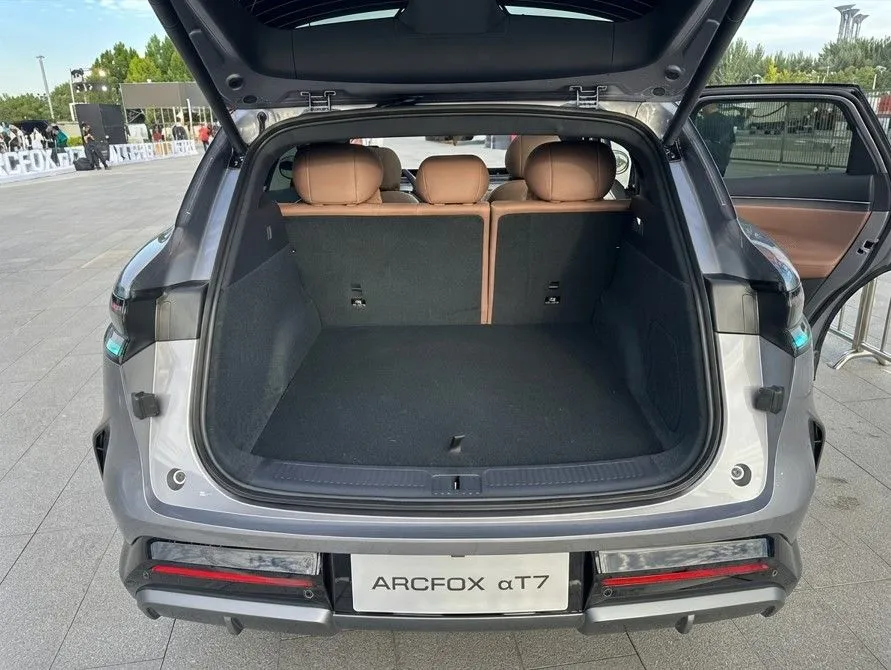
The front end is dominated by a fully enclosed grille and a large 1,700 mm light bar that runs along the front portion. The announced aerodynamic coefficient is 0.251, a reasonable figure for a vehicle of this size that helps keep fuel consumption low at high speeds. At the rear, there is a 645-liter trunk that can expand to 1,845 liters when the rear seats are folded down, while the front compartment adds another 200 liters.
The interior follows the trend of minimizing physical elements. The traditional dashboard disappears, giving way to a 43.3-inch projected information system, while a 17.3-inch 3K resolution screen is located at the center of the console. This system uses a chip manufactured using a 4-nanometer process and offers 5G connectivity, voice control, Huawei HiCar, and Apple CarPlay.
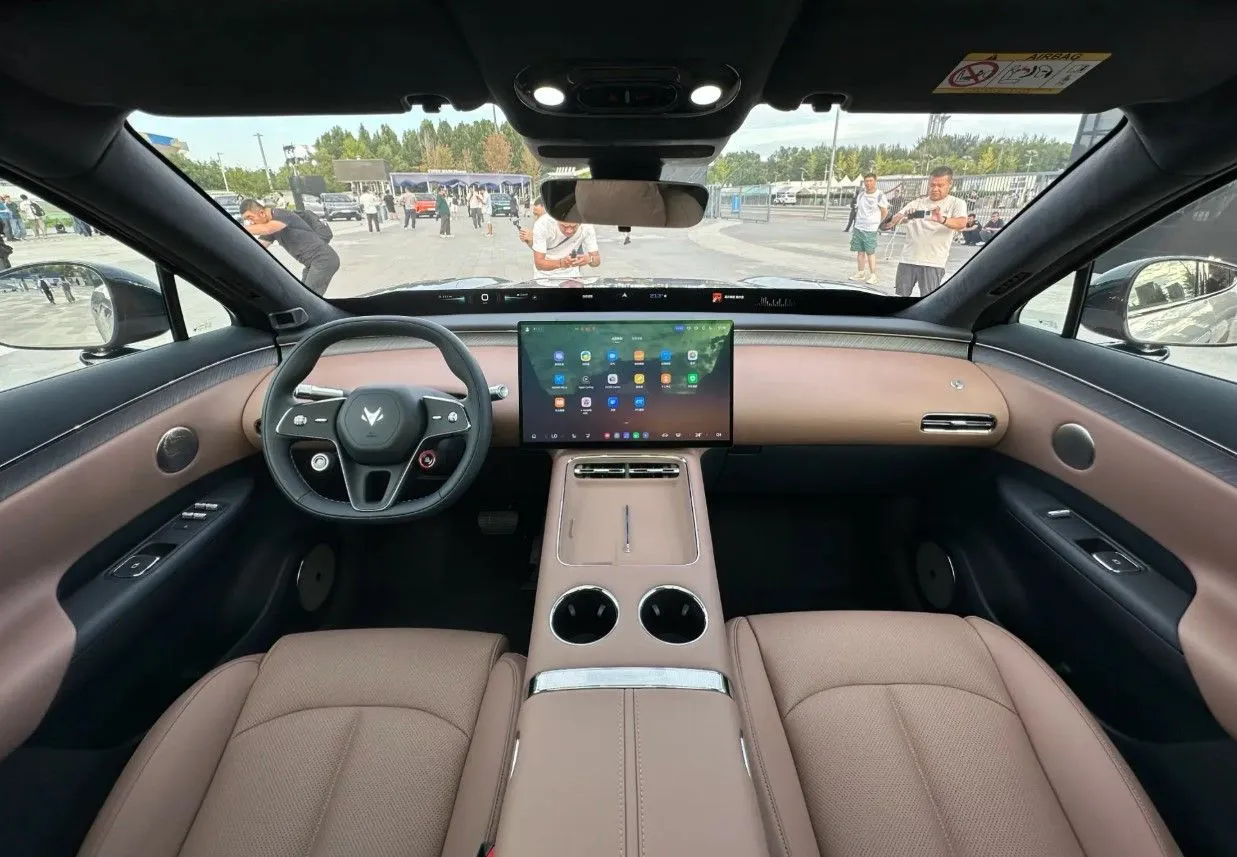
In the higher trims, the Huawei Qiankun ADS 5 Pro driving assistance system is also available, which uses 27 sensors including a laser vision system integrated into the cabin. Arcfox announces highway and city assistance features, along with smart parking in over 160 scenarios. These functions are not standard across the entire range but are available with certain configurations.
The mechanical lineup is divided into two main groups. The electric Alpha T7 models use an 800-volt platform with silicon carbide technology and a single electric motor of 227 kW, equivalent to around 309 horsepower. The 650 Plus combines this motor with a 72.8 kWh battery, achieving 650 kilometers of range under the CLTC cycle, while the higher trims use an 84.8 kWh battery and reach 715 kilometers of CLTC range.
Using the approximate conversion commonly applied to compare these figures with the European cycle, we would be talking about around 566 and 622 kilometers respectively. These are not official WLTP figures, but rather estimates based on Chinese data; however, they provide a more realistic idea of what the model might offer outside of China.
The 800-volt architecture is also one of the strengths of the Alpha T7. Arcfox claims that the system can recover 270 kilometers of range in just 10 minutes, while pre-launch information suggested a charge from 30% to 80% in about 15 minutes. This performance is particularly impressive considering the vehicle’s size and price.
For many, the most impressive version is the one equipped with an extended range option. In this case, the Alpha T7 combines a 200 kW electric motor with a 1.5-liter gasoline engine that functions as a generator, along with a 43.9 kWh battery. The certified all-electric range is 320 kilometers under CLTC standards, around 278 kilometers estimated under WLTP, while the total range reaches 1,315 kilometers under CLTC standards.
This makes the Alpha T7 1315 a particularly unique offering: an SUV over five meters long capable of traveling more than 1,100 kilometers on a range equivalent to the European cycle, with a relatively modest battery and the option to use gasoline to generate electricity when the charge is depleted.
Arcfox Alpha T7 electric
650 Plus: 135,800 yuan → 17,663 euros
715 Max: 149,800 yuan → 19,483 euros
715 Max Qiankun: 158,800 yuan → 20,654 euros
715 Ultra: 159,800 yuan → 20,784 euros
715 Ultra Qiankun: 168,800 yuan → 21,956 euros
Arcfox Alpha T7 with extended range system (EREV)
1315 Plus: 132,800 yuan → 17,270 euros
1315 Max: 144,800 yuan → 18,834 euros
1315 Max Qiankun: 153,800 yuan → 20,005 euros
1315 Ultra Qiankun: 163,800 yuan → 21,306 euros
The result is a car that’s difficult to fit within current European standards. For just over 17,000 euros, Arcfox offers in China an SUV over five meters long, with five seats, long range, and plenty of technology. That’s roughly the price of a basic Renault Twingo in Europe.
The question now is whether such a model will make it to our market and, more importantly, at what price. There’s no current announcement of a European launch, but the Alpha T7 shows just how intense the price war is becoming in China. Large-sized models, increasingly powerful batteries, 800-volt systems, and advanced driver assistance technologies are now available at prices that just a few years ago were reserved for much smaller cars.