
MAN Report “Beyond Diesel”: Electric Trucks as a Competitive Advantage
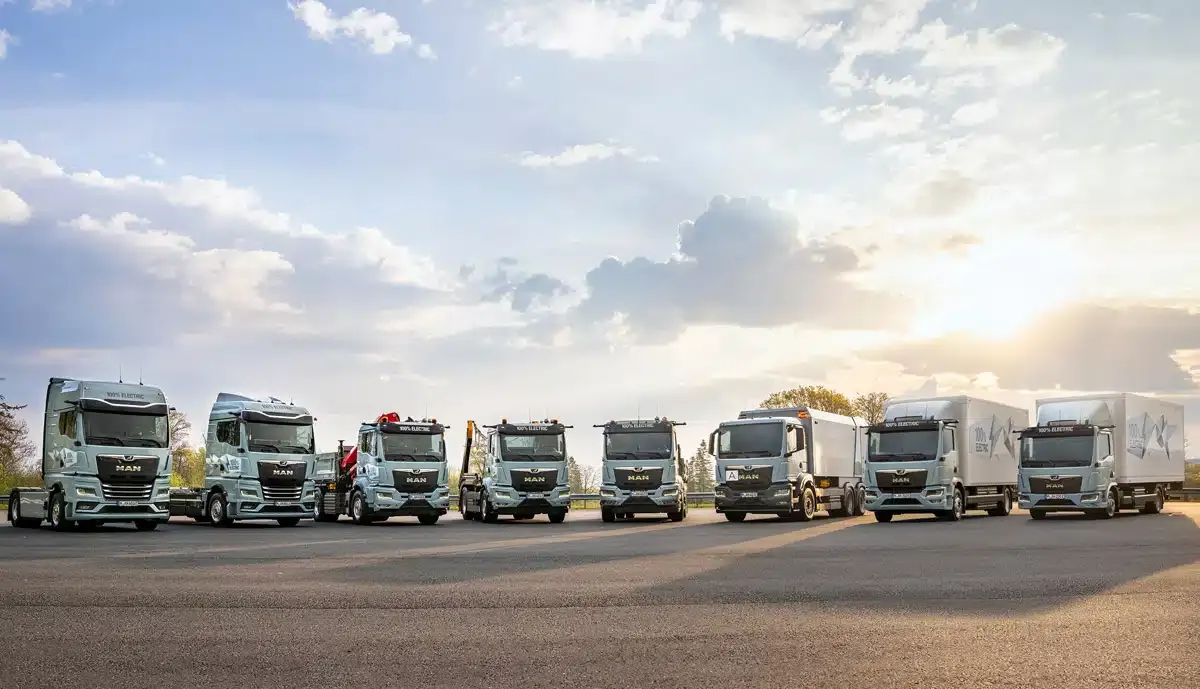
Image: MAN
The strategy report “Beyond Diesel” published by MAN Truck & Bus shows how switching to battery-electric trucks can create a structural competitive advantage – and why eTrucks are increasingly determining access to customers and orders.
Battery-electric trucks are no longer just a future technology but an operational reality: More than 15,000 eTrucks are already on Europe’s roads daily, operated by around 5,000 freight forwarders and transport companies, emphasizes MAN.
The commercial vehicle market is undergoing structural changes and is likely to continue in this direction: The EU mandates lower CO₂ emissions for manufacturers (-45% by 2030 and -90% by 2040), and an increasing number of shippers are requiring zero-emission transportation in their bidding processes. As a result, electrification is shifting from an option to a requirement. According to studies, the share of battery-electric new registrations is expected to rise to 15 to 35 percent by 2030.
MAN states: “Those who start electrifying their depots and fleets early can often benefit from higher prices for zero-emission transportation, position themselves as a key component of low-emission supply chains, and develop the necessary skills in energy generation and utilization that will be crucial for long-term success.”
According to MAN, the key advantage does not lie solely in the electric vehicle itself but in the overall system comprising the vehicle, charging station, as well as charging and energy management. Energy prices, charging infrastructure, as well as toll and CO₂ costs determine the total cost of ownership (TCO). The charging station plays the most crucial role: Up to 90 percent of all charging operations already take place at the vehicle’s own location today and will continue to do so in the future. With photovoltaics, storage systems, and smart charging, energy costs could drop below 16 cents per kilowatt hour. Over a five-year period, this could result in TCO savings of up to 13 percent compared to diesel vehicles.
The MAN Strategic Report “Beyond Diesel” aims to demonstrate that this is already feasible today by showcasing three real customer archetypes at different stages of their business transformation. Foppiani Transport (Italy) represents a structured approach, Betonwerk Bad Lausick (Germany) illustrates scaling through intelligent energy systems, and Schlager Transport Logistik (Austria) shows a successful integrated solution.
“BEV Starter: The Structured Approach”
Foppiani Transport from Milan operates a fleet entirely composed of MAN vehicles, utilizing an electric tractor unit, an electric chassis, depot charging, and a 350-kWp photovoltaic system. Another eTGX has been ordered from MAN. “The benefits of battery-electric trucks outweigh the additional costs — our customers are willing to pay a premium for the advantages they offer,” says Purchasing & Maintenance Manager Pietro Zanon.
“BEV System Operator: Electrification as a Business Strategy”
Schlager Transport Logistik already operates a fleet that is half battery-electric and aims to go fully electric by 2030. At its Saxen location, the company uses an integrated depot energy system with around 765 kWp of photovoltaic panels and 1.6 MWh of storage capacity. Owner Hubert Schlager initially calculated the business case himself using Excel and is convinced that roughly half of the commercial vehicle fleet in Germany and Austria can be economically electrified even today.
“BEV Scaler: Scaling and cost-effectiveness come first.”
The Bad Lausick concrete plant uses five eTGX vehicles, each equipped with six battery packs, along with a depot energy system comprising 400-kW charging stations, 1.8 MWp of photovoltaic panels, and battery storage at several locations. Over a period of five years, this setup yields the company a total operational cost savings of around 500,000 euros. “I’m not going to stand there and engage in greenwashing. Profitability must come first,” emphasizes CEO Robin Schulze.
"The examples show that electric trucks are already economically viable today," says Roland Schurig, Vice President Zero Emission Projects at MAN Truck & Bus. "However, only those companies that electrify the entire system—including the vehicle, depot, as well as charging and energy management—can secure a decisive advantage. As MAN, we act as partners to both new and existing customers, helping them understand where they stand in their transformation process and how they can move forward."
Also interesting
About the author
Thomas Langenbucher is an expert in electromobility with experience in the automotive and financial industries. Since 2011, he has been covering electric vehicles, sustainable technologies, and mobility solutions for ecomento.de. Learn more.
Reader interactions
