
Mahle introduces a range extender for electric trucks
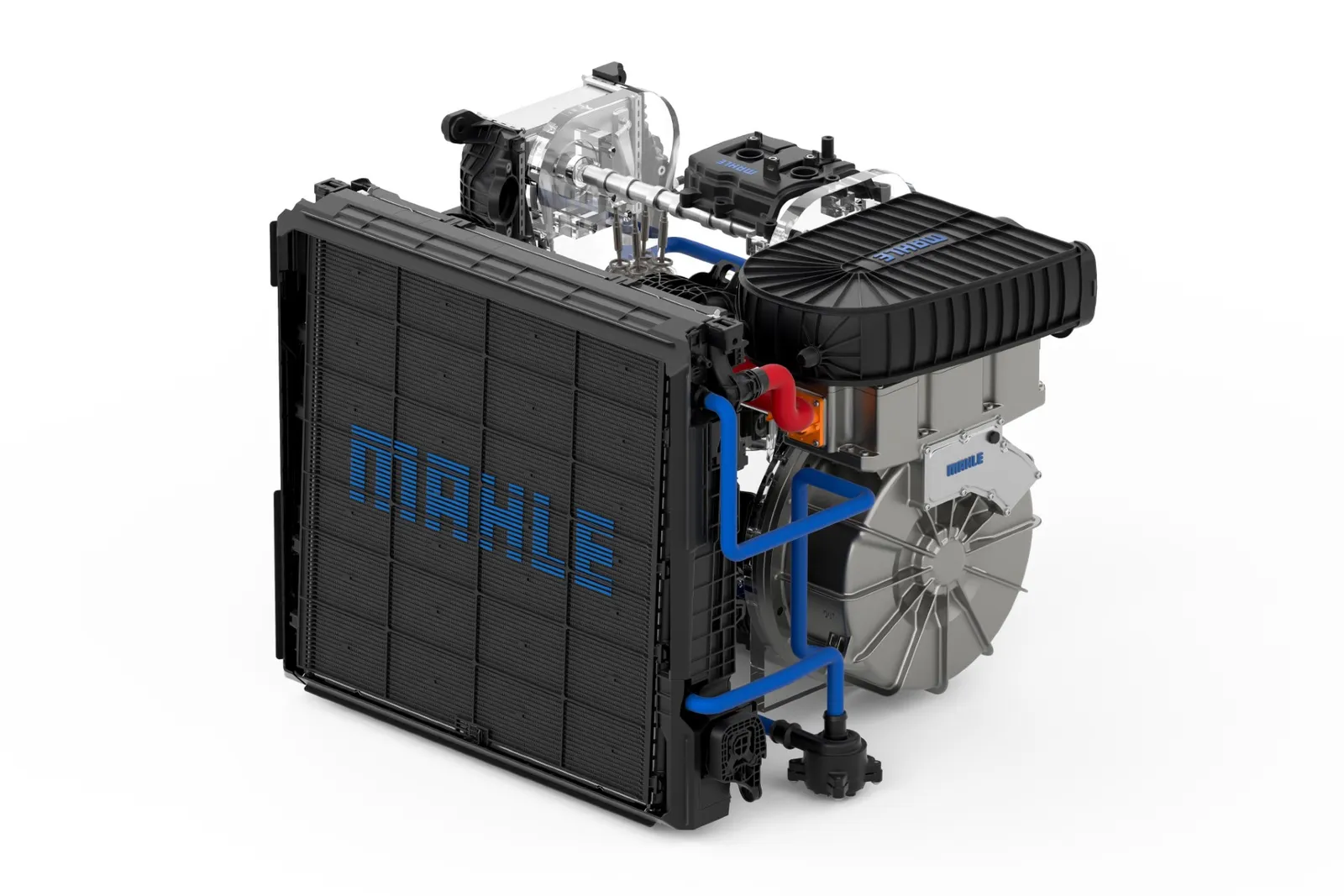
Mahle will introduce a new range-extender system for heavy trucks at the IAA Transportation in September. It can be installed in battery-electric trucks, effectively turning them into plug-in hybrids. The range-extender consists of a high-voltage generator combined with a compact combustion engine.
Mahle discusses its range-extender system for heavy trucks
E-trucks making their world debut, awaiting visitors at the IAA Transportation in Hannover (September 15–20, 2026). With the generator on board, battery-electric trucks will be able to “cover all daily driving distances” in the future, says the Stuttgart-based supplier. This is intended to completely eliminate logistics companies’ concerns about range. Dr. Marco Warth, head of Mahle’s corporate development, comments: “Our range extender is an intelligent ‘emergency power unit’ that activates at the right moment to significantly increase range.”
To put this in context: Trucks equipped with this system become what are known as EREVs. The acronym stands for “Extended Range Electric Vehicles,” a term we’re mostly familiar with from the Chinese automobile market. EREVs are partially electric vehicles that can be charged externally using electricity and also refueled with fuel—similar to plug-in hybrids. Unlike these, however, the wheels in EREVs are always driven solely by an electric motor. When the batteries run out, a small internal combustion engine starts up to generate electricity for the motor. This combustion engine-generator is referred to in technical terms as a range extender. Such range extenders are rare in trucks. However, we’re aware of one field test: DHL and Scania recently experimented with this technology.
Range extender located in the battery compartment
At Mahle, the system is structured as follows: A high-voltage generator with a continuous output of 110 kW and a peak output of 130 kW is driven by a compact combustion engine — which in turn supplies energy to the electric drive on demanding routes and with fully loaded trucks. According to Mahle, the architecture of the range extender can be easily adapted to the specific performance requirements of various applications and regional markets.
The supplier also describes its range extender system as a standalone unit that combines the generator, combustion engine, thermal and fluid management systems, fuel tank, AdBlue tank, and exhaust aftertreatment in a compact box. Thanks to an innovative oil cooling system, the generator is said to achieve a power density of over 7 kW per kilogram.
The range extender unit is installed in the space designated for the battery, which as a result becomes smaller. In other words, part of the battery packs is replaced, which does not mean less range powered solely by batteries, but it allows for the installation of a combustion engine-based range extender that, working together with the remaining batteries, promises greater overall range. However, this logically also results in higher CO2 emissions (though still less than those of a diesel truck).
Mahle promises over 800 km of range
Specifically, according to the manufacturer, the Mahle system replaces about one-third of the existing battery capacity in a BEV truck. “As a result, it can be equipped with a correspondingly smaller battery. This saves approximately 400 kg of axle load on the rear axle of the vehicle,” explains Mahle. “The vehicle weight is reduced by about 600 kg. In total, such a Range Extender BEV truck achieves a range of over 800 km, with the battery providing around 400 km and the Range Extender covering the other 400 km.”
Mahle also provides an assessment regarding CO2 emissions: “In range extender mode, the commercial vehicle emits over 80 percent less CO2 in real-world use compared to a conventional drive system. When the engine, made compatible with biofuels thanks to Mahle’s components, is powered by modern biodiesel such as HVO100, the vehicle runs with almost no CO2 emissions.” A thermal management system with 48 kW of high-temperature cooling capacity and 15 kW of low-temperature cooling capacity is intended to ensure stable operation of the system under heavy load conditions.
"Our range extender is the key to decoupling the rapid growth of battery-electric trucks from the insufficient pace of infrastructure development," believes Marco Warth. "When charging stations are occupied, weather conditions or traffic jams require alternative routes, when infrastructure reaches its limits, or when other fleets get stuck: an electric truck with a range extender keeps moving! Operational availability is ensured, even during peak times."
Mahle Management emphasizes that it sees a solution in the range extender system to accelerate the transition from diesel trucks, which have dominated the transportation industry to date, to battery-electric trucks. “Time and energy are scarce and valuable resources, especially in the transportation sector; only those who operate efficiently can survive. Mahle helps make heavy trucks more efficient and flexible through products for electrification, while reducing operating costs,” said Arnd Franz, chairman of the company’s management board and CEO of Mahle.
Mahle supplies more to Chinese manufacturers
Franz states that Mahle’s electrification products for trucks not only appeal to local manufacturers but also enable it to expand its presence among Chinese commercial vehicle makers, who are increasingly coming to Europe with battery-electric trucks. The Mahle CEO does not mention specific company names, but it is clear that at least three Chinese E-truck manufacturers—Sany, SuperPanther, and Windrose—are aiming to establish a foothold in Europe this year.
At the IAA Transportation in Hannover, Mahle will showcase not only products for battery-electric trucks and hybrids but also technologies for using renewable fuels to decarbonize road freight transport. As another innovation related to eMobility, the Stuttgart-based company is announcing a new electric motor. Named the Mahle Contactless Transmitter (MCT) E-Motor, this unit is designed for use in electric drive axles of heavy commercial vehicles. It does not rely on rare earth magnets. The MCT E-Motor delivers a peak power of 370 kW and a torque of over 900 Nm at 3,900 rpm. Mahle states that the motor’s efficiency rate is 95 percent according to the VECTO cycle.
In general, medium and heavy commercial vehicles account for around 20 percent of Mahle’s business with automakers. According to the company, it benefits “on one hand from development and production partnerships in all key markets as well as from a broadly diversified customer portfolio.” Mahle works with over 120 customers in the commercial vehicle and off-road sectors. Orders received in the first half of 2026 in the commercial vehicle business, like in the passenger car business as well, were significantly higher than in the same period last year, the company says. “We expect to grow faster than the market with our commercial vehicle products over the next five years,” emphasizes Arnd Franz. Mahle sees the greatest growth potential in Asia.