
The Luxeed RX is starting pre-sales in China. Huawei and Chery are aiming at Xiaomi YU7’s customers.
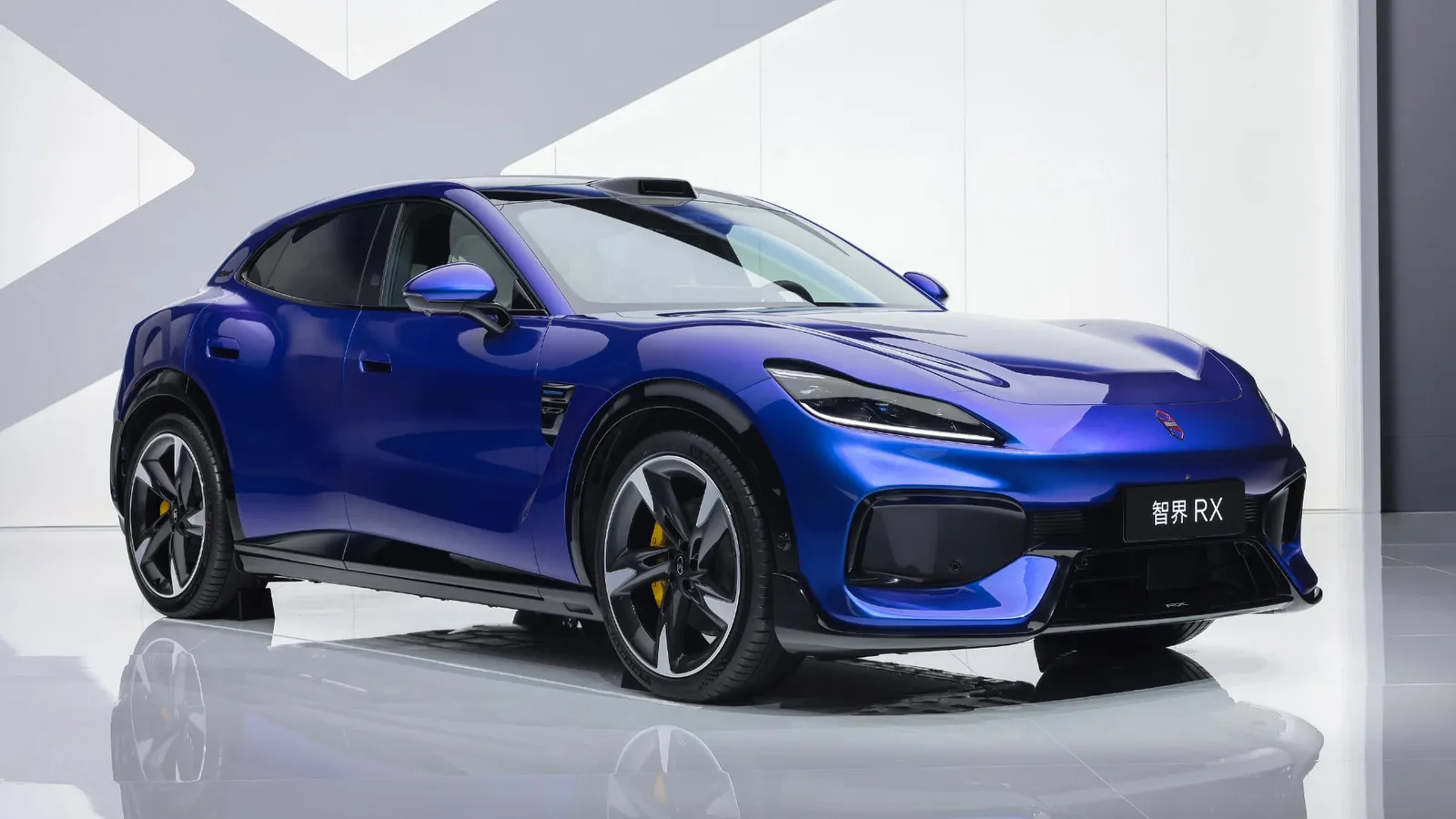
Luxeed has launched pre-sales in China for the RX, an electric coupe-SUV developed jointly by Chery and Huawei. Prices start at 299,800 yuan, with an official market launch scheduled for autumn 2026, right after a debut at the Chengdu Auto Show.
Table of Contents
Show
Hide
This is another move by Huawei in the segment of luxury, large electric vehicles, which is currently extremely competitive. Xiaomi YU7 is already present in that space.
Luxeed RX. A new player in a segment that’s already overflowing
The RX is the fourth model under the Luxeed brand, following the sedan S7, coupe-SUV R7, and van V9. It is also the first SUV in the HIMA ecosystem to move away from the previous alphanumeric naming convention. Instead of another “R-something,” it’s simply called RX.
The car has a high price tag. Pre-sales started at 299,800 yuan for the base version and 359,800 yuan for the more expensive variant. That’s approximately $44,200 to $53,000 in conversion. For comparison, the Xiaomi YU7 currently costs between 233,500 and 389,900 yuan in China.
The target audience here is quite clear. Luxeed doesn’t aim to compete with customers looking for bargains, but rather with those considering the YU7 in a higher version or also eyeing the Voyah Passion S. The latter starts at 229,900 yuan, so the RX is significantly more expensive than it.
In July 2026, Luxeed delivered 9,906 cars in China. These numbers aren’t yet enough to place the brand among the leaders, but Huawei is consistently expanding its HIMA portfolio, and the RX is meant to help penetrate the premium segment more deeply.
Dimensions, powertrain, and battery. The specifications sound impressive on paper, but the actual numbers are strong.
The Luxeed RX is a large car. It measures 5,020 mm in length, 2,007 mm in width, 1,585 mm in height, and has a wheelbase of 3,000 mm. Thus, it is a vehicle that is very similar in size to the Xiaomi YU7 and targets a comparable audience.
The base version comes equipped with one engine on the rear axle producing 277 kW, or 371 horsepower. The AWD variant uses two engines with outputs of 160 kW and 277 kW, totaling 437 kW, or around 586 horsepower. Huawei adds its new powertrain system here, with the engine reaching a maximum rotational speed of 21,000 revolutions per minute.
There are three battery options: 81.1 kWh, 100.256 kWh, and 100.424 kWh. The claimed range according to China’s CLTC standard ranges from 700 to 852 km, depending on the version.
It sounds impressive. But this is still based on CLTC figures, so in real-world driving conditions, especially on highways, the actual range will be significantly lower. The premium segment in China has long learned to use high numbers on paper to make an impact.
Four lidars and L3 readiness. Though currently it’s still mainly a highly advanced L2.
The most interesting part of the RX probably lies not in the battery but in the electronics. The car has 38 sensors and as many as 4 lidars. Among them is one automotive-grade lidar with 896 channels, along with three precise semiconductor lidars.
This is a configuration rarely seen in mass-produced cars. Most higher-end Chinese electric vehicles stop at 1-3 lidars. Luxeed goes a step further, at least in terms of hardware.
The more expensive version of the RX features an architecture prepared for L3 autonomy. The manufacturer also mentions redundant systems for power, communication, perception, steering, and braking. It is elements like these that are necessary if a car is to legally take on more responsibility for driving in the future.
But for now, we’re talking about a highly advanced L2 system with address-to-address driving capabilities, rather than full L3 autonomous driving available without restrictions or limitations. The hardware looks ambitious, but regulations and actual implementation are another story.
Ferrari in the background, Aston Martin under the chassis. Marketing works, but the car also has its practical aspects.
Werner Gruber, a designer formerly associated with Ferrari, Pininfarina, and Saleen, is responsible for the RX’s design. His involvement in the LaFerrari and FXX-K also comes up in the materials. As a result, the RX features a long front end, prominently shaped rear wheels, and a silhouette that has earned it the nickname “Purosangue clone” in China.
It’s a bit sarcastic, but not entirely unfounded. The proportions are indeed unusual for an electric vehicle. On top of that, it has 10 aerodynamic elements and three wheel sizes: 20, 21, and 22 inches.
Tobias Moers, former head of Aston Martin, helped with the chassis tuning. The car also features active suspension and a body stiffness exceeding 50,000 Nm/degree. These specifications suggest the manufacturer aims not only at flashy displays but also at superior handling.
Inside, there are several elements that sound more practical than showy. It includes a 16.1-inch central screen, a 26-inch HUD, a digital rearview mirror, an 8.88-inch passenger screen, and an unusual combination of traditional side mirrors with additional cameras. Screens showing the surrounding environment are placed on the sides of the doors.
There are also seats with 98 pressure sensors and an electrically adjustable sunroof covering 1.8 square meters. It sounds like typical Chinese overkill, but customers in this segment expect exactly that these days.
Where the RX fits into Huawei’s lineup and its significance for Europe
RX will make its public debut at the exhibition in Chengdu, which opens on August 21, 2026. All five brands under the HIMA network are set to be present there. This is significant for Huawei, as the company is increasingly acting like an automaker behind the scenes, although it officially remains a technological and sales partner.
Luxeed says it aims to strengthen its position in 2026 and targets 1 million cars per year by 2030. Ambitious, to put it mildly. Given its current performance, this is more of a direction than a realistic goal.
What about Europe? Nothing concrete for now. But if Huawei continues to push HIMA overseas and Chery maintains its export drive, such a model will eventually come up in discussions about entering the EU. The question isn’t just “whether,” but also “at what cost,” because with EU tariffs and homologation expenses, that price range will quickly become less attractive.
For now, the Luxeed RX appears to be China’s answer to customers for whom the Xiaomi YU7 is no longer sufficient or who simply want something more extravagant. Will four lidars and names associated with Ferrari and Aston Martin be enough to take a piece of Xiaomi’s market share?