
Lucid and Bolt want 25,000 robotaxis in Europe. The problem is that the cars don’t exist yet.
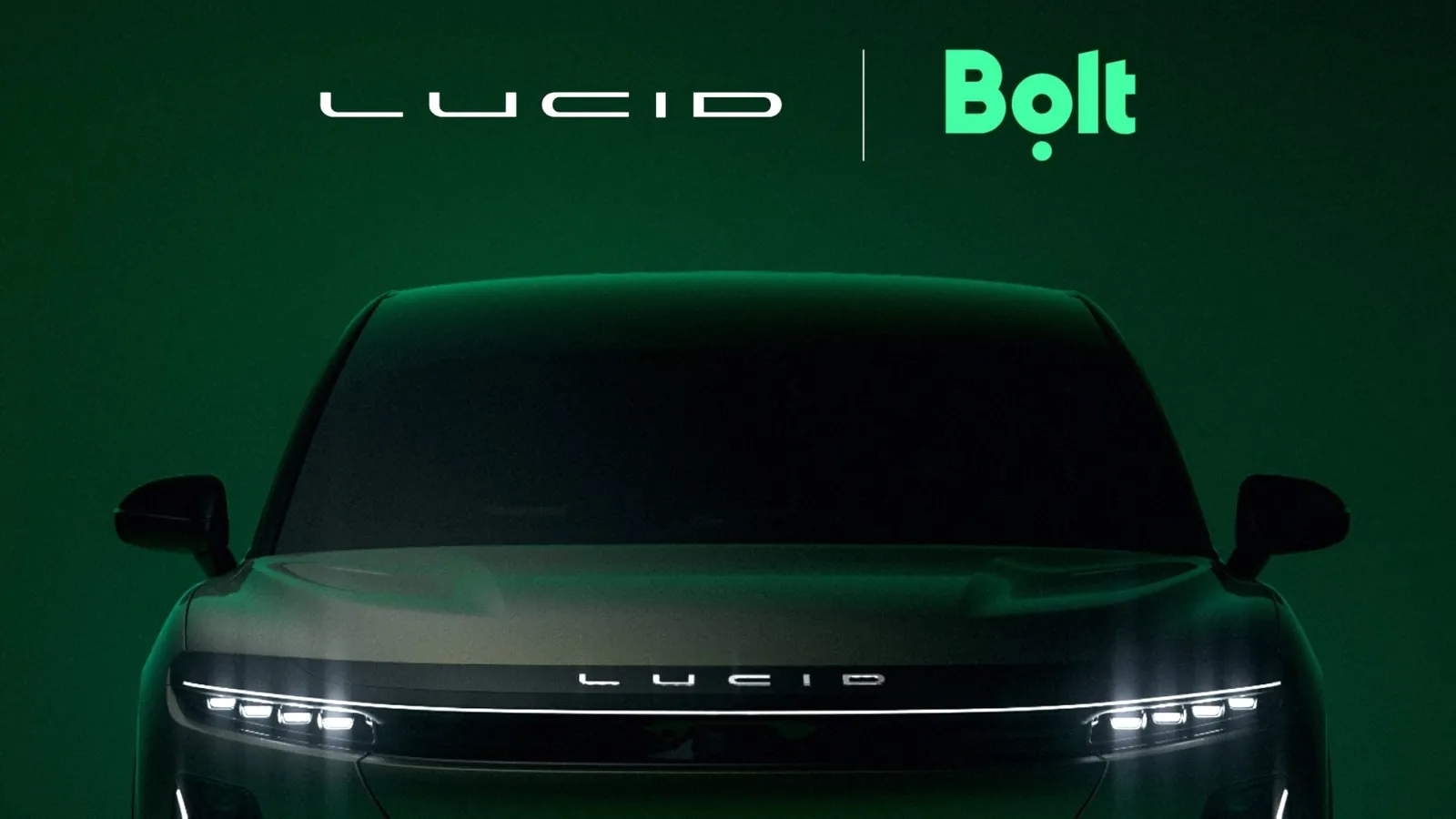
Lucid and Bolt have announced a partnership that will bring at least 25,000 autonomous electric vehicles for passenger transport to European roads. The fleet is set to be based on Lucid’s new Midsize platform, designed for SAE Level 4 autonomous driving.
Table of Contents
Show
Hide
On paper, the scale seems significant, as Bolt operates in over 50 countries and 850 cities. However, the most challenging element of this plan isn’t yet ready, and Lucid itself has only just delayed the launch of the vehicle that will form the foundation of this entire initiative.
What Was Exactly Announced
Bolt, a major European ride-hailing and shared mobility platform, aims to introduce 25,000 autonomous Lucid vehicles into its network. This is part of a broader goal—the company targets 100,000 autonomous vehicles by 2035.
The same model has not been unveiled yet. It is only known that it will be built on Lucid’s upcoming midsize platform and is designed from the start as a vehicle ready for autonomous driving, namely what is known as an ADS-ready vehicle.
In practice, the roles are divided quite clearly. Bolt is responsible for the operational side. This includes requirements for the vehicle, software, and safety, as well as fleet management, service infrastructure, and collaboration with cities. Importantly, Bolt claims it will be the owner and operator of the entire fleet.
Lucid primarily provides the vehicle and technical platform. It has gathered expertise in AI, ADAS, and autonomy under its new Lucid Technologies division.
Nvidia Hyperion is not a ready-made autonomous driver
The announcement mentions NVIDIA Hyperion, which is the reference hardware architecture for autonomous vehicles. This includes powerful onboard computers and a suite of sensors. It sounds good, but one must set a caveat.
Hyperion is not an autonomous driving system ready to use on its own. It is merely a hardware foundation. In other words, Lucid and Bolt have not yet shown who exactly will provide the complete “brain” capable of safe Level 4 driving in real urban traffic in Europe.
And this is where the most interesting part of this story begins. Lucid once again sells the vision of a large fleet of robotaxis, but it does so primarily as a vehicle supplier—not as a company that has independently solved the autonomy problem.
Lucid’s second major deal, but in a different arrangement
This is not the first such contract for the Americans. In 2025, Lucid already reached an agreement with Uber in the U.S., aiming to deploy robotaxis based on the Lucid Gravity vehicle with autonomy technology from Nuro. According to the project brief, the scale of this U.S. initiative is 35,000 vehicles in North America, though other reports mentioned 20,000 vehicles for the initial phase.
The European deal with Bolt differs from the U.S. version in three aspects.
First, it focuses on Europe rather than the U.S. Second, the base model will be the Midsize version, not the larger Gravity SUV. This makes sense because European cities are more compact, and a smaller vehicle is easier to cost-effectively integrate with transportation services. Third, while Nuro served as the autonomy partner in the U.S., Nvidia Hyperion will be the hardware foundation here.
If you combine both major announcements, Lucid already has commitments or declarations in writing for tens of thousands of robotaxis on two continents. The problem is that paper promises mean everything, but factories and approvals don’t necessarily follow.
The biggest issue: the Midsize platform is still unreleased
The entire European project relies on a car that doesn’t exist yet. And this isn’t a minor detail.
A few weeks earlier, Lucid delayed the Midsize launch as part of a broader “operational reset.” During that same period, the company faced severe turmoil. Silvio Napoli became permanent CEO on June 1, after which the company cut 18 percent of its workforce, around 1500 people, and also revised its earlier production forecasts for 2026.
Add to this the operational results. In the second quarter, Lucid delivered 3,953 vehicles. This illustrates the scale of the challenge. A company that currently delivers just under 4,000 cars per quarter to customers is simultaneously announcing plans for tens of thousands of autonomous vehicles.
The lack of a specific launch date is also concerning. Neither company has provided a timeline for implementation. There is only Bolt’s long-term goal of 100,000 autonomous vehicles on its platform by 2035.
Europe is becoming crowded with robotaxis
This development isn’t happening in a vacuum. The market for autonomous transportation in Europe is starting to become more competitive.
Uber, Verne, and Pony.ai have already launched services in Zagreb. Waymo is testing solutions in Europe with a target to enter Germany by the end of 2027. In the UK, Uber is partnering with Wayve to operate a fleet of 15 autonomous Ford Mustang Mach-E vehicles in London, though a human still must be present in the vehicle there for now as full regulatory approval has not yet been granted.
Tesla also promises a European Cybercab, but without a timeline. Classic case.
This shows one thing: Europe is no longer just a testing ground for ideas from the US or China. It’s becoming a battleground for actual deployments. The problem is that regulations here are stricter, cities more complex, and expectations regarding safety higher.
That’s why Markus Villig of Bolt’s statement that Europe needs to integrate data, software, vehicles, and operations into one system sounds quite sensible. Technology alone in a car is not enough.
What this means for Lucid and the market
For Lucid, it’s an attempt to show that the company doesn’t want to rely solely on selling expensive EVs to retail customers. It’s seeking a second revenue stream by selling technology and vehicles to autonomous fleets. The business logic here is obvious, especially after weaker sales volumes and cost cuts.
For Bolt, it’s both a defensive and an offensive move. Defensive, because transportation platforms know that drivers are the most costly component in the long run. Offensive, because whoever builds a viable robotaxi network in Europe first will gain an operational advantage and access to vast amounts of data.
For an average EV driver or market observer, the most honest conclusion is simple. For now, this remains more of a promise than an implementation. Bolt is a real player, and 850 cities and 200 million customers are no small feat for a startup with just a PowerPoint presentation. But Lucid has yet to show a fully developed vehicle, identify a final supplier for the complete autonomy system, or set a launch date.
So yes, this is a big deal. But there’s still a long way to go before the first commercial service becomes available.
If this project succeeds even in part, Europe will gain one of the biggest players in robotaxi, but as of now it’s still more of a production and software promise than an actual service. What do you think? Does Bolt have a better chance with Lucid and NVIDIA, or will Waymo, Uber, or Tesla get there first?