
Xiaomi’s robots are already sorting parts for eight hours at its car factory.
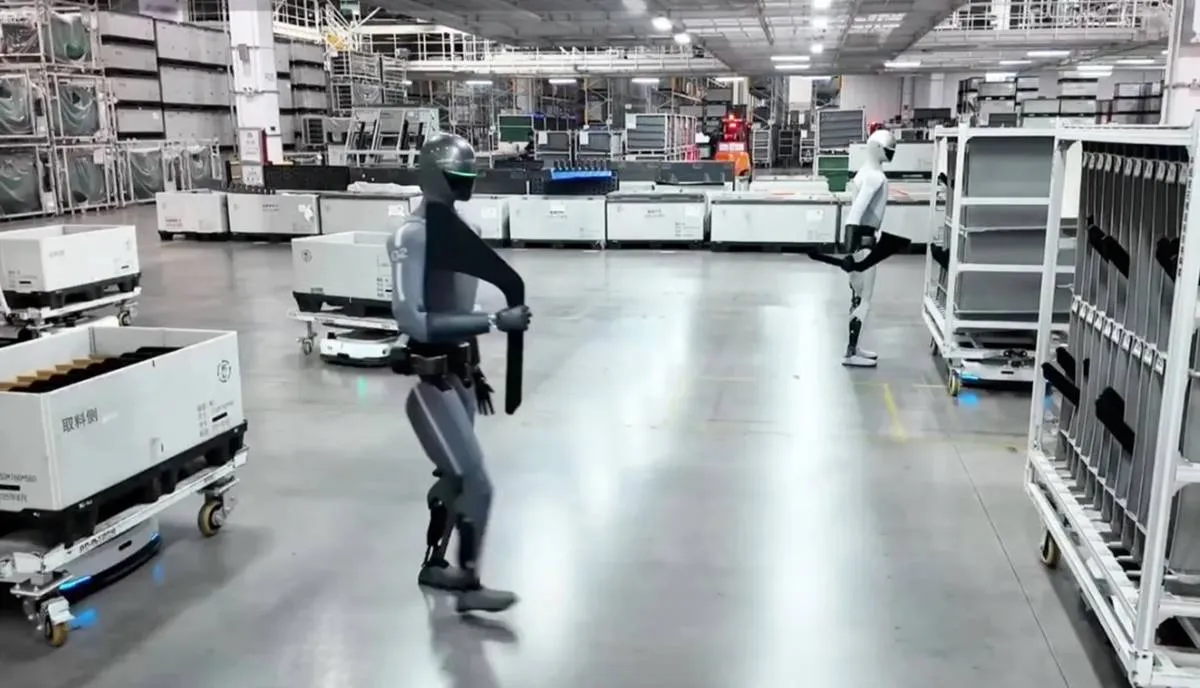
Xiaomi continues to test humanoid robots in the production of its electric cars, where picking up a part and placing it correctly holds far more value than performing a choreography on a stage. Its latest demonstration shows interesting progress, though it also raises questions about what happens off-camera.
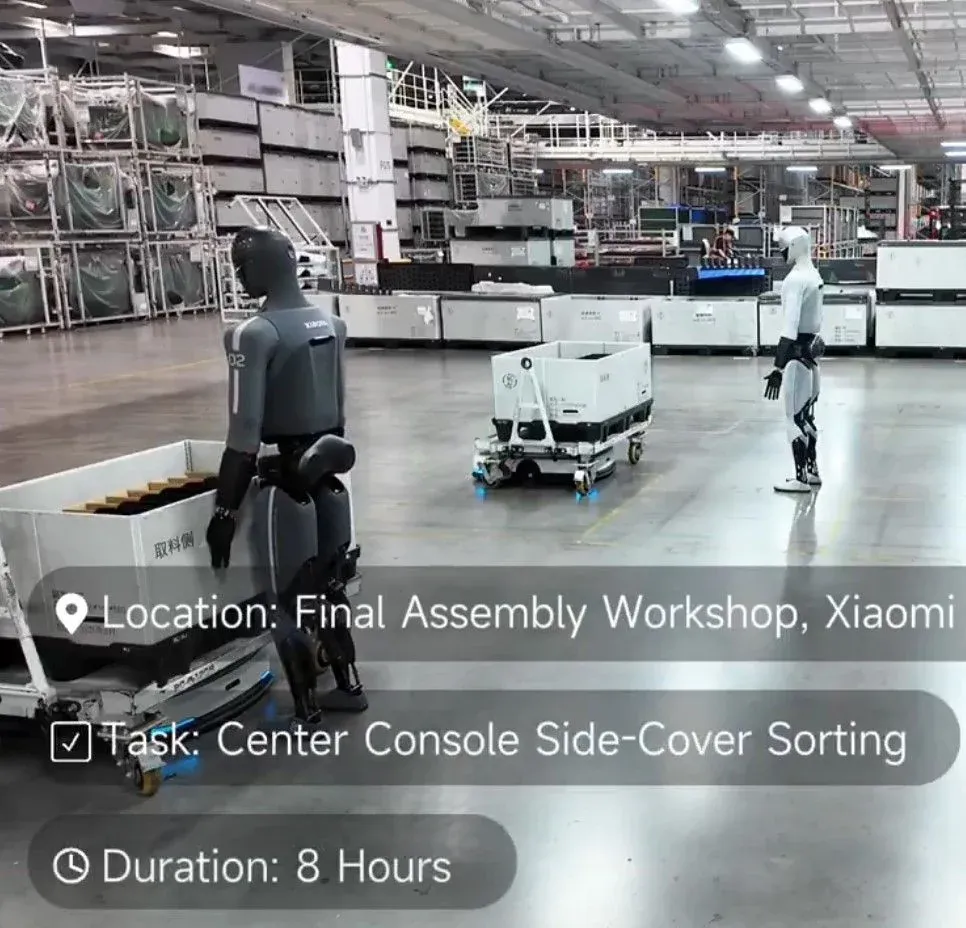
The brand has released a video showing its robots completing an eight-hour shift, according to Xiaomi, sorting the side covers of the central console. The task involves taking components out of containers, transporting them to shelves, and placing them in their designated slots. It’s a repetitive job, but it requires precision and coordination with the rest of the facility.
The images were released on November 3 through Xiaomi Tech, coinciding with the company’s awards at the Wuzhen World Internet Conference. The video includes a timer showing cumulative working time and accelerated sequences up to 100 times, which the manufacturer identifies as autonomous operation.
According to Xiaomi, the robots covered the production needs of that station throughout the day. The company claims they were able to detect and correct abnormalities on their own, as well as coordinate their actions with the line’s control system. This ability to resolve problems without stopping work is particularly important in a factory, where errors also carry consequences.
The project has shown progress for months. In March, Xiaomi deployed a humanoid in its Beijing factory to perform screw installation tasks, achieving an announced success rate of 90.2% over three hours at a pace matching the station’s 76-second cycle. By July, the company raised that percentage to 98% and added two more complex tasks, including part sorting, which is shown in the video now. These are results from previous tests and should not be confused with the accuracy of this latest demonstration.
The ambition goes far beyond a single experiment. Last December, Xiaomi’s top executive Lei Jun announced his intention to deploy humanoid robots in large numbers at its factories within five years. To achieve this, these machines will need to prove they can maintain a useful pace, operate reliably, and justify their cost in everyday use.
Meanwhile, Xiaomi is advancing its developments into home environments. Its open-source artificial intelligence model, Xiaomi-Robotics-1, pre-trained with over 100,000 hours of real-world manipulation data, has begun testing in employees’ apartments. According to the company, it completed more than 50 task sequences across three rooms during a 30-minute session.
What remains unknown and the wheeled robot worth paying attention to
The main issue with the industrial demonstration is the lack of figures to assess its performance. Xiaomi has not specified how many parts were sorted, what percentage of operations were completed correctly, or how many human interventions were required, if any. Without this data, it is difficult to determine to what extent the system can operate independently during a normal workday.
It also has not explained how the robots were powered during the test. Battery replacements, wired power, or breaks for charging could have been used, but Xiaomi has not provided any details on this matter.
There are precedents for such doubts. The Tesla Optimus robots that interacted with the public during the 2024 “We, Robot” event had remote human assistance.
In Xiaomi’s favor, it has already published success rates and cycle times from previous tests. This provides a useful basis for tracking the project’s progress, although similar metrics are still missing for this new task. The next step should be to show how much work these machines complete and how much help they need to achieve it.
There is another detail worth noting. Around minute 1:37, a humanoid torso robot mounted on a wheeled base appears to assist the two legged robots in a sequence focused on retrieving fallen materials. The containers also move on autonomous mobile platforms, a common solution for transporting components within factories.
The scene raises a quite reasonable question: Does a robot that works on a flat surface need legs? A wheeled base can simplify movement, provide stability when transporting parts, and leave more space for a battery. It also eliminates much of the mechanical and control complexity needed to maintain balance while walking. But we assume that having legs catches more attention, and currently the technology is in a phase of both development and investment—so the more attention it draws from investors, the better.
If Xiaomi confirms the functionality it claims with complete data, it will have taken an important step toward the industrial use of humanoid robots. For now, the video shows a specific application and progress that warrants further observation. To determine whether these machines are ready for regular use in production, it remains to be seen what their productivity is, their cost, and what happens when something goes wrong.
The other issue is what will happen to these jobs, and many others, as the technology spreads. More and more jobs are at risk of being automated by robots, raising the debate about what will occur when their capabilities far exceed those of today.