
Plug-in hybrids emit six times more CO₂ than official tests indicate.
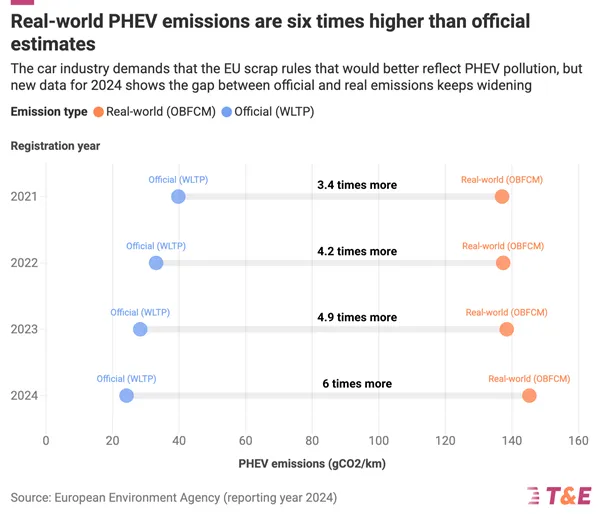
Plug-in hybrids are once again at the center of controversy. The latest data collected by the European Union shows that the actual emissions from these vehicles are much higher than the figures shown in their homologation tests, and the gap continues to widen.
Data for cars registered in 2024 shows that the actual emissions of plug-in hybrids are 145 grams of CO₂ per kilometer, compared to just 24 g/km as indicated by official tests. In other words, under real-world conditions, they emit six times more than what the homologation tests show.
The situation has further worsened compared to the previous year. In 2023, plug-in hybrids recorded an average real-world emissions of 138 g/km, compared to 28 g/km in official tests. The difference was about five times at that time, while in 2024 it has risen to six times, representing a 500% increase over the approved value.
The problem is even more striking because official figures have improved on paper. Between 2023 and 2024, the actual emissions of plug-in hybrids increased by 5%, while the figures obtained from homologation tests decreased by 15%, dropping from 28 to 24 g/km. This development is hard to reconcile with the image of improved efficiency typically associated with this technology.
And the comparison with gasoline cars also does not put plug-in hybrids in a particularly favorable position. With actual emissions of 145 g/km, the gap compared to conventional cars, which average 169 g/km, is only about 14%. In 2023, the gap was 17%, so the real advantage over gasoline-powered models is also shrinking.
220,000 plug-in hybrids analyzed
The figure comes from a particularly relevant source: the European Environment Agency. The data is obtained from fuel consumption monitoring systems installed in cars, which allow us to know exactly how much fuel they use throughout their driving lifespan. The latest database published by the agency covers cars registered in 2024 and was released on September 3, 2026.
In total, data from 220,000 plug-in hybrids was used, a sample that allows comparing the actual behavior of these vehicles with the results obtained in laboratories. The European Environment Agency itself explains that this system aims to determine to what extent the emissions measured during tests still represent what happens when cars are driven on roads.
The reason lies in the functioning of plug-in hybrids. These models combine a battery that enables driving on part of the journey using electricity with a gasoline or diesel engine. Homologation tests use a standardized protocol that does not replicate all conditions of everyday driving, whereas real-world data reflects how owners use their cars.
Europe has been trying for years to address this discrepancy through so-called efficiency factors, which are used to calculate what proportion of driving a plug-in hybrid is supposed to be done using electricity. European regulations include new changes aimed at gradually narrowing the gap between official figures and actual performance.
The problem is that the automotive industry is pushing to slow down some of these changes. Through their European association, manufacturers want to avoid a regulatory update scheduled for 2027 that would tighten the rules for calculating emissions from plug-in hybrids. At the same time, the European Union has opened the door for these models to continue being sold after 2035 under certain conditions.
This issue is becoming increasingly important because plug-in hybrids currently account for 9.8% of car sales in the European Union, according to data from the first half of 2026. Therefore, we are not talking about a niche technology but rather a significant part of the European market.
Negotiations on revising European CO₂ emission standards are already underway. The European Union Council plans to discuss this issue on October 12, while the European Parliament is expected to vote on the revision in November.
The debate thus goes far beyond a simple difference between two figures. If plug-in hybrids continue to have official emission levels much lower than those they actually produce on the road, manufacturers can gain a regulatory advantage that does not reflect how their cars perform outside the laboratory. And new data from the European Environment Agency show that the gap between certification and reality is not only failing to shrink but is actually widening.
Source | Europa.eu