
Gas cars are losing 40% of market share in China while electric vehicles reach a record high.
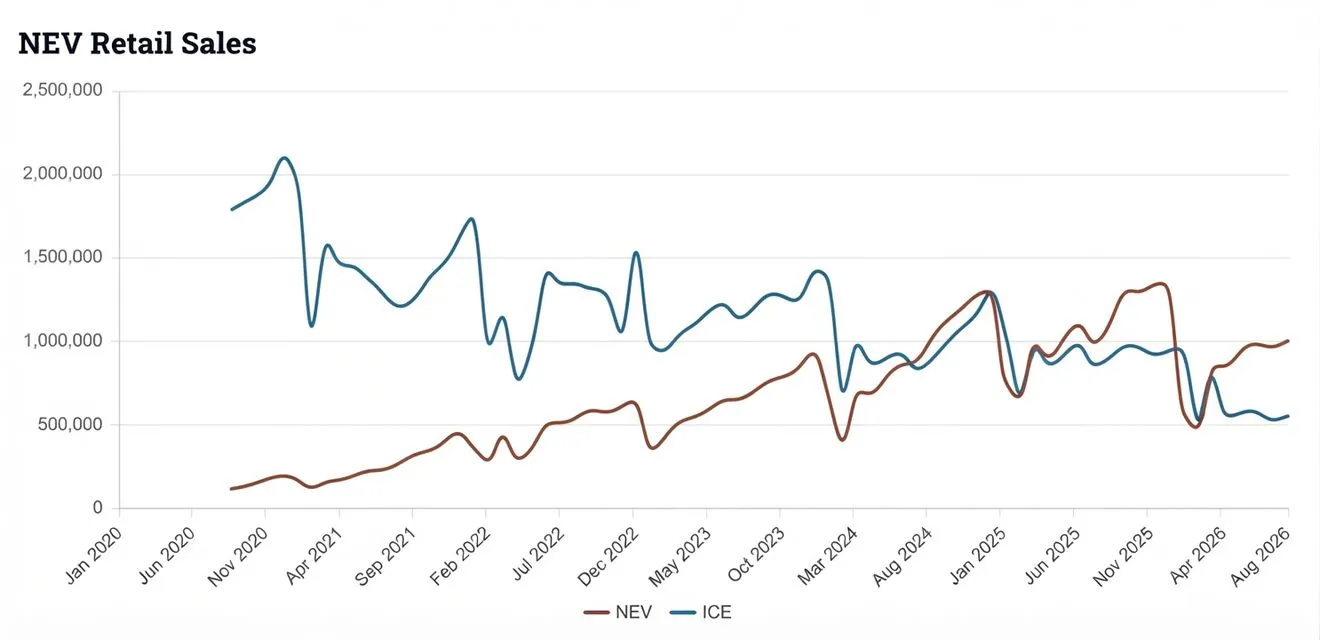
The Chinese automobile market is accelerating its transformation without looking back. In August, sales of gasoline cars plummeted by 40% year-on-year, while electric vehicles and other new energy vehicle (NEV) models—including pure electric cars, plug-in hybrids, and extended-range electric vehicles—reached a record combined share of 65.2%. The picture painted by these figures is particularly striking because the overall market is also going through a difficult period.
In August, 1.54 million passenger cars were sold in China, 23.6% fewer than in the same month of the previous year. Within that market, NEV models accounted for just over 1 million units, 10.1% fewer than a year earlier but 5.7% more than in July. This means that over six out of ten cars sold in China fell into this category.
The most striking figure, however, comes from the other side of the equation. Internal combustion engine vehicles totaled around 536,000 units in August, down from approximately 894,000 units in the same month of 2025. In other words, nearly 358,000 gasoline and diesel cars disappeared from sales in just one year, representing a 40% decline.
As a result, gasoline-powered cars saw their share drop to 34.8% of the Chinese market. Just a few years ago, the situation was completely different, with traditional models clearly dominating sales. Now, developments in recent months suggest a scenario where electric and plug-in hybrid cars are rapidly taking over the space left by gasoline models.
Electric cars are holding up best
There are also significant differences among new energy vehicle models. Pure electric vehicles (BEVs) were the only category to see an increase in annual sales during August. Specifically, 698,000 units were sold, representing a 0.8% increase from August 2025 and a 7.9% increase from July.
In contrast, plug-in hybrids (PHEVs) continue to lose ground. 307,000 units were sold in August, a 25.8% decrease from the previous year. This marks the eighth consecutive month of declining annual registrations for this category. Among all new energy vehicle models, electric vehicles accounted for approximately 69.5%, compared to 30.6% for plug-in hybrids.
The performance of electric cars is particularly significant because it occurs in an overall declining market. This is not growth driven simply by an increase in the total number of cars sold, but rather a shift in the composition of sales. While traditional models are rapidly losing buyers, electric cars manage to maintain or even slightly increase their registrations.
The cost of using a gasoline car also plays a role. The Chinese Automobile Association attributes part of the decline in demand for these models to rising operating costs. Gasoline prices in China have increased by more than 1,720 yuan per ton since the beginning of 2026, with an additional rise of 180 yuan since late July. The average price of 95 octane gasoline is currently around 8.7 yuan per liter.
This puts additional pressure on a technology that already has to compete with increasingly capable electric cars, and especially with a Chinese industry that has significantly reduced prices over the past few years. Manufacturers such as BYD, Geely, Leapmotor, Changan, Chery, Xiaomi, Xpeng, and Nio are offering an ever wider range of electric models, further increasing pressure on traditional brands.
The cumulative trend since January is even more revealing. From January to August, 11.716 million passenger cars were sold in China, 20.8% less than during the same period last year. New energy models accounted for 6.674 million units, while cars with internal combustion engines totaled around 5 million. In other words, new energy vehicles now make up 56.9% of total sales this year, compared to 43.1% for combustion engine models.
The shift is not limited to the domestic market either. Chinese manufacturers are finding significant growth opportunities abroad. In August, automobile exports reached 888,000 units, a 77.8% increase from the previous year, while exports of new energy models surged by 154.7% to 518,000 units. These new energy models accounted for 58.4% of all Chinese automobile exports.
This trend partly explains the growing presence of Chinese manufacturers in Europe. The local market is increasingly saturated, and domestic sales have been under pressure for months, prompting companies such as BYD, Geely, Chery, Leapmotor, and Xiaomi to look toward other markets more often. In fact, exports have become one of the main pillars supporting China’s auto industry as domestic demand weakens.
The August results paint a fairly clear picture. Internal combustion engines are losing ground much faster than electric vehicles, while plug-in hybrids also fail to escape this negative trend. And all this is happening in the world’s largest automobile market, where local manufacturers are competing with such intensity that it forces traditional brands to rethink their strategies.
China has not yet converted all of its car sales to electric vehicles, but the 65.2% figure for new energy vehicles shows just how much the balance has shifted. Rather than a simple technological replacement, what is occurring is a change in Chinese consumers’ preferences, with internal combustion engines clearly becoming a minority.