
Electric cars are already 33% cheaper than gasoline cars.
Electric cars are not only narrowing the price gap with internal combustion engine models. They also have a clear advantage when it comes to operating costs. The International Council on Clean Transportation’s (ICCT) new EV Transition Check 2026 report finds that driving an electric car in Europe was, on average, 33% cheaper than using a gasoline car in 2025.
There’s one particularly interesting detail: this difference was calculated before taking into account the full impact of the oil crisis that began in 2026. According to ICCT, during the first months of this year, energy costs for cars with internal combustion engines rose by 12% to 36%, while those of electric cars remained practically stable. As a result, the economic advantage would have increased even further.
The study examines the progress of the transition to zero-emission transportation in Europe, focusing on what has for years been one of the main arguments against electric cars: their cost. The conclusion here is quite clear. Lower operating costs are no longer a promise for the future but a reality for European drivers.
"Drivers of electric cars in Europe pay approximately one-third less than drivers of gasoline cars," explains Marie Rajon Bernard, lead researcher at ICCT and principal author of the report. The organization believes this savings helps explain why the European market continues to shift toward electrification and expects the presence of electric cars to keep increasing if current policies are maintained.
Even When Using Only Public Chargers
The results become even more interesting when looking at the details. ICCT compares the operating costs of electric cars charged using a combination of private and public charging stations with those of equivalent gasoline-powered vehicles. In 2025, the result was an average savings of 33% for electric cars compared to gasoline cars.
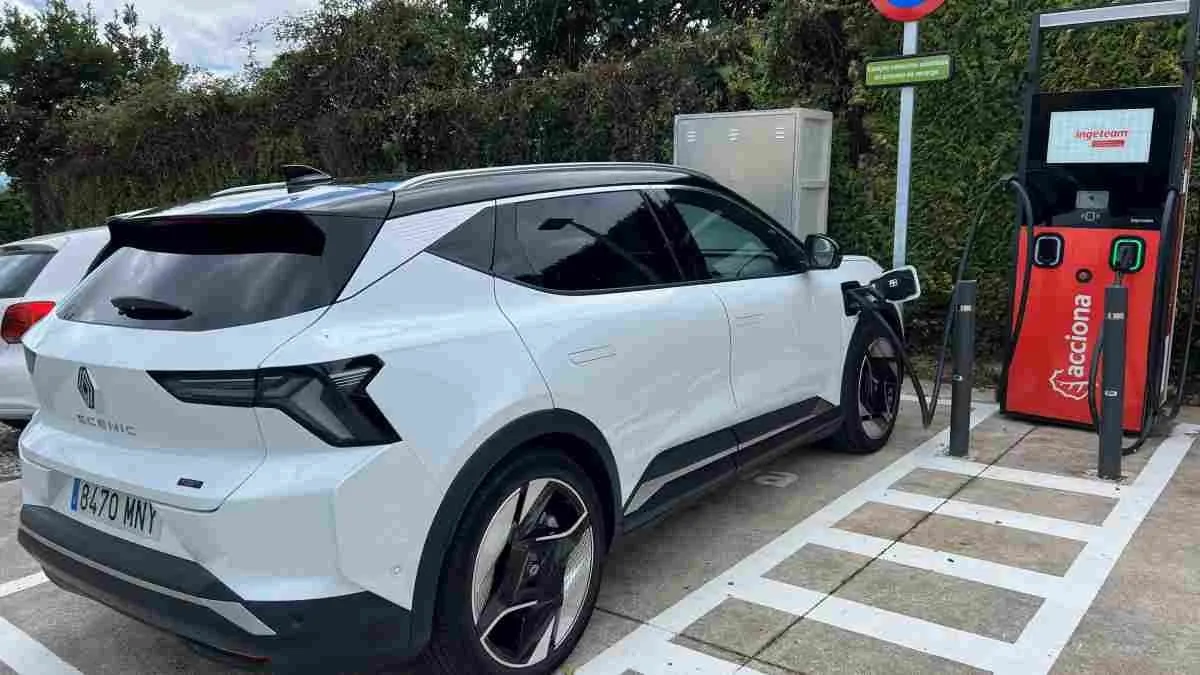
In addition, the report confirms that the advantage does not disappear when the driver does not have a home charger. Public charging remains significantly more expensive than charging at home, but ICCT concludes that even when relying solely on public networks, electric cars remain economically competitive compared to gasoline vehicles. According to the report’s specific comparison, the operating cost remains approximately 5% lower.
This introduces an important correction to the original text: the figure of 28% savings using only public charging does not appear in ICCT’s original 2026 report. The figure published by the organization for this comparison is 5%, while 33% applies to the combined charging scenario. This is an important detail to avoid presenting to readers data that is not supported by the primary source.
In addition, energy prices are favorable for electric cars. As of June 2026, the average cost of an occasional charge in Europe was around 0.50 euros/kWh for AC and 0.62 euros/kWh for DC, including taxes. Although the difference compared to home chargers remains significant, ICCT believes that in most cases even drivers relying on public charging networks can benefit financially from switching from a gasoline car to an electric one.
While the cost of electricity for electric cars has remained relatively stable, the situation has been very different for combustion engine models. The report indicates that the oil crisis that began in February 2026 raised the energy costs of cars with combustion engines by between 12% and 36%. For electric cars, the impact was much smaller.
The other factor is the purchase price. For a long time, one of the main obstacles to the expansion of electric cars was the higher cost of acquisition, even though they ended up being cheaper to operate. This gap is also narrowing. According to ICCT, electric cars have already reached purchase price parity with equivalent combustion engine models in the three largest segments of the German market.
The organization used data from over 100,000 vehicles sold in Germany, the largest automotive market in Europe. After adjusting prices for inflation and vehicle characteristics such as range, the cost of electric cars dropped by 18% between 2020 and 2025. During the same period, cars with internal combustion engines increased in price by 2%.
The reason lies largely in batteries. Their overall cost fell by about 35% between 2020 and 2025, allowing for a reduction in one of the most significant components of manufacturing an electric car. ICCT believes there is still room for these cost reductions to be further passed on to the final price of vehicles.
The range of options has also changed dramatically. The number of electric models available in markets such as Germany, the largest European market, increased by approximately four times between 2020 and 2025, reaching around 160 models. Additionally, the number of electric cars priced below 30,000 euros reached about 35 models by 2025. The selection is still far from matching that of gasoline cars in smaller segments, but the trend is clear.
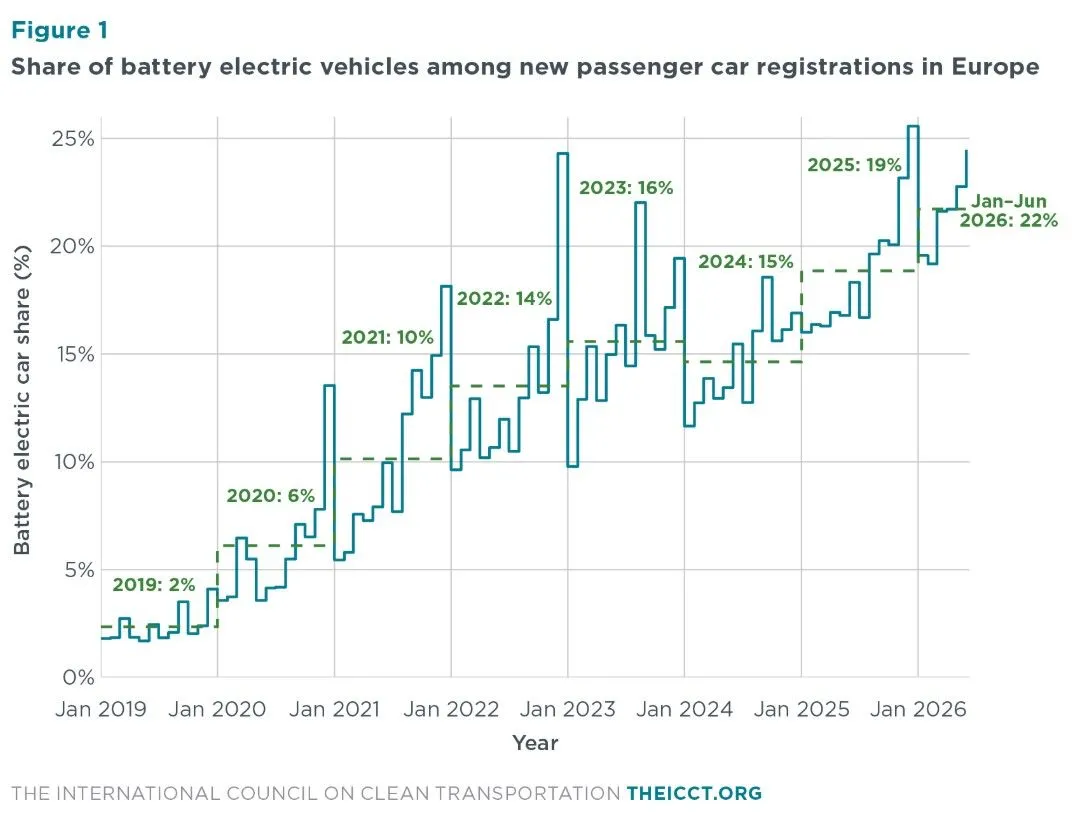
All of this is having an impact on sales. In the first half of 2026, electric cars accounted for 22% of new passenger car registrations in the European Union, five points higher than in the same period the previous year, while overall registrations grew by about 35%. In Germany, this share reached 26% and in France it was 28%. Spain remained at 10%, although it also saw growth compared to the previous year.
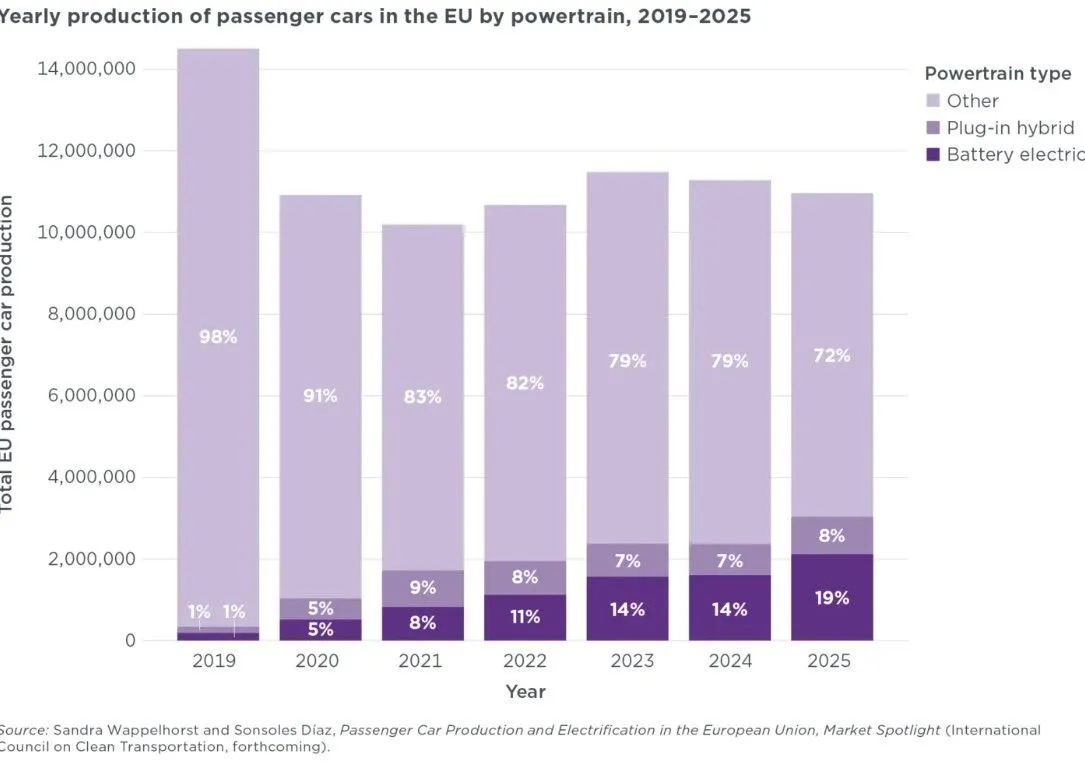
Production is also changing. In 2020, cars with internal combustion engines made up 91% of European production. By 2025, that figure had dropped to 72%, while electric cars accounted for 19% of all passenger cars manufactured in the European Union. Germany is by far the leading European producer of electric and PHEV cars.
The ICCT report also extends its analysis to commercial vehicles. In the case of electric trucks, the situation is becoming particularly interesting. In Germany, where there are toll advantages for electric trucks, models designed for long-distance transport already have a total cost of ownership that is approximately 11% lower than that of equivalent diesel trucks. For long-distance transport across the European Union as a whole, ICCT predicts that both types of propulsion could reach cost parity by 2030.
The advantages of electric cars extend beyond just the wallet. ICCT estimates that, considering the entire vehicle lifecycle, an electric car produces 73% fewer greenhouse gas emissions than a gasoline car. For electric trucks used in long-distance transportation, the reduction compared to diesel trucks reaches 86%.
The report also focuses on plug-in hybrids. Actual usage data shows that the emissions from PHEVs are currently 4.6 times higher than the certified figures, a gap that continues to widen despite these models offering increasing electric range. This is one of the reasons why ICCT believes that, under real-world conditions, plug-in hybrids do not achieve the emission savings suggested by their certified figures.
The infrastructure also no longer seems to be the major bottleneck it was a few years ago. The European Union had around 1.16 million public charging points as of June 2026, nearly eight times more than in 2020. Additionally, DC chargers with at least 150 kW already covered 92% of Europe’s TEN-T road network.
That doesn’t mean everything is resolved. Public charging remains considerably more expensive than home charging, and there is a very uneven distribution of charging points across countries. But the scenario described by ICCT is very different from five years ago: electric cars no longer need to wait for a supposed future economic advantage to justify their lower operating costs. That advantage is already here.
Source | Theicct.org