
Electric cars already dominate sales in these countries: China accounts for 44%, Norway reaches 97%, and Laos hits 100%.
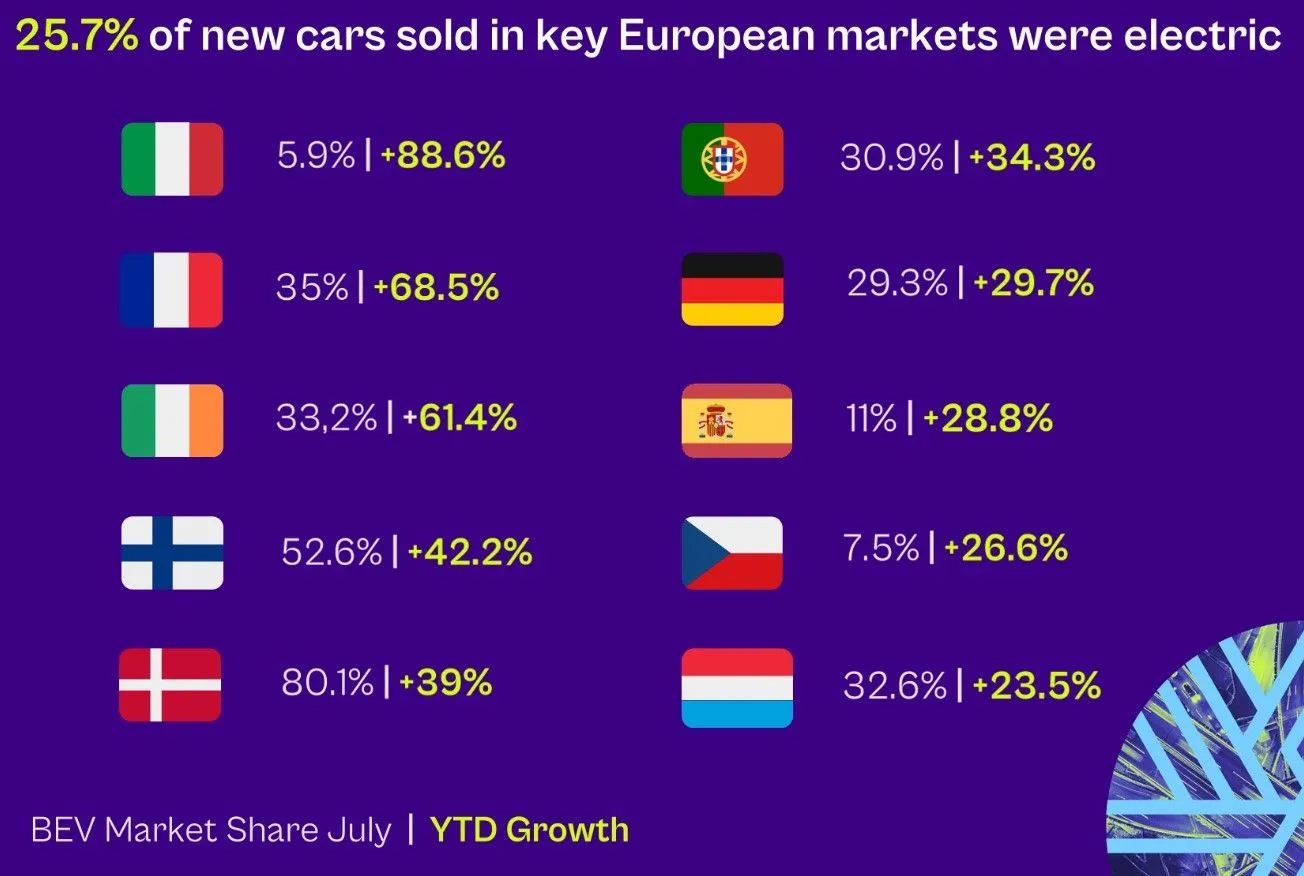
The transition to electric cars is entering a phase where it becomes increasingly difficult to consider it a distant trend. Registration data for July 2026 paints a clear picture: in some markets, electric cars are no longer a minority option but rather the choice accounting for the majority of new car sales.
Norway remains the most extreme example, but it is no longer an isolated case. Denmark, the Netherlands, Belgium, Sweden, France, and China are all recording shares that seemed impossible just a few years ago, while other markets are progressing at a slightly slower pace. The overall picture indicates acceleration that aligns with the typical behavior of new technologies once they reach a certain critical mass.
The most striking case is Laos, where 100% of new passenger car imports during this period were electric vehicles. However, it’s important to put this figure in context: the government suspended imports of new gasoline and diesel cars starting June 1 until the end of the year. Thus, that 100% reflects not only natural demand trends but also an exceptionally decisive political choice.
At the other end of the list, yet still with virtually a total share, is Norway. In July, electric vehicles accounted for 97.6% of new passenger car registrations, with 9,379 units out of a total of 9,609. This figure is particularly revealing for another reason as well: only 15 gasoline cars were registered throughout the month.
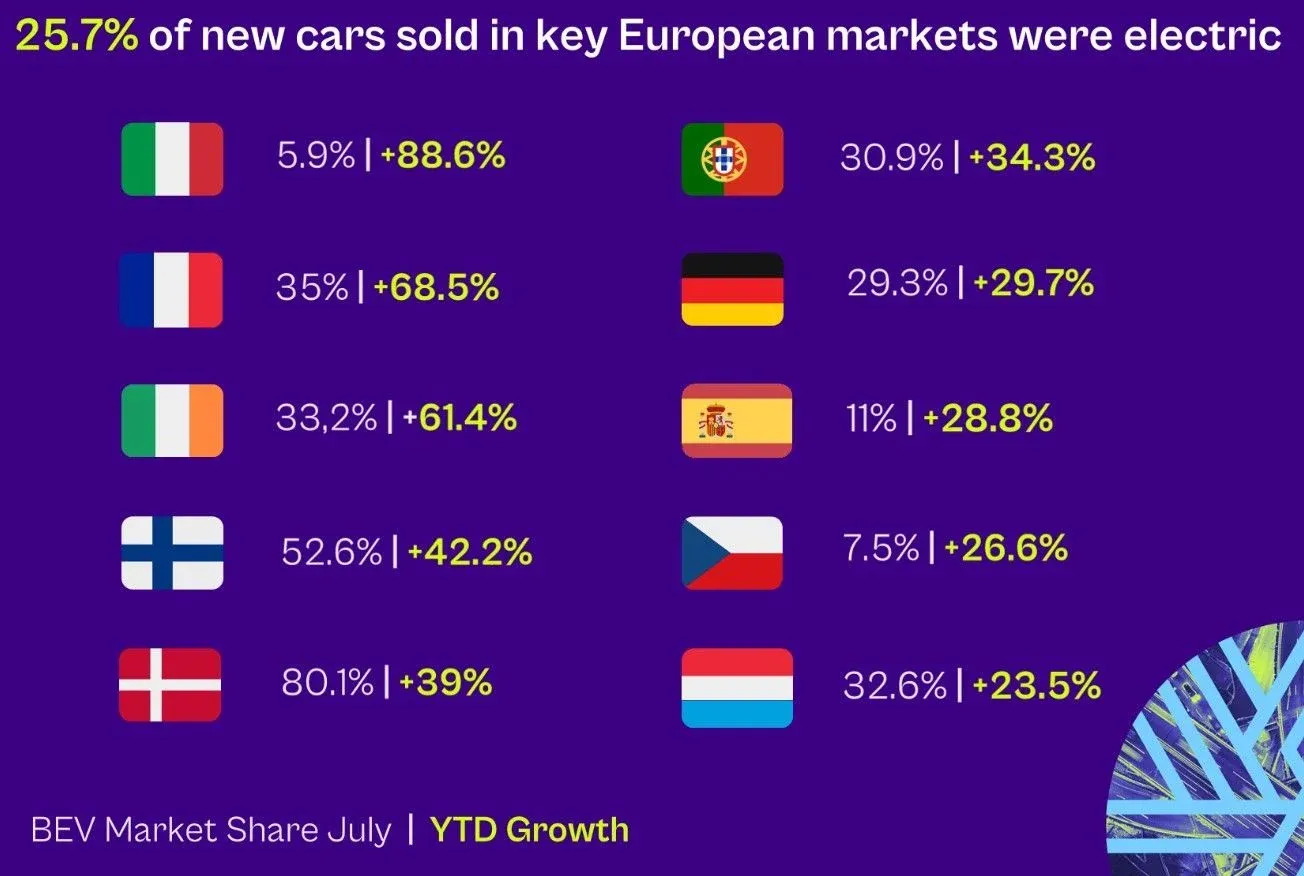
Denmark is also entering a realm that would have seemed like science fiction just a few years ago. Electric cars accounted for 80.1% of new car registrations in July, up from 65.2% in the same month of 2025. In other words, four out of every five new cars sold in the country now come without an internal combustion engine.
The trend is equally significant in other European markets. The Netherlands saw a rise from 30.8% to 47.3%, while Belgium increased from 32.5% to 42.8%. Sweden, for its part, went from 34.2% to 42.6%, further solidifying its position as electric cars move closer to becoming the dominant option in the market.
The French market deserves special mention. France’s share rose from 17% in July 2025 to 35% in July 2026, practically doubling its significance within just one year. In terms of volume, 44,378 electric cars were registered that month—a figure particularly significant given the size of France’s market.
The same trend is emerging in China, though with different characteristics. There, electric cars accounted for 44.3% of passenger car sales in July, up from 33.1% a year earlier. Importantly, this percentage refers only to electric cars, excluding plug-in hybrids and extended-range electric vehicles. When all plug-in technologies are included, the transformation in China’s market is even more profound.
The United Kingdom is also accelerating, though from a position considerably behind Europe’s leaders. Electric cars accounted for 27.5% of new registrations in July, up from 21.5%, totaling 43,106 units. The year-on-year growth rate was 44.5%, while gasoline car registrations dropped by 5.2% and diesel registrations fell by 17.7%.
The July data allows for a quite clear visualization of these markets:
Market
July 2025
July 2026
Laos
36%
100%*
Norway
97.2%
97.6%
Denmark
65.2%
80.1%
Singapore
40.0%
64.6%
Netherlands
30.8%
47.3%
China
33.1%
44.3%
Belgium
32.5%
42.8%
Sweden
34.2%
42.6%
France
17%
35.0%
United Kingdom
21.5%
27.5%
And here comes the most interesting part of the entire process. Electrification is not growing in a linear manner. In many markets, it seems to follow the well-known S-shaped curve associated with the adoption of new technologies: a slow initial phase, followed by rapid acceleration once the technology reaches sufficient maturity, availability, and acceptance, before stabilizing when market share approaches saturation.
The European data for July fits this theory quite well. In the 16 European markets analyzed, electric cars together accounted for a 25.7% market share, with 224,266 registrations and an annual growth rate of 13.6%. As of now in 2026, the number is already approaching 1.5 million units, about 30% more than during the same period in 2025.

This also explains why it’s becoming more interesting to watch the rate at which internal combustion engines are declining rather than just tracking how much electric cars are growing. In the Netherlands, for example, gasoline cars accounted for only 7.5% of the market in July, down from 15.5% a year earlier. In the UK, gasoline and diesel combined now make up less than half of the market.
The picture these figures paint is therefore much deeper than a simple rise in electric car sales. Cables are starting to eat into pipelines: more and more buyers who used to need to refuel are now plugging in their cars, and this shift is rapidly reducing the space available for gasoline and diesel engines.
There are still markets where the transition is moving slowly, and others that rely too heavily on government subsidies or regulatory changes. Italy serves as a good reminder of this: after the removal of certain incentives, its share of electric cars dropped to 5.9% in July. But the trends in markets that have already crossed certain thresholds are hard to ignore.
The question no longer seems to be whether electric cars will eventually dominate new car sales. The big unknown is how long it will take each market to reach that point. And looking at what happened between July 2025 and July 2026, some countries are progressing much faster than predictions made a few years ago would have suggested.