
Cheap electric cars are starting to flood Europe, and sales are soaring.
The European market is entering a new phase. A analysis by the organization Transport & Environment (T&E) shows that nearly 40 new electric models entered the European market in the first half of 2026, raising the total number of models available for the general market to over 150. Among them are models such as the Volkswagen ID. Polo, Renault 5, and Leapmotor T03, while manufacturers like Volkswagen, Renault, Stellantis, Kia, and BMW continue to expand their ranges.
The planned launch pace for this year is also particularly striking. T&E estimates that around 60 new electric models will have entered the European market by the end of 2026, compared to an average of just 15 new models per year between 2021 and 2025. This is not a temporary increase but rather a significant acceleration in the range available to buyers.
One of the most significant consequences is occurring precisely in the area where electric cars have faced difficulties for the longest time: price. The number of models with a starting price below 25,000 euros will double by 2026, while their registrations could increase sevenfold compared to 2024. The trend also points toward even more affordable cars, with a new generation of A-segment models aiming to bring the entry price down to around 15,000 euros.
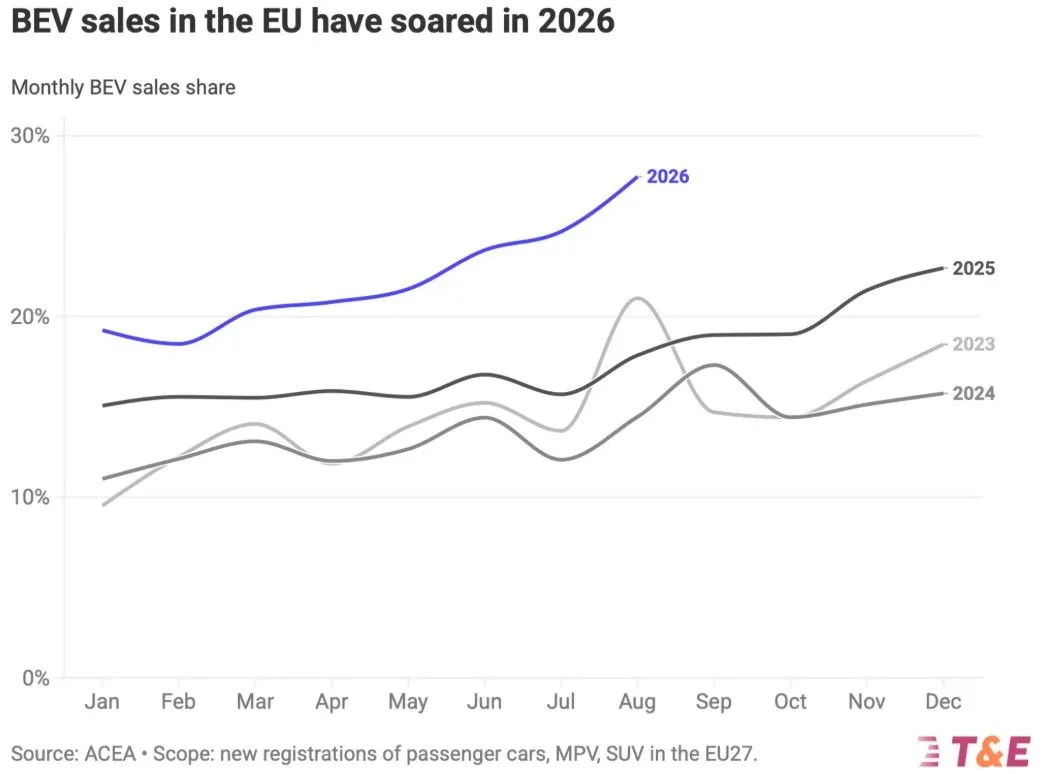
The trend in sales confirms there is demand for these models. From January to August 2026, 1.64 million electric cars were registered in the European Union, 45% more than during the same period the previous year. Additionally, in the second quarter of that year, electric cars surpassed gasoline vehicles for the first time in terms of cumulative quarterly sales, accounting for 22% of the market.
This data is particularly significant because for years European manufacturers have used the alleged lack of demand as one of the arguments to explain the absence of small, affordable electric cars in their ranges. However, recent results point in a different direction. T&E itself believes that the main problem lay not so much in demand as in the available supply.
The energy landscape is also playing a significant role. The organization estimates that rising oil prices have added 53 billion euros in costs for users of European roads. In mid-September, filling a 50-liter diesel tank cost about 30 euros more than before the Iran war. According to their calculations, a driver who had switched to an electric car at the start of this crisis would have saved around 350 euros in operating costs by mid-September.
The acceleration behind this is also driven by European emission regulations. T&E believes that the CO₂ targets set for 2025-2027 are forcing manufacturers to increase their sales of electric cars and, consequently, to rapidly expand their product lines. The organization estimates that all European manufacturers should meet their targets within the specified period, with some already achieving them ahead of schedule.
The difference compared to previous years is significant. Between 2021 and 2024, the targets remained virtually unchanged, offering little incentive for brands to develop small and affordable electric models. With higher requirements, the strategy has shifted, and now models that were once hard to find in Europe are starting to appear.
The availability is still far from matching that of cars with internal combustion engines. T&E estimates that in the first half of 2026, there were 24 electric models priced below 30,000 euros, compared to a much larger selection of combustion engine models. However, the organization expects the gap between 20,000 and 25,000 euros to virtually disappear by 2028 if the current trend continues.
In this process, European manufacturers are playing a key role. T&E notes that they account for nearly 60% of the available electric models, while Chinese manufacturers make up around 21%. At the same time, the market is shifting away from focusing solely on large electric SUVs and sedans to regain prominence in smaller segments, which are where a significant portion of European sales take place.
The organization warns, however, that this progress could be halted if Europe lowers its targets for 2030. According to their calculations, altering the current requirements would lead to a significant reduction in the supply of affordable models just as they begin to enter the market. This is an issue that goes beyond emissions: regulations are determining what cars manufacturers develop, and thus what alternatives European consumers will have in the coming years.
