
Electric trucks are growing by 50% in the EU, while buses already account for over 26% of the market.
The electrification of heavy transport is progressing in Europe, though at very different speeds. While some countries are beginning to introduce electric trucks in significant numbers, their presence remains minimal in others. Buses have an advantage, but they too are subject to the fluctuations of a market where large fleet purchases can greatly change the landscape from one year to another.
ACEA data for the first nine months of 2026 show a recovery in Europe’s industrial vehicle market. In the European Union, 245,079 trucks were registered, a 7.5% increase, and 32,695 buses, with a 15.2% growth rate. Within this overall progress, registrations of electric models increased much faster than the overall market.
For accuracy regarding the source, ACEA’s statistical category also includes plug-in hybrids without breaking them down separately. The figures refer to registrations made between January and September, thus reflecting the growth of these technologies among new vehicles rather than their proportion in the overall existing vehicle fleet.
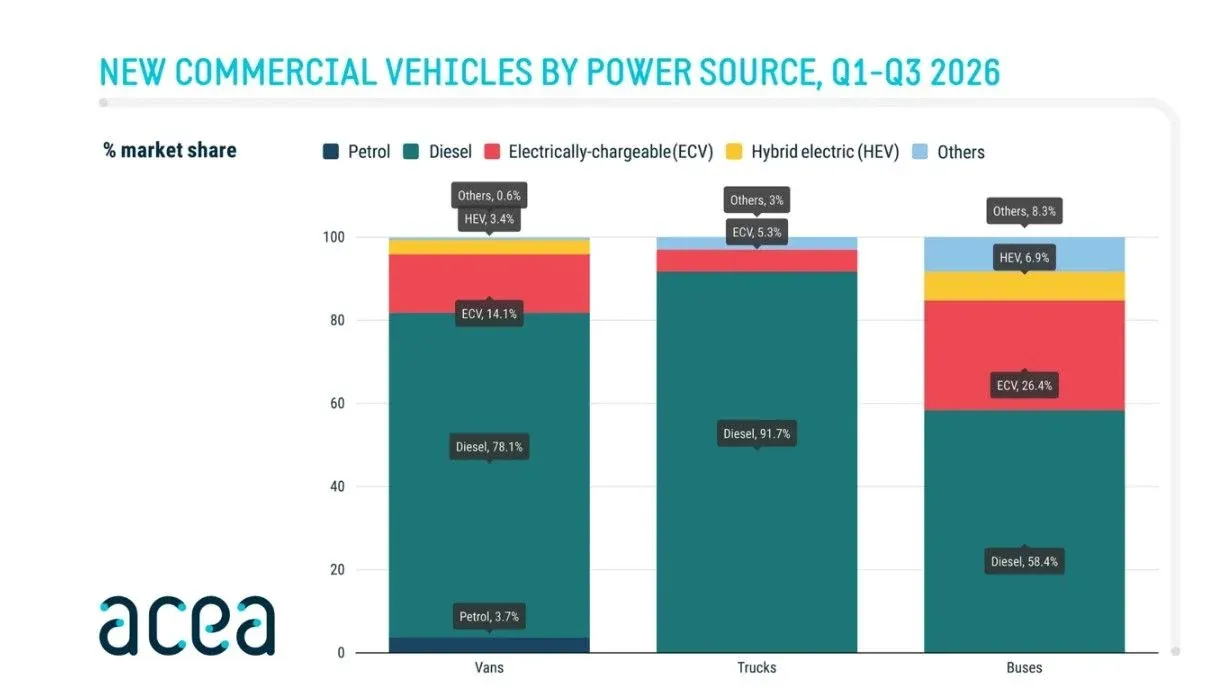
In the overall truck market, registrations of electric trucks rose by nearly 50%, reaching a share of 5.3% compared to 3.8% in the same period last year. In other words, about one in twenty new trucks now falls into this category. Diesel still dominates clearly, accounting for 91.7% of the market, but it is beginning to lose ground.
The growth is not evenly distributed either. Germany, France, and the Netherlands accounted for 74% of all electric truck registrations in the European Union. Their increases were 77.2%, 60.2%, and 57.5% respectively, showing how much progress still relies on a small group of countries.
Medium-sized trucks are approaching 20%, while buses have already surpassed 26%.
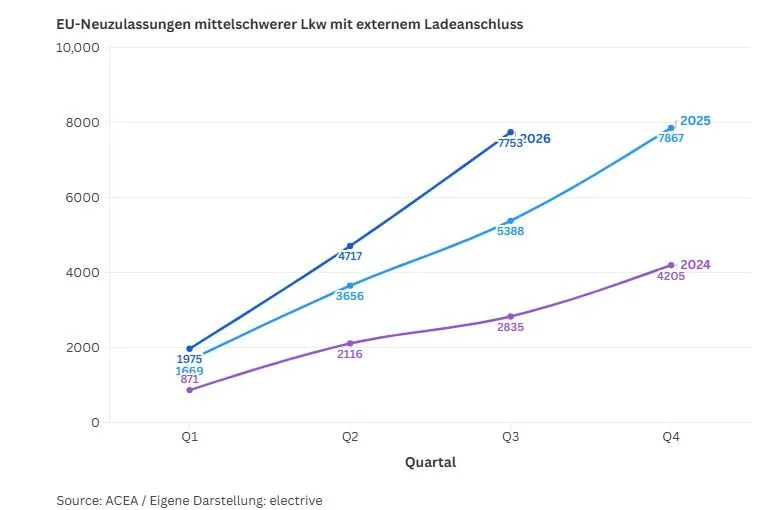
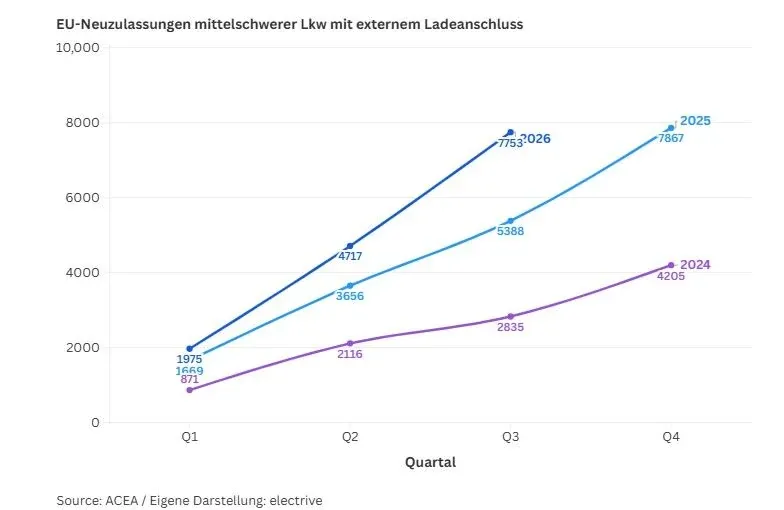
The difference between categories is particularly striking. Among trucks weighing 3.5 to 16 tons, 7,753 electric units were registered, representing a 44% increase. Their share reached 19.8%, almost one in five, compared to 14.1% the previous year. It is in this segment that electrification is gaining a stronger foothold in the truck market.
Germany accounted for half of those registrations, with 3,879 units and a 72% increase. Followed by the Netherlands, with 1,195 units, and France, with 974. Spain added 320 medium electric trucks, a 36% increase — a positive trend though still below the regional growth rate and far from the markets leading the rankings.
Not all countries followed this pattern. Italy saw a 56% decline to 200 units, while Belgium dropped by 58%, to just 42 units. Outside the European Union, the United Kingdom recorded 2,960 electric trucks in this category, a 55% increase, whereas Norway more than doubled its registrations to reach 445 units.
In heavy trucks, starting from 16 tons, the situation is quite different. The European Union registered 205,857 vehicles of all power types, but only 5,120 were in the electric category. Although these increased by 59.9%, their share remained at 2.5%, compared to 1.7% the previous year. The growth rate is high, but the starting point is still very low.
Germany once again led in terms of volume, with 1,722 units and a 91% increase, followed by the Netherlands, with 1,022 units and an 84% increase. However, the country that stands out the most in terms of penetration is Switzerland: it registered 605 heavy electric trucks, enough to achieve a share of 24%. Followed by Norway at 14.4%, the Netherlands at 11.1%, and Sweden at 10.3%. In Germany, despite its leadership in numbers, the share was 4.2%.
Buses show a much larger adoption rate. From January to September, 8,633 electric buses were registered in the European Union, representing a 37.6% increase and accounting for 26.4% of the market. A year earlier, they made up 22.1% of the market. These figures cover all buses over 3.5 tons, not just urban buses where electrification is particularly prominent.
Italy led in electric bus registrations with 1,970 units, an increase of 116%. Notably impressive were the advances in Poland, which reached 999 units after a 557% increase, and Portugal, with 642 units and a 379% rise. The Netherlands added 783 units, an increase of 86%, while France reached 665 units, with a 33% increase.
Germany, on the other hand, saw a 30% decline to 836 units following an especially strong 2025. Sweden and Belgium also experienced drops, of 40% and 71%, respectively. These differences suggest that European growth should not be viewed as uniform, as the schedule for fleet renewal and delivery can have a significant impact in each country.
Outside the European Union, the UK lost its first-place position in terms of electric bus volume to Italy, with a 22.7% decline to 1,727 units. However, the highest shares were in other markets: Romania reached 82% and the Netherlands 75%. This contrasts sharply with heavy trucks, where electrification is still in its early commercial stages across much of Europe.