
Lies, Özdemir, and Söder call for more support for the automotive industry
Three automobile states — one cross-party consensus: The prime ministers of Baden-Württemberg, Bavaria, and Lower Saxony call in a joint statement for the federal government and the EU to take concrete actions to ensure the competitiveness of Germany’s automotive industry.
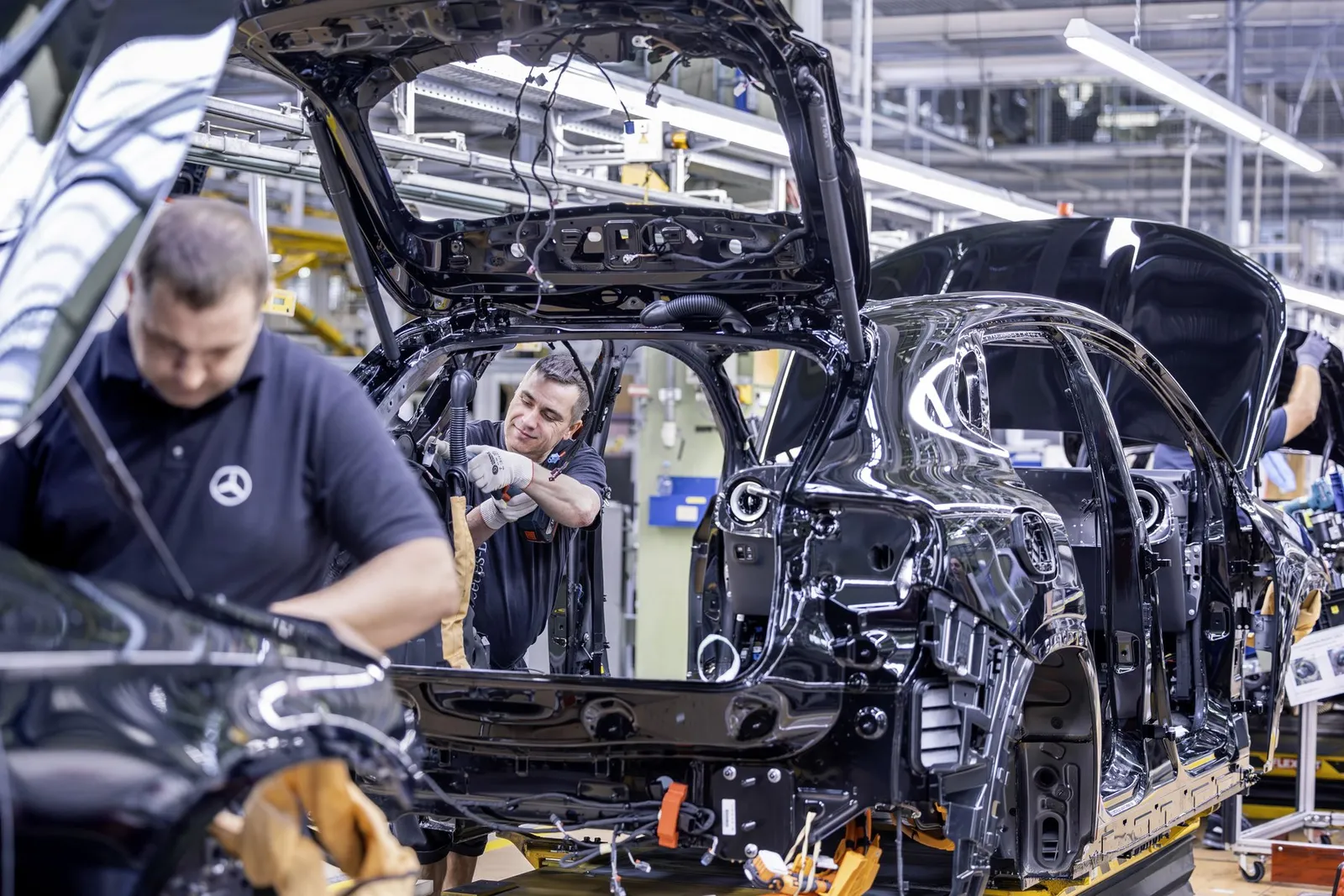
Production of the electric Mercedes-Benz GLA in Rastatt
Image: Mercedes-Benz
In an unusual move, Germany’s three states most heavily influenced by the automotive industry have outlined numerous demands to support the sector in a policy document. These self-proclaimed “auto states” have directed these requests both to the German federal government and to the EU.
The signatories of this cross-party document are Prime Ministers Olaf Lies (SPD) from Lower Saxony, where Volkswagen has its headquarters in Wolfsburg and operates several factories. Also included is Cem Özdemir (Green Party) from Baden-Württemberg, home to not only Mercedes-Benz and Porsche but also the world-renowned suppliers Bosch and ZF. Finally, there is Markus Söder (CSU) from Bavaria, the birthplace of BMW.
Protecting the automotive industry from unfair competition
Notably, among the statements from the three prime ministers, Cem Özedmir of the Greens—the only one who drives a fully electric Mercedes-Benz EQS as a service vehicle—did not explicitly address electrification. Instead, he offered a broader perspective on the automotive industry: “Europe must transform from a continent of regulation to one of innovation. That is the message we need to send together to Brussels. We need less bureaucracy and more investment in batteries, semiconductors, and our own key technologies. The EU must protect our industry even more strongly from unfair competition than before, rather than standing by while heavily subsidized imports displace our domestic value creation.”
Özedmir continues, “To restore fairness in international competition, we should make greater use of strategic protection tools in Europe without becoming isolated. This requires a strong European industrial policy. We want to not only drive cars but also build them right here in Germany.”
“Made in EU” regulations must be introduced
What Özedmir means by this: The EU Commission’s Industrial Accelerator Act, proposed as early as March, needs to be swiftly discussed and adopted. According to the prime ministers of the automobile-producing countries, moderate yet clear, unified, and practical local-content rules along with “Made with Europe” criteria are necessary to ensure European value creation. This should be implemented with the involvement of EWR and EFTA countries (Iceland, Liechtenstein, Norway, and Switzerland), the United Kingdom, and other established partners.
Niedersachsen’s Prime Minister Olaf Lies focused his statement on supporting the automotive industry primarily on electric mobility: “Electric mobility remains the key future technology in the automotive sector. At the same time, we see that the transformation of the industry is taking longer than originally expected. Therefore, companies and workers need reliable and flexible transitional solutions on the path to climate neutrality.” He emphasized that the success of electric mobility depends on its practicality in everyday life, which is why charging prices must be reduced to a minimum through low electricity taxes to make electric vehicles affordable in daily use.
Olaf Lies continues to emphasize: “A high-performance and environmentally sustainable battery technology is crucial for the mobility of the future and, by extension, for Germany’s economic position. Without it, there are no foundations for new value chains, job preservation, or a strong automotive industry in the future. Additionally, the federal government’s support should focus more on used electric vehicles going forward, to make electromobility more attractive and affordable for even more people.”
Söder wants to remain open to different technologies
Bavaria’s Prime Minister Markus Söder also mentions electric mobility, but does not want to commit to a specific propulsion type. He appeals to the EU Commission: “Give priority to technological openness and say no to bans. There must finally be a real end to the rigid ban on internal combustion engines, comprehensive reforms to CO2 fleet limits, prevention of penalties at the EU level, and a significant reduction in bureaucracy. Alongside expanding electric mobility, high-tech internal combustion engines also have a future. Germany and all of Europe need cars. It would be a serious mistake to leave our expertise in the hands of foreign countries. Overall, we must place even more emphasis on innovation and high technology, because prosperity and jobs lie in that area in the future.”
In total, the position paper, which you can download here as a PDF, is six pages long. The demands of the three prime ministers regarding the automotive industry can be summarized in brief bullet points as follows:
Location policies for competitive conditions
- Reduce energy and labor costs, expand infrastructure.
- Significantly cut bureaucracy and approval processes.
Realistic EU regulations for transformation
- Make CO2 fleet rules more flexible and technology-inclusive.
- By 2035: 90 percent instead of 100 percent CO2 reduction, give greater credit to e-fuels, suspend the PHEV utility factor.
- No mandatory EU corporate fleet quota; review CO2 rules for trucks.
European technology and investment policies
- Targeted support for key technologies such as batteries, semiconductors, software, hydrogen, and synthetic fuels.
- Building Europe’s battery industry (“Airbus for batteries”).
- Strengthening Europe in software, AI, and autonomous driving.
- Greater room for government support of the automotive industry.
Reforming purchase incentives
- Extending electric vehicle incentives to used cars as well.
- Exploring investment incentives for new technologies and production facilities.
Reducing charging costs and making charging infrastructure more attractive
- Reducing government components in charging costs and lowering electricity taxes to the EU minimum level.
- Increasing charging infrastructure, especially fast chargers, in rural areas and for heavy commercial vehicles.
Trade Policy: Level Playing Field and European Sovereignty
- Combat competition distortions and critical dependencies.
- Expand anti-subsidy measures, including special tariffs, to plug-in hybrids as well.
- Foster local-content and “Made with Europe” rules.
Take Action Now
* The federal government and the EU should swiftly implement measures to strengthen the European/German automotive industry through competitive conditions, protective tools, and fair trade.
The background to the position paper is, among other things, that the effects of the transformation in the automotive industry are “alarming,” given that tens of thousands of jobs have already been lost in Germany’s automotive sector since the peak employment level in 2018, particularly in the supply industry. Alone last year, around 52,000 jobs were lost. To ensure that Germany remains a core automotive country in the future, there is a need for prompt and significant improvements in the underlying conditions as well as decisive action to address any emerging issues, according to Olaf Lies, Cem Özdemir, and Markus Söder.