
Lidl transports goods using a truck without a cab. Germany has approved SAE Level 4 for public roads.
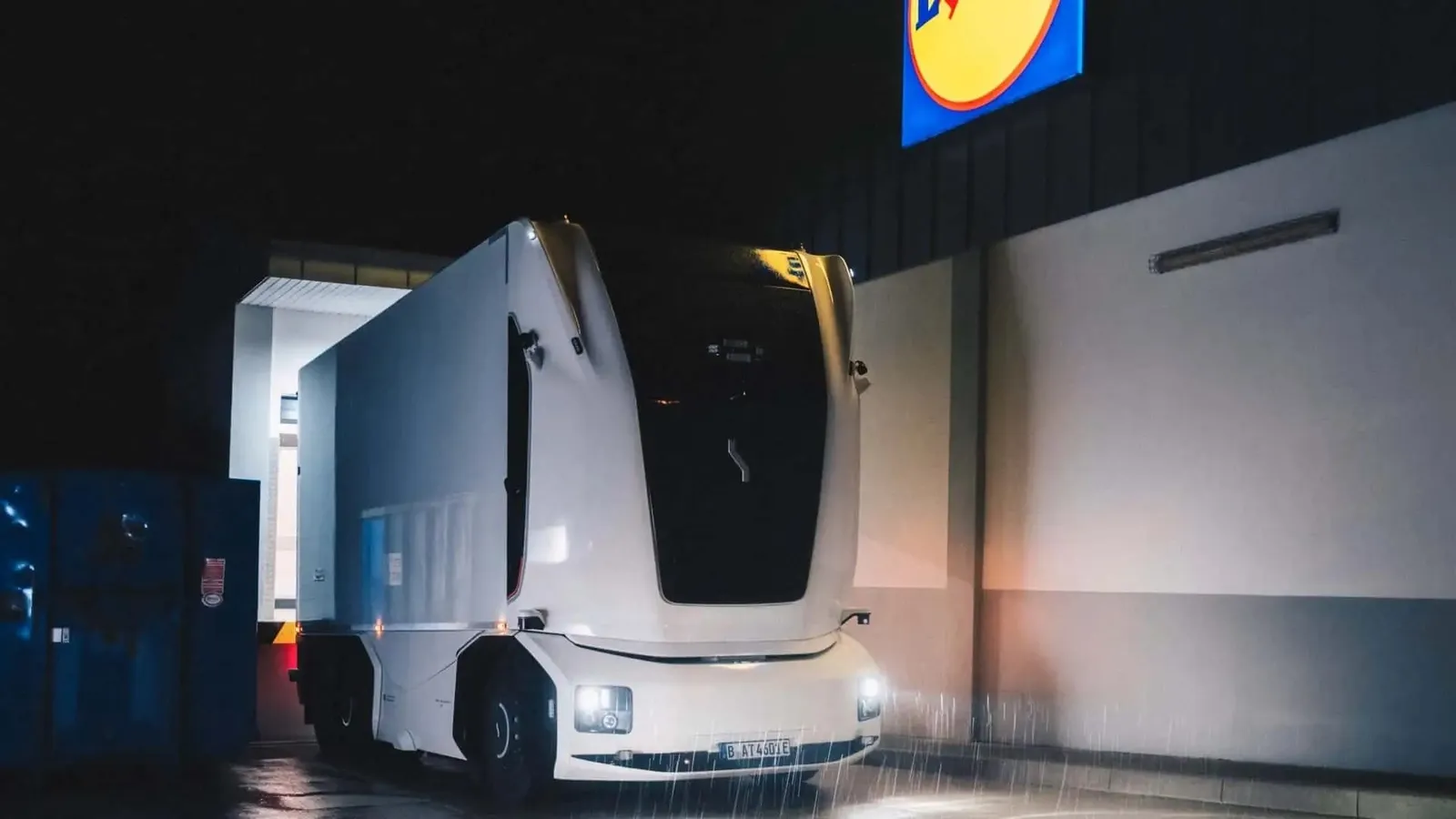
Lidl has launched daily deliveries in Germany using Einride’s driverless autonomous truck. The vehicle received approval from the KBA, Germany’s transportation authority, and operates between a logistics center and a store in Edermünde.
This is a significant achievement for the industry. It’s also good news for readers, as the route appears to be shorter than 1 mile, or less than 1.6 kilometers.
What exactly Lidl and Einride have launched
It refers to Einride’s electric vehicle in the form of a pod, without a driver’s seat or onboard safety monitor. The company refers to this as SAE Level 4, meaning autonomy under strictly defined conditions without the need for a human to be constantly present in the cabin. There is no cabin at all.
The truck has received approval from the Kraftfahrt-Bundesamt, KBA, and Einride emphasizes that Germany’s procedures are among the strictest in the world. The company’s CEO, Roozbeh Charli, said such approval provides a foundation for further scaling up the project.
For now, it’s a very specific and limited operation. The vehicle transports goods between a warehouse and a Lidl store in Edermünde, operating one shift per day, five days a week, and carrying about 45 pallets per shift.
This is no longer a demonstration on a closed site. But it’s also not a full-scale long-distance route. Full stop.
There is a remote operator, but they don’t drive the truck
Einride notes that the vehicle is monitored remotely by a human. This operator does not drive the truck on a daily basis, but can take control at low speeds of up to 4 mph, or about 6 km/h, for example when docking or in more challenging situations.
The entire sensor suite looks quite impressive. The vehicle is equipped with 9 external cameras, 6 radars, and 4 lidars. Production is handled by a contract manufacturer in the Netherlands.
There’s another important aspect to consider. According to route analysis and video footage, the distance between the warehouse and the store is very short, practically next to each other. This doesn’t invalidate the project, but it sets realistic expectations. Level 4 operates well within this favorable scenario.
Einride plans the next step, which is expanding the route to a milkrun model with multiple stops along the way. The company is also discussing broader implementation with Schwarz Group, the owner of Lidl. Once again, the common arguments about a shortage of professional drivers and supply chain stability come up.
The most interesting part now isn’t just that the truck moved, but how far and how extensively this model can be extended beyond the usual route to the warehouse next to the store. Do you think such implementations will start with short logistics loops in Europe, or will they remain at the demonstrator stage?
LovEV Newsletter
Want more content like this?
Sign up — we’ll send you a weekly summary once the newsletter goes live.