
LG Energy Solution begins battery production in Lansing
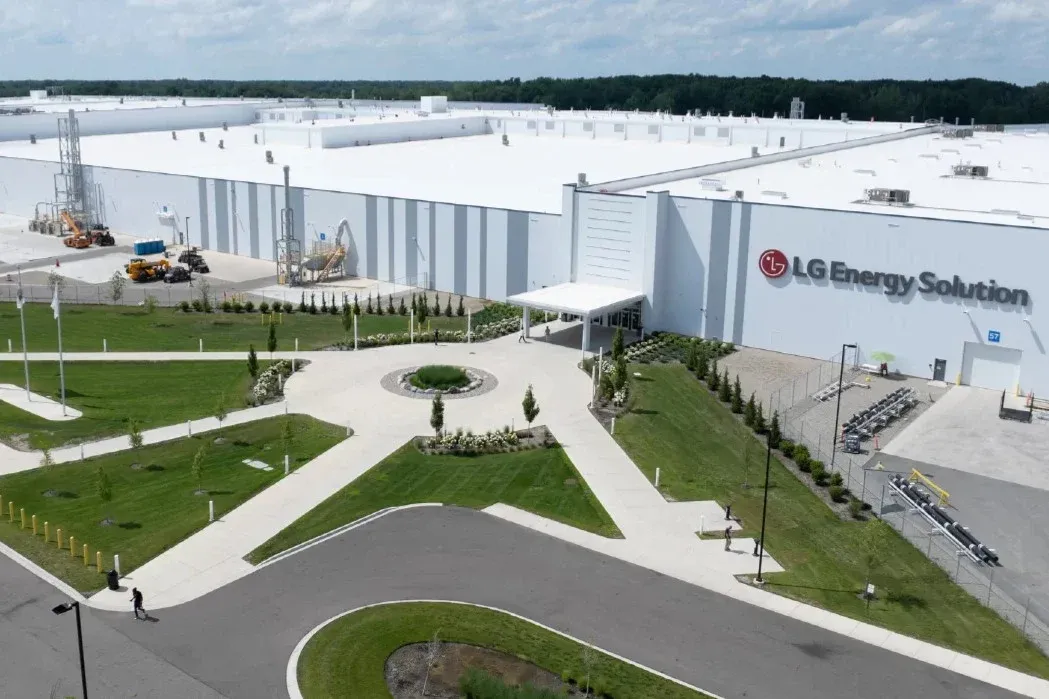
LG Energy Solution (LGES) has begun production at its new battery plant in Lansing, Michigan. The facility, originally planned in partnership with GM, is now fully owned by the Korean cell manufacturer. LGES is expanding the site’s capabilities: in addition to LFP cells for Tesla’s stationary storage systems, it will also produce NMC cells for Toyota’s electric vehicles.
LG Energy Solution (LGES) officially announced the start of production at its battery plant in Lansing. The facility, covering approximately 91.5 hectares, is expected to achieve an annual production capacity of over 35 GWh once fully operational. Since 2022, LGES has invested more than two billion dollars in the site according to its own statements. Currently, the plant employs around 900 people, with plans to increase this number to up to 1,700 in the future.
The commencement of production is particularly notable given the plant’s history: Lansing was originally planned as the third cell factory for Ultium Cells, the battery joint venture between General Motors and LG Energy Solution. However, at the end of 2024, GM announced it would sell its share in what was then nearly complete facility to LGES.
This did not mean a complete withdrawal of General Motors from Ultium Cells. The joint plants in Ohio and Tennessee remained unaffected by the transaction. GM cited, among other reasons, its need to adapt its battery production capacity in a capital-efficient manner to the development of the electric vehicle market.
The acquisition was completed in May 2025. By that time, construction work had already been 98 percent finished according to LGES. Since then, Lansing has been fully owned by the Korean cell manufacturer.
Toyota Acquires GM’s Capacities
After GM withdrew from the project, LGES realigned the facility. As early as 2025, it was reported that Toyota would shift an existing battery order from LG Energy Solution to the Lansing plant. This gave the facility, previously designed for GM, a new major customer in the automotive industry.
Going forward, LG Energy Solution plans to produce NMC cells containing nickel, manganese, and cobalt for Toyota at the Lansing plant. One of the target vehicles is Toyota’s all-electric Highlander for the 2027 model year. This three-row electric SUV is set to be manufactured at Toyota’s plant in Georgetown, Kentucky.
The battery supply chain includes additional locations: Toyota states that the battery modules for the Highlander are assembled at its battery plant in North Carolina. The cells from Lansing mentioned by LGES can therefore be further processed within a largely U.S.-based supply chain before the battery is installed in the vehicle in Kentucky.
Unlike Toyota’s cells, LFP production for stationary energy storage is already underway in Lansing. LGES manufactures lithium-iron-phosphate cells there for so-called Energy Storage Systems (ESS). These are intended to be integrated by LG Energy Solution Vertech’s U.S. subsidiary into complete systems for energy providers as well as commercial and industrial applications. Among future customers is DTE Energy, an energy provider based in Detroit.
Tesla is set to receive cells starting in 2027
Starting in 2027, Tesla is also expected to source LFP cells from Lansing. LGES had already announced in 2025 a supply contract worth around $4.3 billion for prismatic LFP cells. In March 2026, the U.S. government confirmed that Tesla is behind the order.
The cells are intended for use in Tesla’s Megapack 3, among other applications, with production planned in Houston, Texas. This gives LGES increasing importance not only in the electric vehicle battery market but also in the stationary large-scale energy storage market.
For the Lansing site specifically, this diversification is strategically important. What was originally a cell factory designed primarily to support General Motors’ production has evolved into a facility serving two distinct markets and types of battery cells: energy-dense NMC cells for electric vehicles, as well as cheaper and more cycle-resistant LFP cells for stationary storage.
The different applications impose varying requirements on batteries. In vehicles, energy density, weight, and space constraints are particularly critical. For stationary storage, cost, lifespan, and a high number of charge cycles are the main considerations.
LGES Expands Its ESS Business in North America
Lansing is part of a larger strategy by LG Energy Solution. By the end of 2026, the company plans to build a total production capacity of over 50 GWh for LFP cells used in stationary storage at three facilities owned by it and two jointly operated sites in North America.
According to the company, around 80 percent of its global ESS production capacity will be located in North America by then. LGES is responding to both the growing demand for locally produced batteries and the increasing need for large-scale storage systems for power grids, renewable energy, and industry.
The once-planned third Ultium plant by GM and LGES has now become a much broader battery production facility. Toyota meets part of the future demand from the automotive sector, while the ESS business already ensures operational capacity. For LGES, this combination also reduces reliance on the market success of individual electric vehicle models and manufacturers.