
Former Greenpeace director: “Nuclear power in Italy? An ideological myth.”
#
Giuseppe Onufrio says the return of nuclear energy in Italy “is based on a false ideology” and risks diverting attention and resources away from technologies already available for energy transition. The former head of Greenpeace Italy particularly questions the economic viability of new nuclear power and Small Modular Reactors (SMR). He argues that investments should focus on renewables, energy storage, and grids. “New nuclear power won’t reduce electricity bills,” he states in an interview with Fuoco Amico, citing the costs and timelines of recent European and American projects as evidence.
The issue of costs for new nuclear power
Onufrio begins with the bill through which the government aims to reopen nuclear power in Italy, pending subsequent implementation decrees. His criticism focuses primarily on economic considerations: according to the former Greenpeace director, there is no evidence to suggest that new nuclear power plants can result in cheaper electricity.
In his view, the most recent projects built in France and the United States demonstrate significant difficulties regarding costs and construction timelines. He specifically cites the EPR at Flamanville, the French reactor that came online after more than 17 years of construction, with costs estimated by France’s Court of Auditors to be far higher than initially planned.
Nuclear 2/ Disaster in France: 12 years of delays, 10 billion in extra costs
"The nuclear power that exists today, namely that of the French and American next-generation reactors, is an economic failure," says Onufrio, citing the conclusions of Lazard’s LCOE+ 2026 report.
SMR, a technology that still doesn’t exist
Another key point in the interview concerns small modular reactors, or SMRs, which are identified in the National Integrated Energy and Climate Plan as a potential component of Italy’s future energy mix.
Onufrio emphasizes, however, that there is still no established Western supply chain for commercially competitive SMRs (read more). In his view, reducing reactor size does not automatically mean lower costs; on the contrary, some of the scale economies that drove the development of the nuclear industry are lost.
Onufrio also cites Italy’s experience with the IRIS project, developed in the 1990s and later abandoned, arguing that the economic problems behind that decision have not been resolved by newer technologies.
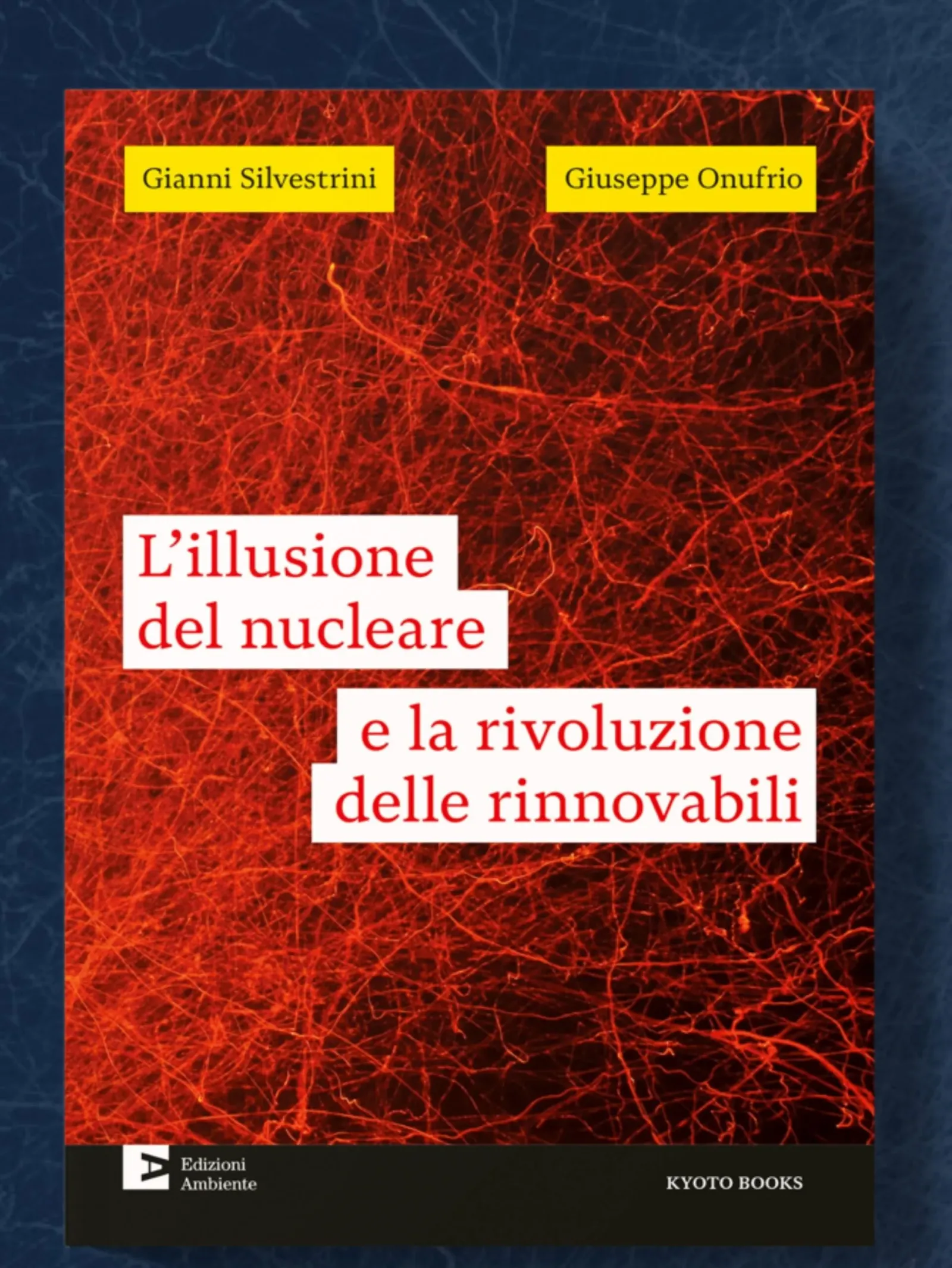
Onufrio, along with Gianni Silvestrini, the scientific director of the Kyoto Club, published the essay “The Illusion of Nuclear Energy and the Revolution of Renewables” in spring for Edizioni Ambiente (photo here).
Waste and national storage: an unresolved issue
For Onufrio, returning to nuclear energy also raises a preliminary issue: the management of radioactive waste. Italy still lacks a national repository for low and medium-level waste and has not completed the decommissioning of old nuclear plants.
This is why he objects to the idea of building new reactors before resolving the problems left over from nuclear energy in the past.
The problem, he notes, concerns not only the construction of new plants but the entire lifecycle of the technology, including the management of materials and facilities once they are no longer in use.
Renewables and storage instead of base load
The part of the interview closest to Vaielettrico’s themes concerns the relationship between nuclear energy and renewables. According to Onufrio, the traditional view of nuclear as a source of “base load” is losing relevance in an electrical system characterized by increasing shares of solar and wind power and a growing use of energy storage.
Batteries, thermal storage, hydrogen, and other forms of storage can help manage the variability of renewable sources. Onufrio cites sodium batteries, for example, which could find interesting applications in stationary storage, where weight and size matter differently than in vehicles.
According to his perspective, the goal is not to find a single technology capable of replacing all others, but to build a flexible energy system in which renewable generation, storage, and grids work together.
The risk of slowing down the energy transition
In the final part of the interview, Onufrio shifts focus to the amount of renewable energy that, in his view, is already available but hindered by approval processes and bureaucratic constraints.
His argument is that the debate over nuclear energy risks becoming a distraction from immediate investments in wind, solar, storage, and power grids.
We have low-cost, low-risk alternatives that create many jobs and do not produce waste for the next 100,000 years,” he claims.
A position that directly links the debate on atoms to that on electric mobility: according to Onufrio, even in the automotive sector Italy should accelerate investment in batteries, electric cars, and new energy technologies rather than slowing down the transition.
Nuclear yes or nuclear no? Prandi’s view
If this doesn’t happen here, he concludes, it is due to the resistance of the “fossil fuel barons.” By supporting unlikely sustainable alternatives, they prolong our dependence on natural gas for electricity generation and oil for transportation.
The fundamental question that arises from the interview is primarily industrial: what technologies can be developed today with timelines and costs that align with Italy’s energy goals? For Onufrio, the answer lies first and foremost in renewables, storage, and grids, while nuclear power represents a long-term, costly option that still lacks a solid industrial ecosystem.
READ ALSO: “Clarifying Nuclear Energy: A Study Worth Considering” and watch the VIDEO
