
Electric vans, trucks, coaches, and buses are gaining traction in Europe
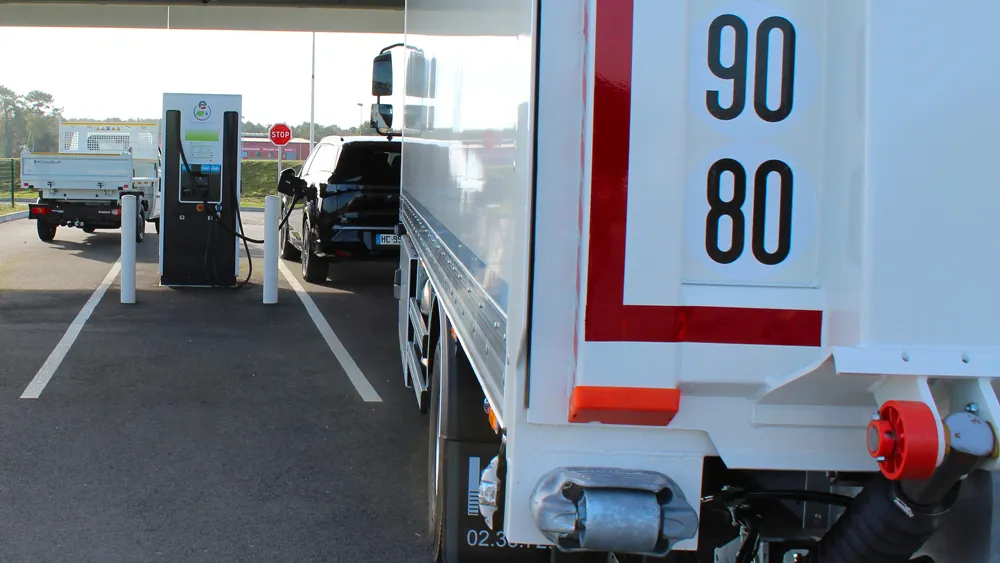
According to CCFA figures, in the European Union, France, Germany, and the Netherlands continued to lead from January to the end of September 2026 in terms of electric vehicles other than passenger cars and lighter vehicles. However, smaller countries disrupted these figures, especially in the category of coaches and buses.
Light commercial vehicles
In the European Union, France registered the highest number of commercial vehicles with a gross vehicle weight rating of up to 3.5 tonnes in the first three quarters of 2026. Of the 249,656 units registered across all energy types, diesel still dominated (186,259 units, accounting for 74.6% of the total during that period), but there was a downward trend (-9.7%).
Electric vehicles accounted for 13.8% of sales, representing a 33.3% increase compared to the same period last year. With 34,355 units, France is the EU country that registered the most electric models during this period.
Across all energy types, Germany follows with 188,704 units, including 28,755 electric vehicles, marking a 49.7% increase from 2025 and accounting for 15.2% of total sales; Spain has 147,218 units, including 16,792 electric vehicles, with a 41.5% increase and 11.4% share; and Italy has 133,992 units, including only 8,043 electric vehicles, with a 5.5% increase and 6% share. For comparison, the Netherlands performs better than Italy with 14,556 units, a 22.8% increase, and 84.3% share; Sweden has 9,108 units, a 41.1% increase, and 32.1% share; and Denmark has 8,273 units, a 48.3% increase, and 43.7% share.
In the European Union, 151,691 electric vehicles were registered from January 1 to September 30, 2026, bringing the total to 1,073,427 commercial vehicles (+38.2%, accounting for 14.1%). However, in Europe outside the EU, the United Kingdom reported the best figures (251,036 units across all energy types, including 320 electric vehicles, +35.6%, accounting for 8.4%).
Source: CCFA
Industrial vehicles weighing 3.5 to 16 tonnes
During the first three quarters of 2026, Germany registered the highest number of industrial vehicles weighing 3.5 to 16 tonnes across all energy types (17,613) and electric vehicles (3,879, a 71.6% increase compared to 2025, accounting for 22%).
The three European Union countries listed below are France (5,285 units, including 974 electric, representing an 86.6% increase compared to 2025, with a 18.4% share over the period), Spain (3,812 units, including 974 electric, +86.6%, with a 18.4% share), and Italy (3,233 units, including 200 electric, -56.1%, with a 6.2% share).
When looking only at electric vehicles, the Nordic countries perform better: the Netherlands (1,195 units, +40.3%, with a 66.9% share), Sweden (443 units, +5%, with a 58.1% share), and Denmark (370 units, +22.9%, with a 62% share).
In the EU, 7,753 electric vehicles were registered during this period (+43.9%, accounting for 19.8%), bringing the total number of industrial vehicles weighing 3.5 to 16 tonnes to 39,222. Elsewhere on the continent, the United Kingdom also performed well, with 2,960 electric vehicles registered during this period (+55%, accounting for 18.6%), resulting in a total of 15,909 industrial vehicles in that weight range.
Source: CCFA
Trucks over 16 tonnes
For trucks over 16 tonnes, Germany once again leads the rankings. For the first three quarters of this year, there were 41,275 trucks of all types, including 1,722 electric trucks (+91.3%, accounting for 4.2%).
Behind them, based this time solely on electric vehicles, we find roughly the same countries, but in a different order: the Netherlands (1,022 units, +83.8%, 11.1% share), France (771 units, +36%, 2.81% share), Sweden (387 units, +48.8%, 10.3% share), and Denmark (271 units, +62.3%, 8.2% share).
Countries that are major buyers of these trucks have registered very few electric vehicles. For example, Poland (23,549 trucks, only 46 electric), Spain (19,884 / 54), Italy (17,868 / 60), Lithuania (10,963 / 1), and so on. For this reason, there were only 5,120 electric vehicles (+59.9%, 2.5% share) in the EU, out of 205,857 trucks.
Elsewhere on the continent, Switzerland stands out significantly with a 24.2% share of electric vehicles (+62.2%, 605 units out of 2,502 trucks), as does Norway (14.4% share, +61.5%, 444 units out of 3,081 vehicles). In contrast, the United Kingdom ranks among the lowest performers (1.1% share, -4.7%, 286 units out of 25,449 trucks over 16 tonnes).
Source: CCFA
Coaches and buses (over 3.5 tonnes)
On a European Union scale, for heavy road transport vehicles used in public transportation, the situation is quite good in the first three quarters of 2026, with a 26.4% share, accounting for 8,633 electric vehicles out of 32,695 vehicles (+37.6%).
The countries that have recorded the highest numbers of electric coaches and buses are: Italy (1,970 units out of 5,338 vehicles, +116.2%, accounting for 36.9%), Poland (999 units out of 3,107 vehicles, +557.2%, accounting for 32.2%), Germany (836 units out of 5,245 vehicles, -30.4%, accounting for 15.9%), the Netherlands (783 units out of 1,045 vehicles, +86%, accounting for 74.9%), France (665 units out of 5,289 vehicles, +32.7%, accounting for 12.6%), and Portugal (642 units out of 1,168 vehicles, +379.1%, accounting for 55%). Even a small country like Malta can provide interesting figures, with 40 electric vehicles out of 67 registered, representing nearly 60% and a growth rate of 1,900%.
Outside the EU but in Europe, there are also significant shares of electric vehicles: 58.4% in Norway (785 electric vehicles out of 1,344 total vehicles, +31.1%), 43.6% in Switzerland (244 electric vehicles out of 559 total vehicles, +37.1%), and 30.4% in the United Kingdom (1,727 electric vehicles out of 5,672 total vehicles, -22.7%).