
Leapmotor earned 210 million yuan in half a year. Margins are weakening, and the company is moving into robotics.

Leapmotor released its results for the first half of 2026, showing another positive performance. The company reported a net profit of 210 million yuan, with revenue reaching 38.11 billion yuan and 356,487 vehicles delivered. However, its gross margin and cash flow deteriorated. Meanwhile, the Chinese brand is expanding its partnership with FAW and officially confirming its entry into embodied robotics, which refers to AI-driven physical robots in a broad sense.
Table of Contents
Show
Hide
On paper, the numbers look good. In practice, it’s clear that Leapmotor is growing rapidly, but the quality of this growth isn’t as solid as it was a year ago.
Profit is there, but margins and cash flow are not looking as good
In the first half of 2026, Leapmotor saw its revenue increase by 57.2% year-on-year. Sales of vehicles and spare parts grew at a nearly identical pace to deliveries, which rose by 60.8% to 356,487 units. The company claims it was number one among new Chinese brands in terms of sales.
Net profit increased even more, from 30 million yuan the previous year to 210 million yuan now. This is already the second consecutive profitable half-year according to one set of figures, and per the company’s remarks at its earnings conference, it could even be the third profitable half-year using a different reporting method. Either way, one thing is clear: Leapmotor is no longer just a company that burns cash.
There is, however, a silver lining. The gross margin dropped from 14.1% to 11.7%, even though the gross profit itself increased by 29.7% to 4.45 billion yuan. The company attributes this to higher raw material costs and a change in the product mix. In simpler terms, it is selling more, but making less profit on some vehicles.
The second quarter looks better. There, the gross margin reached 12.6%, which was 3.2 percentage points higher than in the first quarter. This suggests a recovery, but not yet a return to last year’s levels.
The adjusted profit is even more interesting. After accounting for share-based payment costs, the adjusted non-IFRS net profit was 270 million yuan, which was 18.2% lower year-on-year. In other words, the surge in reported net profit is not solely due to improved operational performance. Some accounting adjustments played a role.
Severely declining cash flows
This is the part that is usually not shown in marketing slides. Operating cash flows dropped by 24.1% to 2.17 billion yuan. Free cash flow plummeted by 83.7%, from 860 million to 140 million yuan.
The company cited increased purchases for inventory buildup as the reason. This makes sense given the rapid increase in production, but the effect is simple: Leapmotor is still profitable, only its cash reserves are no longer growing as comfortably as before.
The ambitious goal of 1 million cars becomes difficult
To wrap up the year, the company needs an average of around 108,449 cars per month for the next five months. This is more than in record-breaking July, when global deliveries totaled 101,267 units. Is it possible? Mathematically, yes. Operationally, it’s getting tight.
Leapmotor is counting on new models. These include the A10, D19, and A05. The D19 model found 10,043 buyers in July, while the 100,000th A10 unit rolled off the production line 135 days after its launch. The pace is fast, but there’s still a long way to go before reaching one million units.
The company itself has also tempered its profit expectations. At the start of the year, it targeted 5 billion yuan in net profit for the entire 2026 year. Now, management admits it will be “very difficult,” with the new forecast at around 3 billion yuan. The expected gross margin for the whole year is 13-14%, while the margin on cars alone is 10-11%.
In short, sales volume needs to grow faster than profitability. This is a common pattern among Chinese manufacturers competing on scale.
Exports Have Become the Second Growth Engine
The strongest aspect of the report is its focus on overseas markets. In the first half of the year, Leapmotor exported 96,294 vehicles, a 372.6% increase year-on-year. Exports already accounted for 27% of total sales, surpassing the entire figure for 2025.
The brand has set its target for 2026 at around 200,000 vehicles outside China. For 2027, the goal is 350,000–400,000 units, with the company aiming to reach the upper end of this range.
This is no longer just a supplement to business in China. It’s becoming the second pillar of the company’s operations.
Leapmotor is currently present in over 40 markets, with more than 2,000 sales outlets overseas, and its European network alone has exceeded 1,000 locations. The next phase of expansion will cover Eastern Europe, Northern Europe, and South America.
Another important detail for Europe is the factory in Spain, which is being used together with Stellantis, and is set to begin producing the B10 model in October. Leapmotor expects sales of locally produced vehicles overseas to reach around 50,000 units by 2027. At the same time, the company admits honestly that local production may not immediately improve margins. It is more about logistics, tariffs, and policy implications rather than an immediate boost in profitability.
From a Polish perspective, this is significant because the brand backed by Stellantis now has a shorter path to establishing a stronger presence in Europe. If production and distribution scale up, price pressure in the affordable EV segment will further increase.
FAW contributes capital and technology, Leapmotor contributes robots
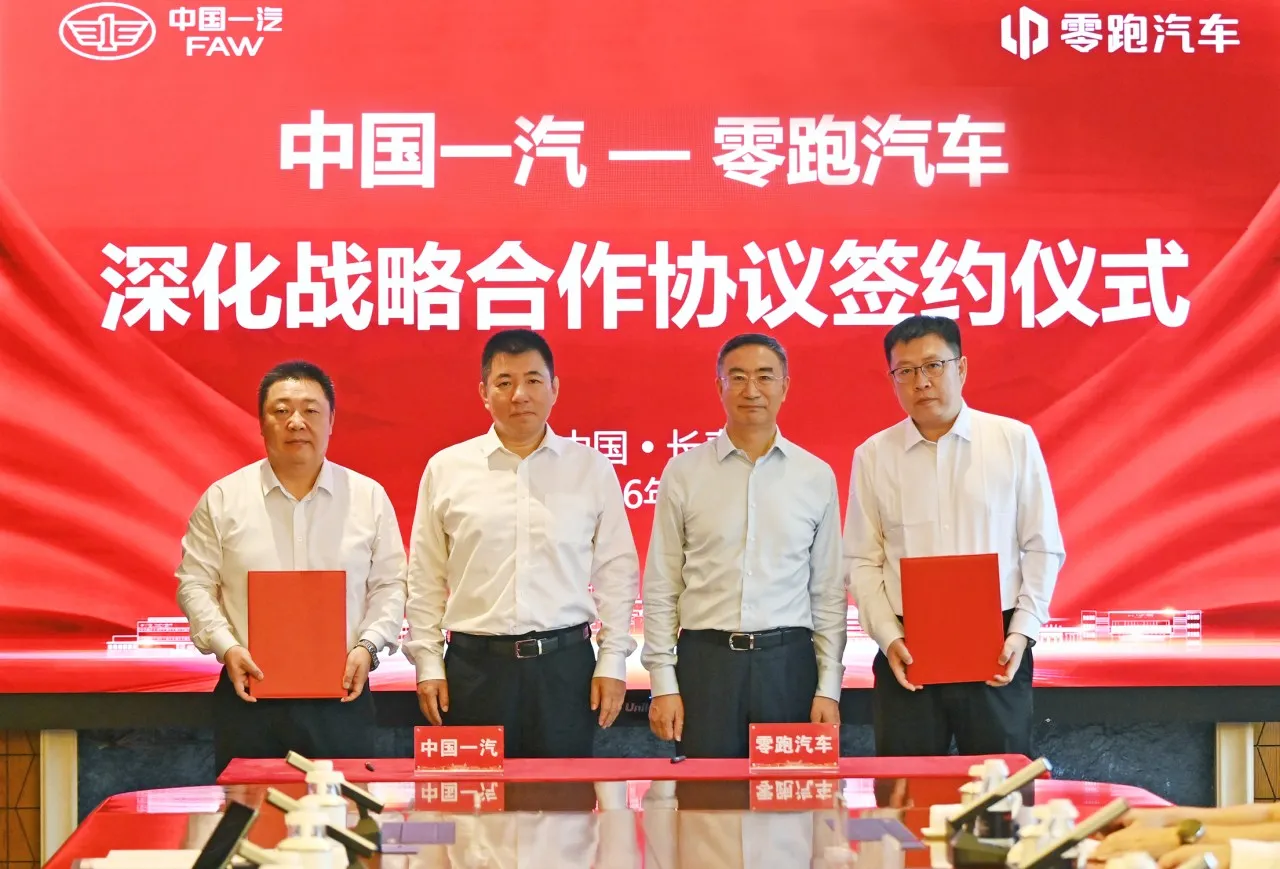
On August 24, Leapmotor and FAW signed an expanded strategic agreement in Changchun. This marks the third extension of their cooperation since March 2025. Initially, there was a memorandum on jointly developing electric vehicles, components, and capital cooperation. Later, in December 2025, FAW invested in Leapmotor through its investment arm, and FAW Qixin Power signed a cooperation agreement regarding PHEV powertrains and range extenders.
Now the scope is much broader. It includes capital investments, NEV vehicles, ADAS systems, powertrains, traction batteries, intelligent chassis, lightweight components, financial services, and embodied intelligent robots.
The latter sounds like the trend for 2026 in China’s automotive industry. Xpeng is showcasing a humanoid robot, Nio is investing in embodied AI, and now Leapmotor is stating outright that it too is entering this field.
Leapmotor Confirms Entry into Embodied Robotics
At the results conference, vice president and CFO Li Tengfei confirmed that Leapmotor already has a plan for its robotics business and will soon reveal the details. He did not specify the product form, development stage, or scale of investment.
So for now we have a declaration, not a finished product. And this needs to be clearly separated.
The company explains that as a new energy vehicle manufacturer with its own R&D capabilities and full stack development expertise, it is well positioned to build physical robots. The argument isn’t far-fetched. Today’s electric cars with ADAS already consist of cameras, sensors, controllers, algorithms, and drives. Some of these capabilities can be transferred to robotics. But simply transferring them doesn’t mean immediate profits.
A sign that this is a viable topic comes from a new subsidiary company as well. At the end of July, Huzhou Lingsheng Precision Manufacturing was established, with operations covering industrial robot production, intelligent robot development, and automotive parts. Wu Cun, senior vice president of Leapmotor and head of the electric drive product line, became the legal representative of the company.
Will it result in a humanoid, an industrial robot, a logistics platform, or something in between? The company hasn’t said yet. For now, it’s more of an open exploration of a new path than a fully formed business.
Technology in September, not just narratives
Leapmotor has announced a tech event for September 16. The company plans to showcase a new world model for driver assistance systems, as well as progress in batteries and powertrains.
The announcement sounds ambitious. As usual, the devil is in the details. The “World model” looks good in presentations, but what matters to drivers is whether the system works stably, on what roads, with what map, and under what level of manufacturer responsibility. Leapmotor claims that urban navigation assistance is already available in models A, B, C, and D, while nationwide deployment for vehicles based on the LEAP3.0 architecture is set to begin in the third quarter. The new system is scheduled to launch in September.
So this September might say more about the company than just its financial results. If Leapmotor demonstrates a technology that truly works and can be scaled beyond China, we’ll have another strong player with ambitions greater than just being a “cheap EV.” If not, there will be rapid growth, thinner margins, and a very long slide about robots.
The coming months will show whether Leapmotor is building another Chinese export powerhouse or simply trying to do too much at once. How do you view this move into robotics—as a sensible use of its capabilities or as a classic attempt to impress investors?