
Leapmotor aims to become the Apple of cars and is preparing a second brand for 2027.

Leapmotor aims to take another step forward in its growth and is not content with simply expanding its range of electric cars. The Chinese manufacturer has unveiled its new LEAP 5.0 architecture, along with several technologies that will be featured in its upcoming models, and has confirmed it is developing a second brand whose first product will hit the market in the fourth quarter of 2027.
The announcement was made during the Technology Day 2026 held in Huzhou, in China’s Zhejiang province. There, Leapmotor’s founder, president, and CEO, Zhu Jiangming, explained that the company wants to become something akin to a “car industry Apple,” though its approach focuses more on integrating technologies and creating a unique experience rather than competing solely through higher power or better equipment.
Zhu Jiangming used Apple’s example precisely to explain his strategy. According to the executive, Apple did not invent wireless broadband communications, computers, touchscreens, digital cameras, or MP3 players, but it excelled at combining various technologies to create products and ecosystems around them.
Leapmotor believes there is still much room for cars to evolve in this regard. The company thinks current vehicles still retain too many solutions inherited from internal combustion engine cars, both in terms of exterior design, interior layout, and the way their different functions are used.

The first application of this new philosophy will be Leapmotor’s second brand, which will introduce the LEAP 5.0 architecture. The manufacturer intends for its first model to offer a experience distinct enough to create a sensation similar to that brought about by the shift from traditional phones to smartphones. Zhu Jiangming has described it as a “mobile space,” a term that suggests a model with an unconventional interior layout.
The company has not yet revealed the final model or its key specifications, but it has explained what the architecture that will make it possible will look like. The goal is to make better use of the available space in the vehicle by reducing the volume occupied by certain mechanical components and reorganizing elements that have previously been located in more traditional positions.
LEAP 5.0 Introduces a New Generation of Technologies
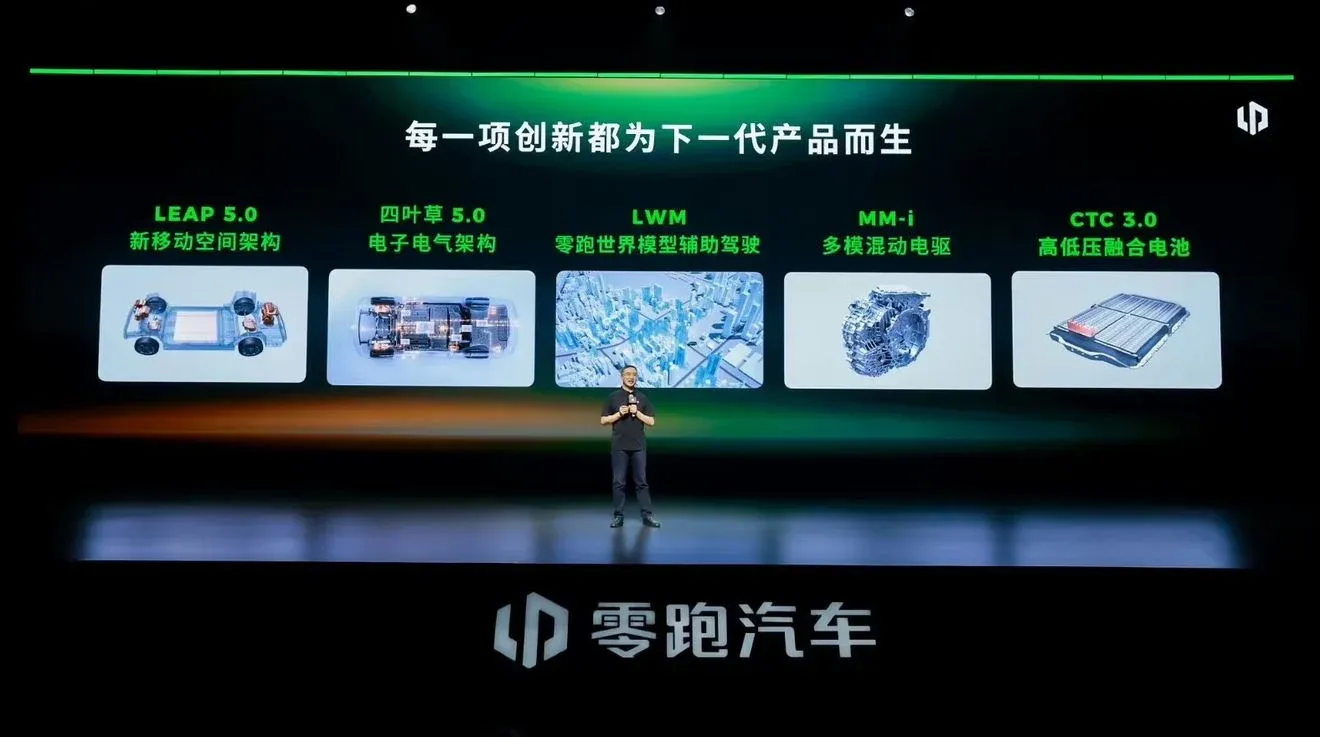
The LEAP 5.0 architecture combines a new concept of interior space with the Clover 5.0 electronic architecture. One of the most notable changes is in climate control, which replaces the conventional unit with an integrated air conditioning module. The propulsion system is also moved to the rear, and the layout of various mechanical components is altered.
According to Leapmotor, these modifications allow the available space inside the cabin to increase by over 19%. The company is also working on a layout that makes use of space across all three axes of the vehicle, aiming to achieve an exceptionally large interior area for its external dimensions.
Electronically, Clover 5.0 centralizes many of the vehicle’s functions. The new architecture features a 48-volt power supply, Ethernet connectivity throughout the car, and an Agent OS system that connects the vehicle to cloud services. The goal is to reduce the number of separate units and simplify both function integration and future updates.
One of the technologies that received the most attention during the presentation is LWM, Leapmotor World Model, the company’s new driving assistance system. Leapmotor claims its approach moves away from the conventional perception system based primarily on a top-down view of the environment, opting instead for a model capable of interpreting what happens around the car in a different way.
The manufacturer also explained that lidar will play a more limited role in this strategy, being used primarily as a backup safety feature. The company believes that advancements in algorithms are more important than continuously increasing the vehicle’s computing power.
Leapmotor has also announced that it will provide free upgrades to its new LWM system for all compatible cars equipped with lidar, including lifetime free use. By the end of August, the company had delivered over 350,000 cars equipped with lidar and advanced computing systems.
Another significant innovation is CTC 3.0, the third generation of its battery integration technology. In this case, Leapmotor has chosen to integrate the low-voltage battery within the main battery pack, eliminating the traditional separate lead acid battery.
The company claims that this solution enables the sharing of features such as protection, thermal management, and energy distribution, while also reducing the number of components. Leapmotor also plans to make the patents related to this technology available to other manufacturers, a move aimed at facilitating its adoption across the industry.
The Chinese manufacturer has also introduced the MM-i, a new multi-mode hybrid propulsion system designed for international markets. With this technology, Leapmotor expands its product range beyond electric vehicles and those with extended range to enter the field of plug-in hybrids as well.
The system can operate in series and parallel, combining a thermal engine with two electric motors to offer up to nine operating modes. This allows the vehicle to move using only the electric motors, use the thermal engine to generate electricity, rely on a combination of both systems, or employ the thermal engine directly to power the wheels.
With the MM-i, Leapmotor completes a lineup that now includes electric vehicles, extended-range electric vehicles, and plug-in hybrids—a strategy the company considers crucial for its international expansion.
The presentation also touched on robotics, though in this case Leapmotor takes a much more cautious approach. The company claims to have developed a robot entirely on its own, utilizing technologies from its motor systems, batteries, controllers, and perception systems.
However, Zhu Jiangming made it clear that the company does not intend to enter the race of releasing a robot merely to showcase its capabilities. Their strategy is to first find an application that can generate real business value before bringing the product to market.
In the meantime, Leapmotor enters this new phase with extremely strong growth. In August, it delivered 103,129 vehicles worldwide, an 80.72% increase from the same month last year, and for the second consecutive month it exceeded 100,000 units per month.
Between January and August 2026, the company delivered 560,883 vehicles, accounting for about 56% of its annual target of one million units. This growth largely explains why Leapmotor is already preparing for the next step: a second brand and an architecture designed from scratch for a new generation of models.
The real breakthrough is still to come. Leapmotor has not yet revealed the model that will introduce LEAP 5.0, but it has made clear that its second brand will launch this new phase in the fourth quarter of 2027. It will then be possible to see whether all these new technologies truly result in a different driving experience or merely represent another evolution of the cars we already know.