
Leapmotor will launch a second brand in 2027. It aims for a smartphone-like car, not a more expensive clone of the C10.
Leapmotor confirmed that it will launch a second car brand in the fourth quarter of 2027 and begin deliveries of the first model during the same period. The company aims to target a higher price point, around 300,000 yuan, which is approximately 160,000–165,000 zł when converted simply without taxes and duties, but the car’s new design is considered more important than the price.
Table of Contents
Show
Hide
The announcement was made during the 2026 Technology Day in Huzhou. What makes this interesting for European drivers is that Leapmotor isn’t talking about another SUV with a larger battery, but rather a vehicle designed as a “mobile space.” It sounds ambitious. And a bit marketing-driven.
Not “Leapmotor premium,” but a new brand above the current offerings
Leapmotor’s founder, chairman, and president, Zhu Jiangming, compared the planned product to the moment when smartphones replaced traditional cell phones. He believes today’s electric vehicles still mimic the logic of gasoline cars, both in their design and interior layout.
This is what the second brand aims to change. It’s not just about using better materials in the cabin and raising prices. Leapmotor wants to create a separate product line that will redefine how people use cars.
The company’s current range already spans from 500,000 to 300,000 yuan. The new brand will sit above the existing portfolio, but according to the management, it won’t simply be a “more expensive Leapmotor.”
And that’s right, as Chinese companies often fall into this trap. They promise “premium” features, but it ends up being the same car with a different grille, a more powerful processor, and a larger screen.
"Mobile space" and over 100 percent usable space efficiency
The most interesting part of this announcement relates to the interior. Leapmotor claims over 100 percent usable space efficiency, meaning an efficiency rate exceeding 100 percent for the usable space. This is of course a brand slogan, not an established industry metric, so it needs to be viewed with caution.
What does the company mean by this? The car is designed to be a mobile space rather than just a means of transportation. Vice President Cao Li described the future vehicles of this brand as interiors that can function as offices, relaxation areas, campsites, or even something akin to cafes or hotels.
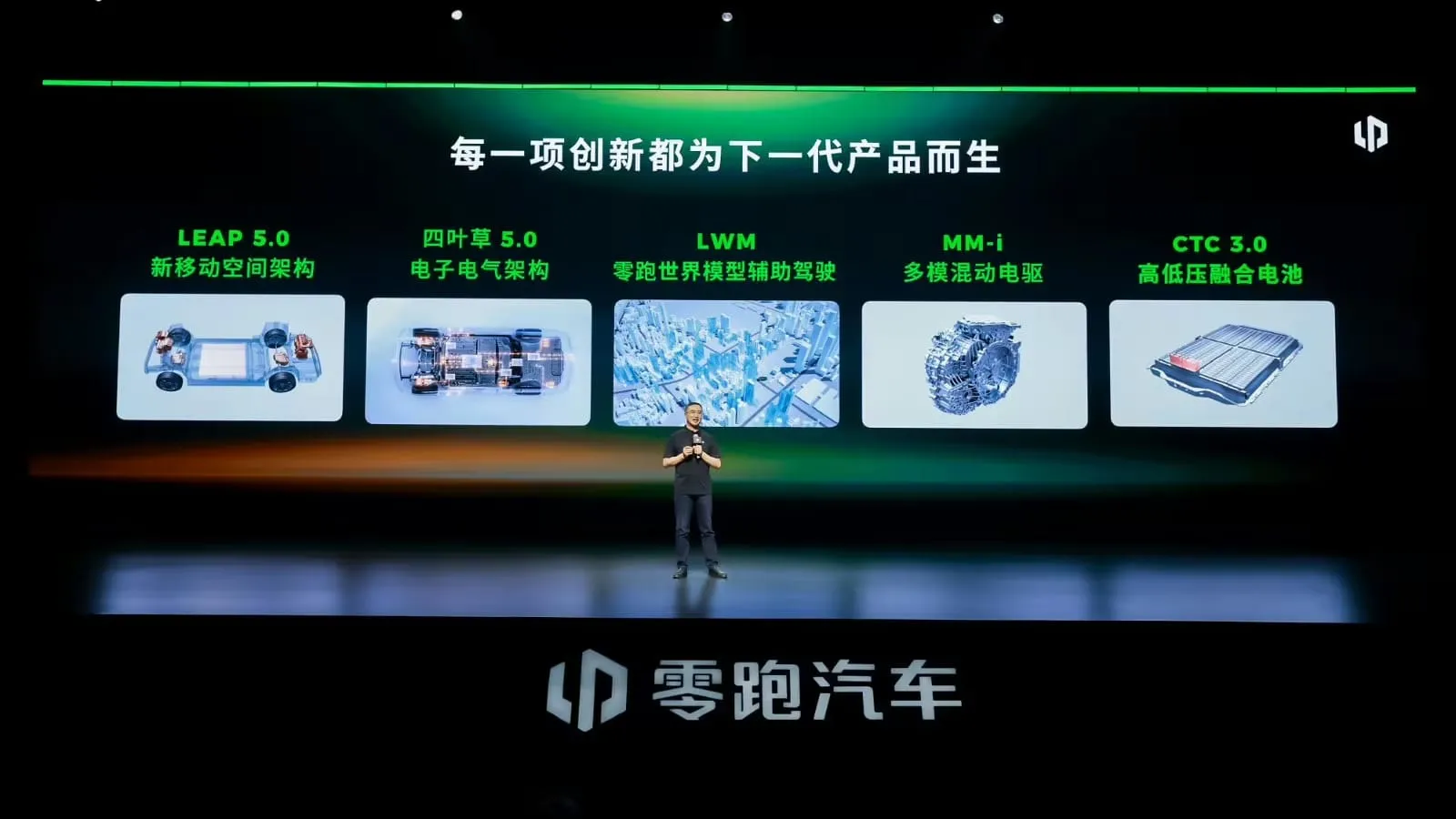
This mindset is driven by the new LEAP 5.0 architecture. It is on this platform that the first model of the second brand will be developed. The manufacturer claims that by reconfiguring the components, it has gained over 19 percent more space in the cabin.
How was this achieved? Leapmotor moved the drive system to the rear and replaced the traditional HVAC module with an integrated cooling system. On paper, it makes sense, as competing for every centimeter of interior space is one of the key challenges in EVs today. However, the real test begins only when someone sits in the back seat to see if it actually works, rather than just looking good on slides.
LEAP 5.0, 48 V, and a proprietary ADAS “world model”
The new brand is set to benefit not only from a different body architecture but also from Leapmotor’s entire suite of new technologies. The company showcased several key components during the event.
The first is Clover 5.0, which refers to a centrally integrated electrical and electronic architecture. This is complemented by a 48-volt power system for the entire vehicle, Ethernet throughout the car, and Agent OS, which is designed to connect the car to the cloud.
The second element is the driver assistance system LWM, Leapmotor World Model. The company claims it moves away from a traditional BEV-based approach, treating LiDAR mainly as a safety measure. Zhu Jiangming argues that algorithms are more important than adding computing power, and Leapmotor already has algorithms at the top of the market.
This one needs to be taken with a grain of salt. Almost every Chinese manufacturer claims today that its software is among the best in class. Without rigorous road tests and data on performance in real traffic, this remains just a claim.
Leapmotor has, however, announced something concrete: all cars equipped with LiDAR will receive an update to the world model for free, and access to the system will be free for life. By the end of August, the company had delivered 350,000 cars with LiDAR and advanced chips.
Batteries, CTC 3.0, and Hybrids for Overseas Markets
Leapmotor also places strong emphasis on the development of its own components. The company stated that its current production capacity for LFP cells is sufficient to supply 500,000–600,000 cars per year, with a long-term goal of reaching 1 million vehicles.
The CTC 3.0 technology was also demonstrated, which involves integrating cells with the chassis. In this approach, the low-voltage battery is incorporated into the main traction pack, eliminating the need for traditional lead-acid batteries. Leapmotor intends to make this technology available to other manufacturers under an open-source model. It’s an interesting move, though we’ll see how many are willing to adopt it.
There’s also a development relevant to Europe. The brand is working on the MM-i intelligent multi-mode hybrid system, which supports series and parallel operation in 9 modes. This expands the company’s offerings beyond BEV and EREV to include PHEV as well.
Importantly, the PHEV’s direct drive system is primarily designed for foreign markets. Earlier reports suggested that Leapmotor’s plug-in hybrids could reach markets outside China as early as the first half of 2027. This makes business sense. In many countries, full electric vehicles are selling slower than manufacturers anticipated, so PHEVs serve as a bridge, even if they represent a transitional solution from an EV enthusiast’s perspective.
Sales figures show Leapmotor has the resources to fund its experiments
Behind these announcements are quite substantial numbers. In August, Leapmotor delivered 103,129 vehicles globally, representing an 80.72% year-on-year increase. It was the second consecutive month with sales exceeding 100,000 units.
In the first eight months of 2026, the company delivered 560,883 vehicles, accounting for about 56% of its annual target of 1 million cars. According to available data, Leapmotor also became the first Chinese EV startup to exceed 100,000 vehicles per month this year.
This is significant because projects involving “new brands, new architectures, and new interior designs” require substantial capital. It’s easier to conduct such experiments once one has scale, proprietary batteries, and a portfolio ranging from cheaper models to vehicles priced at 300,000 yuan.
From Europe and Poland’s perspective, the issue is simple. If Leapmotor indeed introduces a new brand in 2027 and ties it to its international expansion, we’ll have another Chinese player trying to sell not just “cheaper EVs” but a whole new car format. The question is whether consumers will buy into this vision or opt for a regular car with a large trunk and fair pricing.
So far, Leapmotor has done a good job of storytelling. Now it needs to show a car that isn’t just an iPhone from a presentation. What do you think? Will the market embrace this car as a “mobile space,” or is it just a catchy slogan for two seasons?