
The Volkswagen ID. Buzz joins the California lineup with 2 seating positions
Under the name “ID. California Cruise,” the ID. Buzz becomes the first electric vehicle in the compact converted van segment. With orders set to open soon in France, enthusiasts may be able to use it for next year’s summer vacations.
Easily recognizable
Since its launch in 1988, Volkswagen California models have been based on the Combi or Transporter to become recreational vehicles for those who enjoy camping, touring, and various other more or less impromptu outdoor activities.
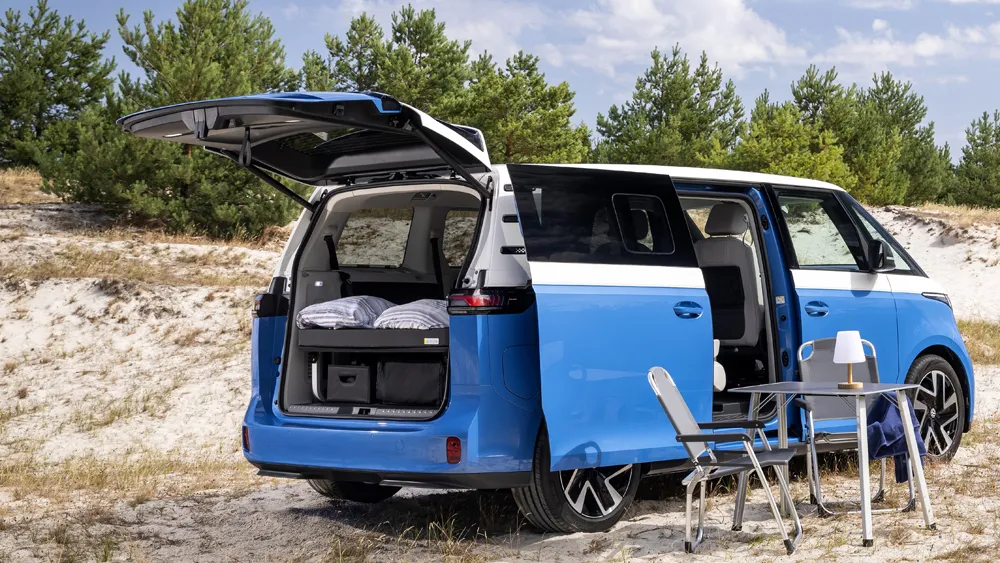
Unveiled this Friday, August 28, 2026, as part of the Caravan Show taking place in Düsseldorf, Germany, until September 6th, the ID. California Cruise is designed to accommodate two people. When parked, they can sleep on a bed measuring 2.03 x 1.20 meters. The manufacturer promises “a comfortably thick 9 cm folding mattress, newly developed and designed to provide pleasant sleeping nights while on the road.”
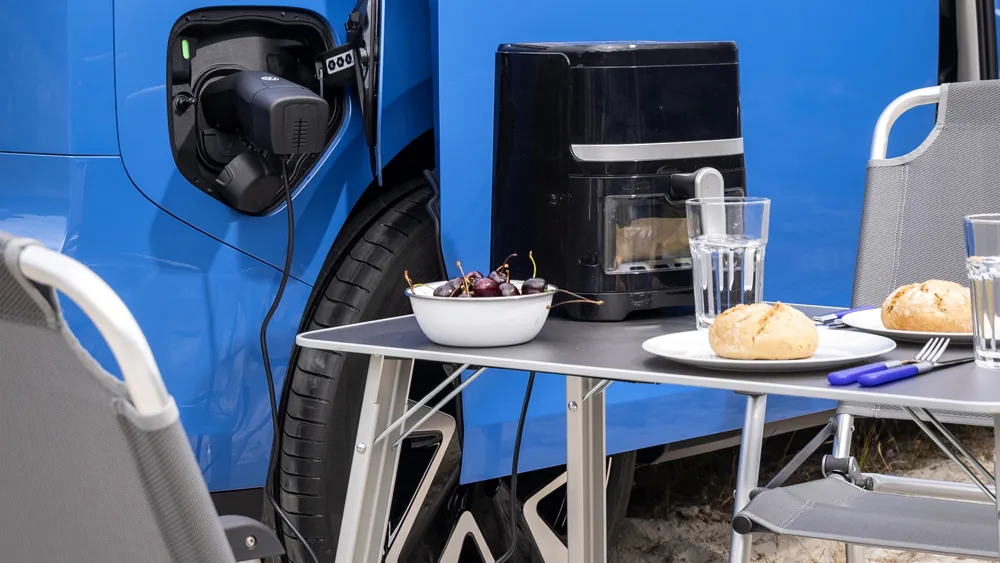
The two-color painting on the vehicle, here in blue and white, clearly indicates its intended use. This is even more evident when the air vents for the front side windows and the sunshades are in place and clearly visible. The equipment also includes two chairs and a camping table. For models equipped with a glass panoramic roof, an additional special curtain is provided. All these elements are stored onboard when not in use.
Notable distinctive features include the seat covers, which feature the California logo. This logo appears as a monogram at the rear, while the word “Cruise” is written on the sides.
Lifestyle and Comfort Onboard
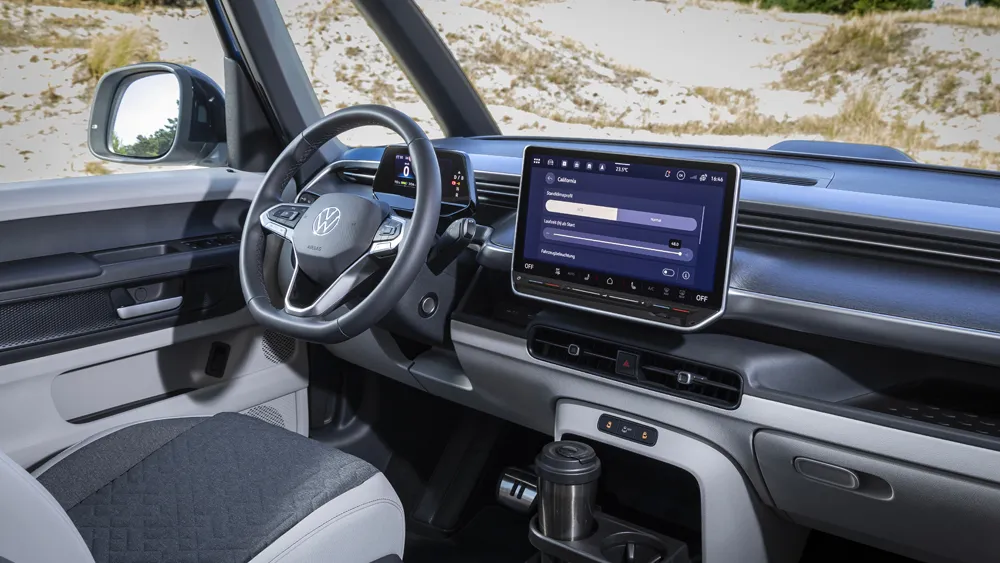
Regarding comfort and onboard living, the air conditioning or heating system can maintain an ideal sleeping temperature for up to 48 hours continuously. Of course, this depends on the battery level and outdoor temperature. Another new feature of the ID. California Cruise is a control unit used to adjust various lighting and comfort functions. Additionally, USB ports can be powered continuously.
It would have seemed unthinkable for the two-way charging feature associated with V2L (Vehicle-to-Load) to be absent from this vehicle, as it is not only practical for such a vehicle but also entirely essential. With maximum powers of up to 3.6 kW for continuous use, the occupants of the ID. California Cruise can plug in everything from coffee makers, kettles, stoves, and refrigerators to lighting systems or chargers for electric bikes and scooters.
With a bit of imagination, the list of possibilities offered by this feature is long. However, the V2L PowerSocket adapter will be available as an optional add-on at an extra cost.
Facilitating Recharges
For a vehicle that will most often be used to explore new locations, regions, and countries, it is essential to easily find charging stations to top up the battery. This is especially true since for many users, this might be their first long-distance trip in an electric vehicle.
That’s why compatible EV charging infrastructure located nearby will be displayed alongside the route planner. The planner can be accessed through the California app. By completing the necessary registration steps in advance, identifying charging stations becomes simpler thanks to the Plug & Charge feature. There’s no need to bring a badge—the vehicle is recognized as soon as the cable is connected, automatically starting the charging process.
In its press release dated August 27, 2026, Volkswagen did not specify the possible battery energy capacities for the ID. California Cruise, nor its range or fuel consumption, all of which could vary significantly since the vehicle will be available in both long and short wheelbase versions.
Orders open this fall
As a reference, it is already known that the price range for Germany will start at 60,761 euros, with first deliveries expected early next year. In France, orders are set to open this fall.
Volkswagen emphasizes that the California family is set to gradually welcome additional electrified models, with more electric versions arriving as early as 2028: “California Cruise is an attractive model that previews the brand’s electric future for converted vans.”
The manufacturer aims to maintain for this lineup the values of freedom, versatility, and comfort in everyday use — all now available in electric form.