
Batteries learn to act in anticipation of energy prices
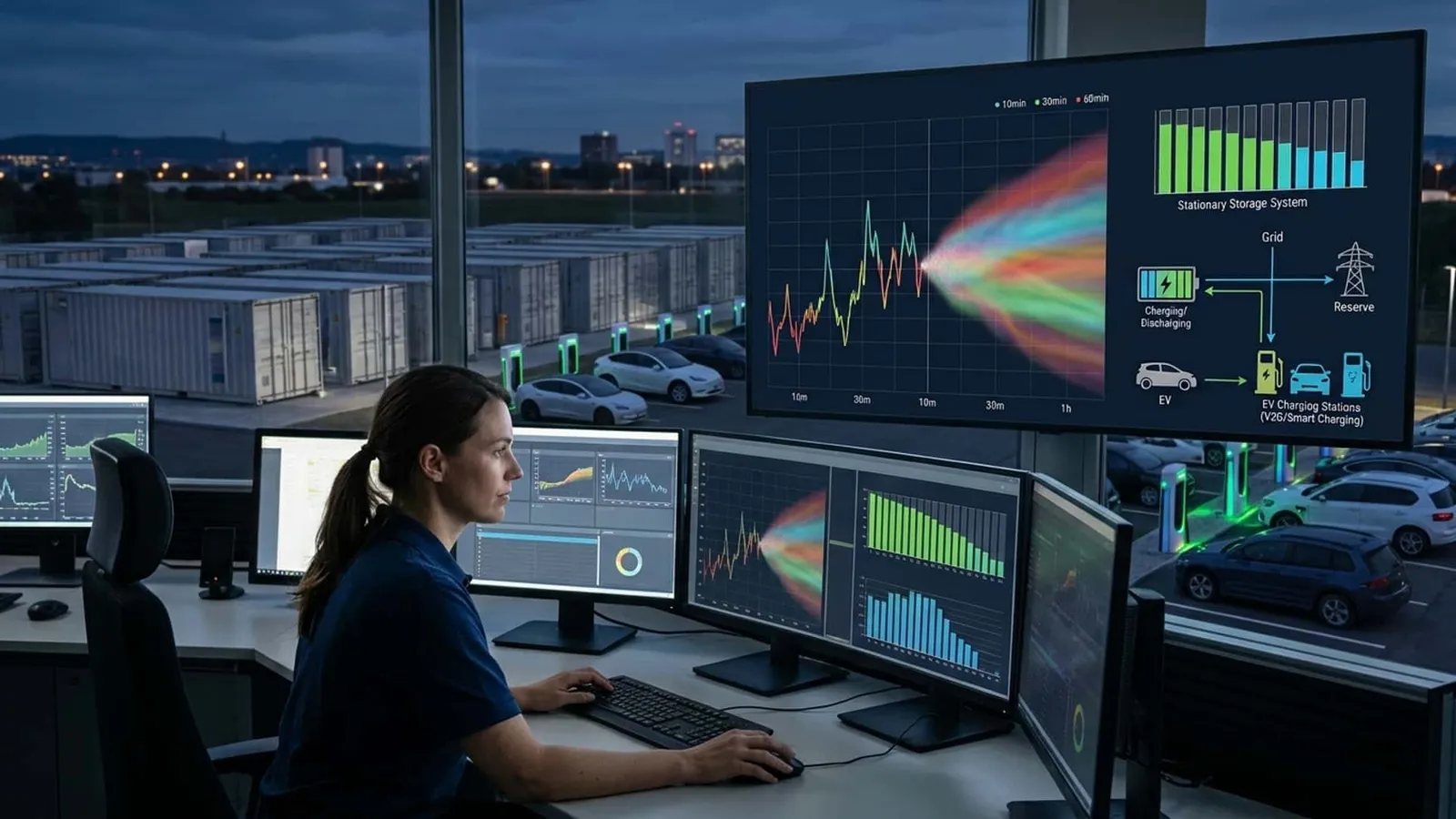
A battery connected to the electricity market can never be certain of how much its energy will be worth in ten minutes. It also doesn’t know how much it’s worth holding back as a reserve. This is the problem faced by stochastic control systems, which are designed to decide when to charge and discharge a storage unit within intraday markets, where prices keep changing until just a few minutes before energy delivery.
This topic is closely related to the world of electric vehicles, although basic research focuses on stationary storage systems rather than vehicles. However, the same decision-making logic under uncertainty is being applied to corporate fleet management and smart charging projects, where each charging station becomes a small energy reserve that needs to be optimized.
Practical explanation of stochastic control
Stochastic control is a method that makes decisions by explicitly accounting for what is not known with certainty, such as the energy price in 15 minutes. Instead of relying on a single predicted scenario, it calculates multiple possible outcomes. It then selects the action that works best on average, taking measured risks.
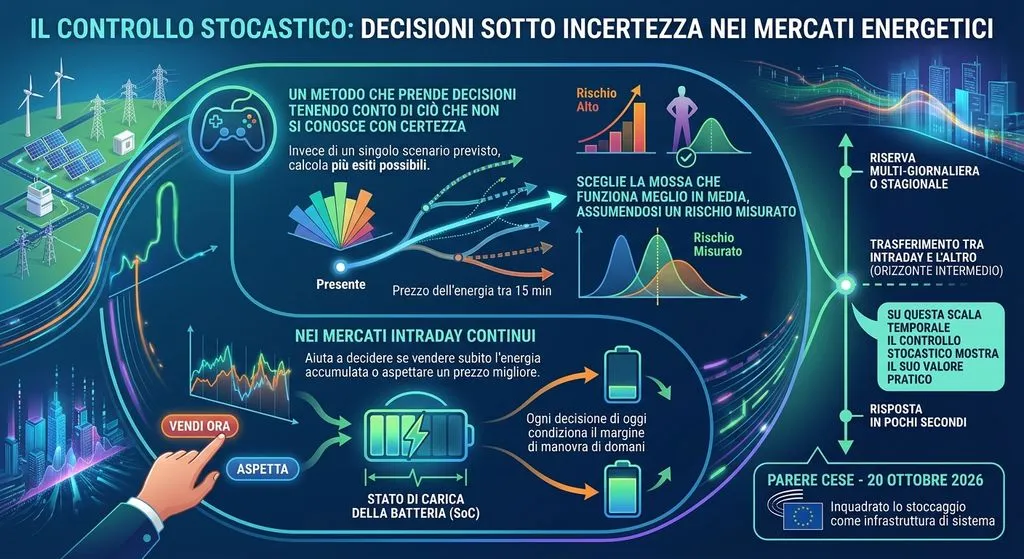
Stochastic control optimizes battery charging and discharging based on energy prices.
Photo by: Motor1 Italia visual (AI-assisted)
In continuous intraday markets, where electricity trades occur almost in real time up until just before physical delivery, this approach helps determine whether to sell the stored energy immediately or wait for a better price. The critical variable is the battery’s charge level. Every decision made today affects the options available tomorrow.
The European Economic and Social Committee classified storage as a system infrastructure in its opinion published on October 20, 2026. The time horizons covered range from responses within seconds to energy transfer between intraday periods, to multi-day or seasonal storage. At this intermediate time scale, stochastic control demonstrates its practical value.
What changes for charging and fleets
Corporate fleets that charge dozens of vehicles in the same depot face a similar problem on a smaller scale. They need to determine when it is advantageous to charge and when the energy stored in the vehicles can be sold back or used to cover peak demand. This is the principle behind bidirectional charging to stabilize the electricity grid.
On May 20, 2026, two groups of experts from the European Commission, along with the European Bidirectional Charging Coalition, presented recommendations to simplify the exchange of data needed for smart charging and energy flexibility, a framework that includes electric vehicles, heat pumps, and fixed storage systems. However, without reliable data on battery levels and prices, no stochastic algorithm can function effectively.
Regulation (EU) 2026/256, in force since April 9, 2026, requires that transactions involving the supply or storage of electricity or gas to a single consumption unit with a technical capacity of at least 600 GWh per year be reported every six months if they are not concluded on an organized market. This rule applies to operators of large-scale facilities, not to individual owners of electric vehicles. However, this regulatory measure helps to build the data infrastructure that will also support future applications for vehicle fleets.
Read more