
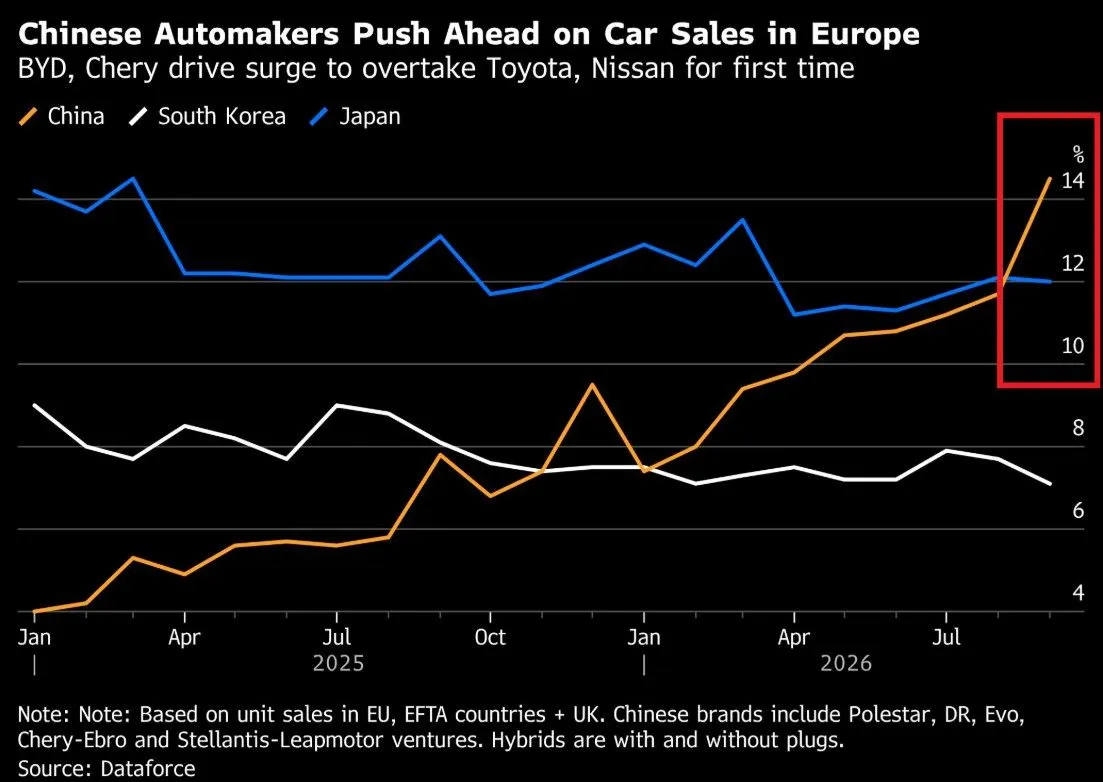
Chinese brands sold more cars than Japanese brands in Europe for the first time in a quarter.
Chinese brands are transforming the European market at such a rapid pace that they leave their competitors with ever fewer opportunities to respond. Their influence is already evident in dealerships, advertising, and especially in vehicle registrations. What seemed a few years ago to be an effort to gain visibility has now turned into direct competition for manufacturers that have been established in Europe for decades.
Chinese automakers sold more cars than Japanese ones in Europe for the first time over a full quarter. According to data from Dataforce cited by Bloomberg, between July and September they achieved a market share of 12.7%, compared to 11.9% for Japanese brands, including Toyota and Nissan. This growth was driven primarily by hybrid vehicles, both plug-in and non-plug-in.
The pace accelerated further as the quarter came to an end. In September, China’s share reached 14.5%, nearly three percentage points higher than in August. It is important to distinguish between these two periods: the quarterly advance reflects steady progress over several months, while September’s figure shows that Chinese brands gained even more ground by the end of that period.
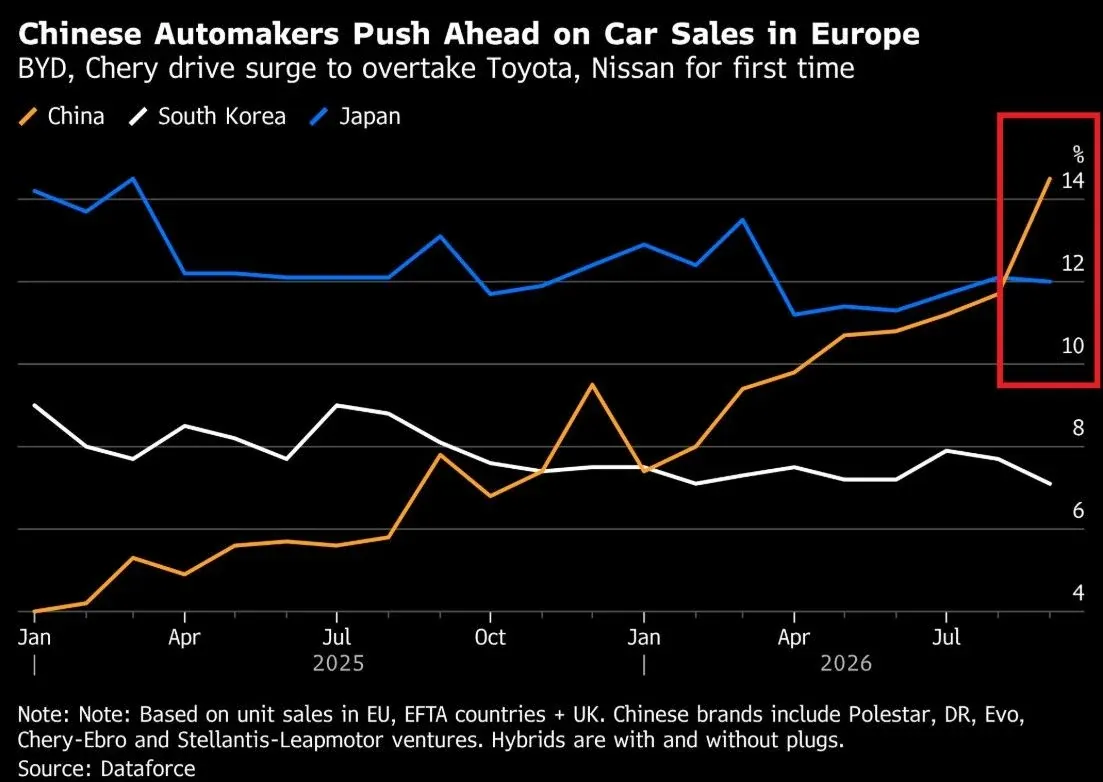
The comparison includes the European Union, the countries of the European Free Trade Association, and the United Kingdom. It also has an important feature: the classification used includes Polestar, DR, Evo, as well as the Chery-Ebro and Stellantis-Leapmotor operations within the Chinese bloc. Therefore, it is not simply about counting cars imported from China, but rather about the grouping of brands and alliances used in the study.
Volkswagen and Renault remain among the manufacturers dominating the European market, but the speed of change is hard to ignore. Just five years ago, Chinese brands accounted for around 1% of sales. In contrast, Japanese manufacturers have needed decades of investment, factories, and distribution networks to establish their position.
Toyota has been selling cars in Europe since 1963, with production facilities spread across the continent. Nissan has been manufacturing in Sunderland, United Kingdom, since 1986. These histories explain the significance of this advancement: Chinese brands are already competing with manufacturers that once had well-established customer bases and commercial presence.
The United Kingdom is one of the markets where this transformation is most evident. There, Chery’s Jaecoo 7 was the best-selling model in both March and September, according to Bloomberg. This outcome helps explain why China’s growth is starting to cause concern beyond the electric vehicle sector.
Hybrids are accelerating this progress as Chinese brands prepare their European factories.
European manufacturers face pressure from two directions. In China, companies like Volkswagen and BMW are losing customers to local brands that rapidly update their product lines and compete with lower costs. At the same time, these Chinese firms seek to expand outside their home country and find Europe as a market to increase their sales in.
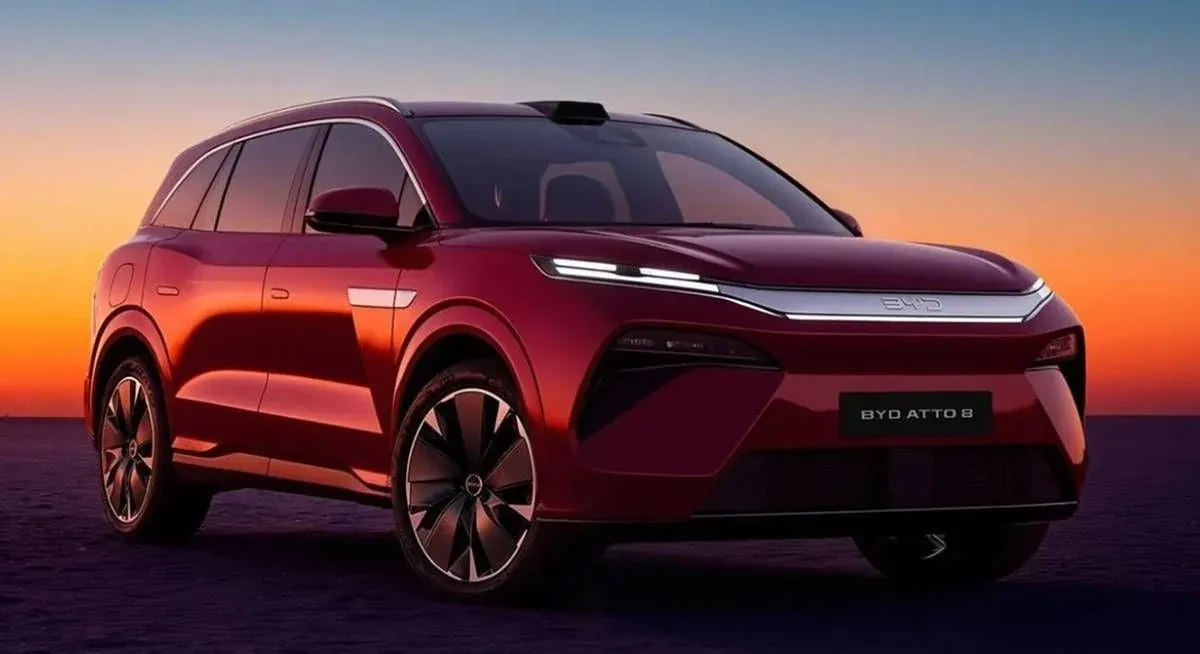
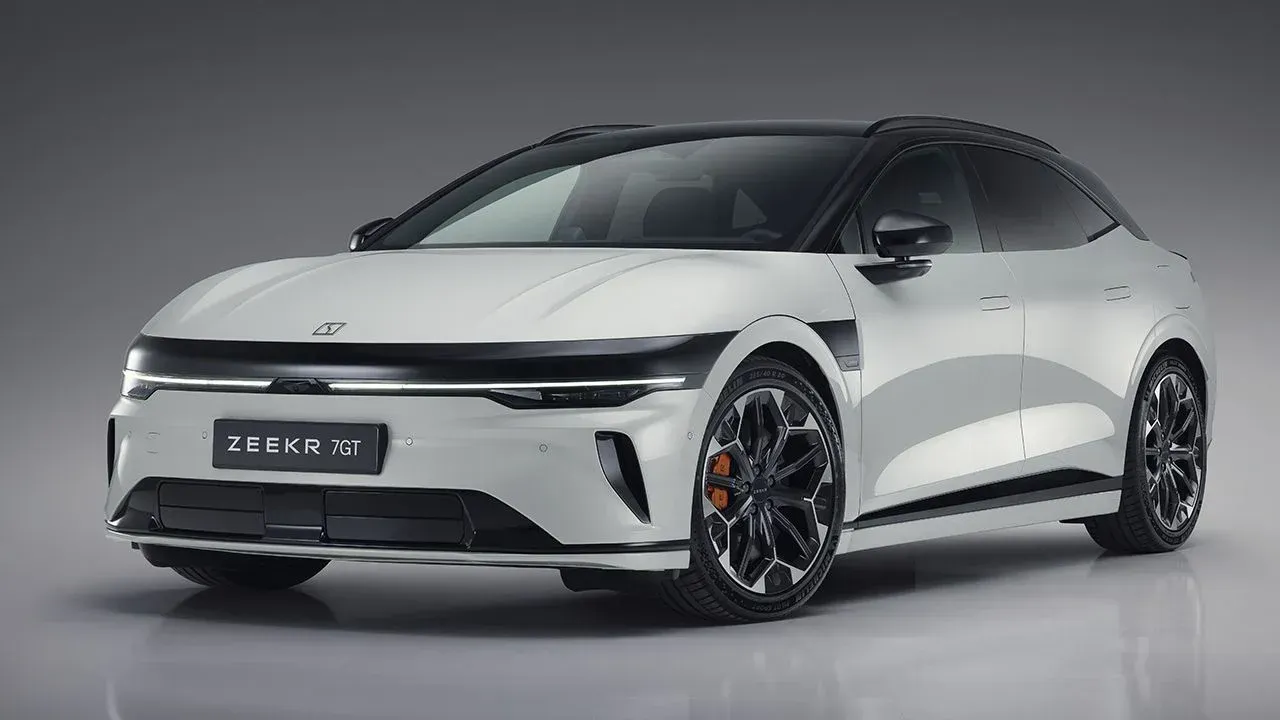
The lineup unveiled at the Paris Salon reflects that ambition. Chery, BYD, and Zeekr—whose parent company is Geely—presented new models to strengthen their presence. Among them is the BYD Dolphin G DM-i, a plug-in hybrid compact car developed specifically for Europe, demonstrating that the strategy also involves adapting products to local buyers.
Electric cars remain a key part of this expansion, especially amid high fuel prices. However, hybrids offer Chinese manufacturers another way to attract customers. The variety of propulsion systems allows them to reach both those who want to move away from internal combustion engines and those who still prefer gasoline engines.
Bruussels is trying to curb this trend. After imposing additional tariffs on electric cars manufactured in China, the European Union reached a preliminary agreement this month to limit imports of hybrids from that Asian country. According to Reuters, the deal covers 350,000 cars per year with a 6% annual increase, though its implementation details and timeline remain to be determined separately from the announcement of the agreement.
The prospect of new restrictions is already affecting the market. Bloomberg reports that shipments of hybrid vehicles have accelerated amid concerns these limits might take effect. For manufacturers, getting cars onto the market before changes in import rules can make a significant difference to their business plans.
Meanwhile, the European Union is considering offering support and other incentives to locally produced cars. Proposals include linking certain tax benefits for business vehicles to European manufacturing. This is a powerful tool in markets like Germany, where corporate and fleet purchases account for a large portion of sales.
But that policy also raises doubts within the industry itself. Mercedes has welcomed the political support, though it has warned that poorly designed requirements could disrupt supply chains and increase costs. The UK, Turkey, and Morocco supply cars and components to the European Union, so defining what counts as European production will have consequences beyond China.
Chinese manufacturers, meanwhile, are preparing their industrial response. Chery is advancing its production plans in Barcelona, BYD is finalizing its factory in Hungary, and according to Bloomberg, Leapmotor has already begun manufacturing the B10 at Stellantis’ plant in Zaragoza. Producing within Europe allows them to get closer to customers and reduce their exposure to certain trade barriers.
Overcoming Japanese brands does not guarantee that this advantage will be maintained every quarter, but it shows how far the change has progressed. Chinese brands are already competing for a significant share of the market and are backing up their sales with industrial investments. For their rivals, the challenge lies in responding to this competition as the newcomers continue to expand their product lines, dealership network, and production capacity.