
Batteries could last much longer thanks to this new additive for graphite.
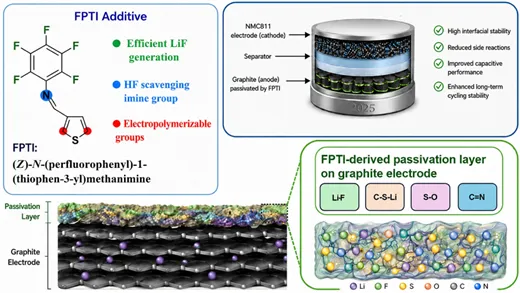
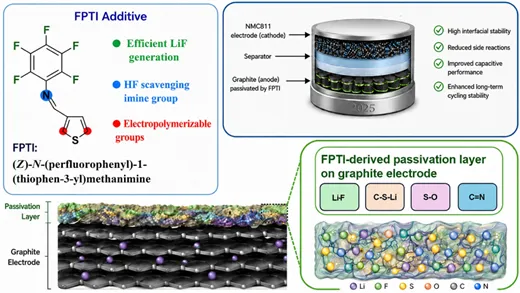
The team from the Japan Advanced Institute of Science and Technology (JAIST) has developed a compound called pentafluorophenylthiophene imine, or FPTI for short. Its role is to enhance the protective layer that forms on graphite during the initial charging cycles, which is crucial for controlling battery aging.
The most striking result appears after 1,000 cycles. Test cells treated with a concentration of 4 milligrams of FPTI per milliliter managed to retain 95.6% of their capacity, while cells without the additive only retained 62.7%. With a lower concentration of 2 milligrams per milliliter, the retained capacity was 89.4%.
The key lies in a part of the battery that is usually overlooked. During the first charges, a layer known as the solid electrolyte interphase, or SEI, forms on top of the graphite. This film allows lithium ions to move but also restricts certain chemical reactions that could accelerate cell degradation.
When this layer loses stability, internal resistance increases and some of the battery’s active lithium is consumed. The result is a gradual loss of capacity. What Japanese researchers have been seeking is to make this protection more stable from the start.
A additive that creates a more resilient protective layer
FPTI is designed to react during the early stages of operation before other components of the electrolyte. In this way, it helps create a more stable protective layer over the graphite. The team’s analysis also revealed a high presence of lithium fluoride in this layer, while other components from sulfur and the imine group of the compound also play a role in its formation.
The effect can be measured directly in the cell’s internal resistance. With the highest concentration of FPTI, the resistance of the protective layer dropped from 7.6 ohms in the reference cell to just 2.2 ohms. The resistance associated with charge transfer also decreased from 41.8 to 19.8 ohms, while lithium ion movement improved.
But it is in the long-term test that the most significant difference appears. After 1,000 cycles, the cell without FPTI retained 62.7% of its reference capacity, while those treated with 2 and 4 milligrams per milliliter retained 89.4% and 95.6%, respectively. Additionally, the cells without the additive began to show particularly significant capacity loss starting around 350 cycles.
The researchers then wanted to test whether the same principle could be applied to a full battery, using an NMC811 positive electrode and a graphite negative electrode. Here, a significant limitation emerged: directly adding FPTI to the electrolyte of the entire battery did not work well, as it increased resistance in the positive electrode and impaired performance.
The solution was to use the compound only to pre-treat the graphite electrode. First, an improved protective layer was formed on the graphite using FPTI, and then the complete battery was assembled using conventional electrolyte, without retaining the additive throughout the cell.
The results were also significant. The complete battery that used graphite treated with 4 milligrams per milliliter of FPTI achieved an energy density of approximately 233 Wh/kg, compared to around 192 Wh/kg with a treatment of 2 milligrams per milliliter and about 130 Wh/kg in the reference configuration.
The research shows that it is not always necessary to replace graphite with a completely new material to improve battery lifespan. In this case, the goal is to better control what happens on its surface and prevent secondary reactions from deteriorating the electrode with each cycle.
That said, there is still a long way to go before this can be applied to electric cars. The 95.6% result was achieved mainly in graphite-lithium test cells, while testing with a full battery was done through prior treatment of the negative electrode. The researchers themselves note that tests using larger cells under conditions closer to those in commercial use will be necessary.
The importance of this work lies more in the path it opens up than in any immediate application. If this strategy can be implemented on an industrial scale, it could help extend the lifespan of batteries using existing materials without requiring a complete change to their composition. This could be beneficial for both electric vehicles and other storage systems that need to withstand hundreds or thousands of cycles without losing too much capacity.