
Agriculture produces 47% of its own energy.
#
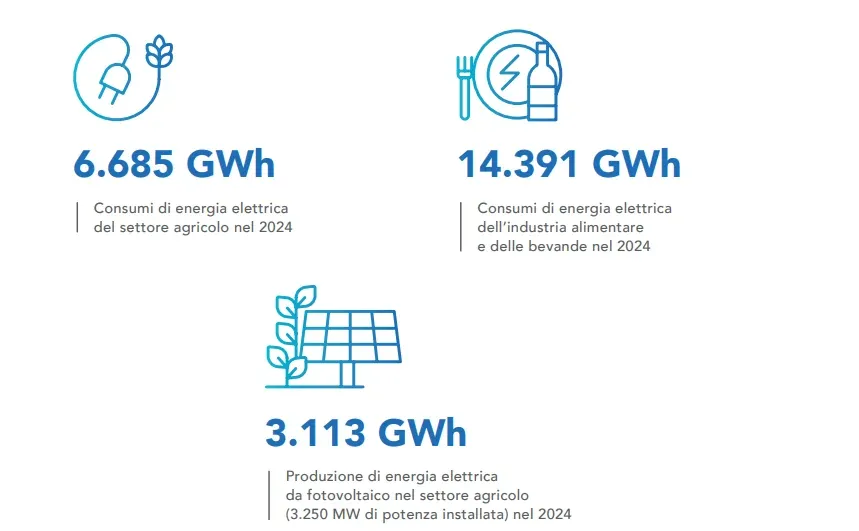
In just a few years, Italian agriculture has managed to meet nearly half of its electricity needs through photovoltaic systems. This is a significant achievement, obtained despite the ban on ground-mounted photovoltaics imposed by the Agriculture Law and despite often ideological resistance to agrivoltaics. If these barriers had not existed, the sector would not need to purchase energy today: it could produce enough on its own and might even sell substantial amounts of it. However, more work is needed in the agricultural food chain.
Consumption at 6 TWh, production at 3 TWh
The figures confirm a shift in direction. Italian agriculture consumes just over 6 TWh per year, but it already generates more than 3.1 TWh thanks to photovoltaic systems installed directly on farms. This covers 47% of its energy needs. It is a historic breakthrough, made possible also by Europe and the Pnrr funds through the Parco Agrisolare initiative, which introduced photovoltaics into production chains.
The data was released by Crea – Council for Research in Agriculture and Analysis of Agricultural Economics – and Rse – Research on the Energy System – during a conference. To complete the picture, consider the energy consumption of the agri-food and beverage industry: 14.3 TWh in 2024.
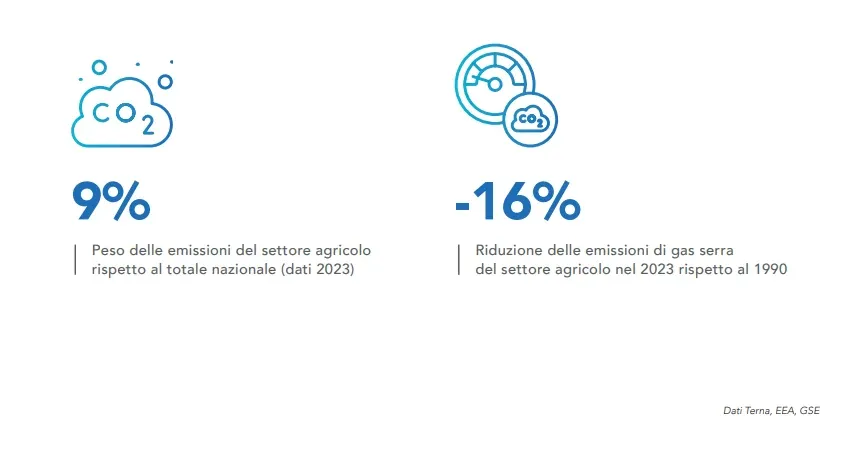
In terms of emissions, the agricultural sector accounts for about 9% of the national total (2023 data), while greenhouse gas reductions have reached –16% compared to 1990 levels. This is real progress, but still far from reaching potential. It’s a shame that regulatory and cultural barriers have hindered the adoption of renewables in farms.
Dependence on agricultural diesel
Low-cost energy has not driven true electrification of agricultural activities and logistics, leaving untapped potential that could transform the sector’s energy profile. Highly polluting agricultural machinery is still in use across rural areas, and subsidies for farm diesel do not help. The deadline for applying for the 20% discount on fuel purchases made between March and May 2026 expired yesterday, September 30. However, geopolitical tensions have pushed the price of farm diesel to around 1.70 euros per liter, far above the previous 70-80 cents per liter. It is no surprise that tractors are returning to the roads.
It’s also a shame that the Pnrr funds allocated for electric tractors have been opened up to other technologies, effectively undermining the European initiative. Compared to the automotive industry, this sector is still lagging technologically, but precisely because of this it needs clear direction and consistent decisions.
In the RSE manifesto: electrification of agricultural machinery
In the RSE manifesto, “Energy Transition and Agri-Food Sector,” in addition to outlining a path to meet agricultural needs, it emphasizes the necessity of deploying battery-powered vehicles for product delivery and other activities as well.
Here are the approaches to follow:
- solar and agrivoltaic systems integrated into agricultural land;
- biomass installations capable of utilizing agricultural waste and organic by-products;
These measures reduce emissions, but they also enhance businesses’ resilience to energy price volatility and optimize operating costs in the medium to long term.
"In processes that require significant thermal or mechanical energy, the potential of self-production from renewable sources combined with the electrification of consumption is particularly important," reads the RSE report.
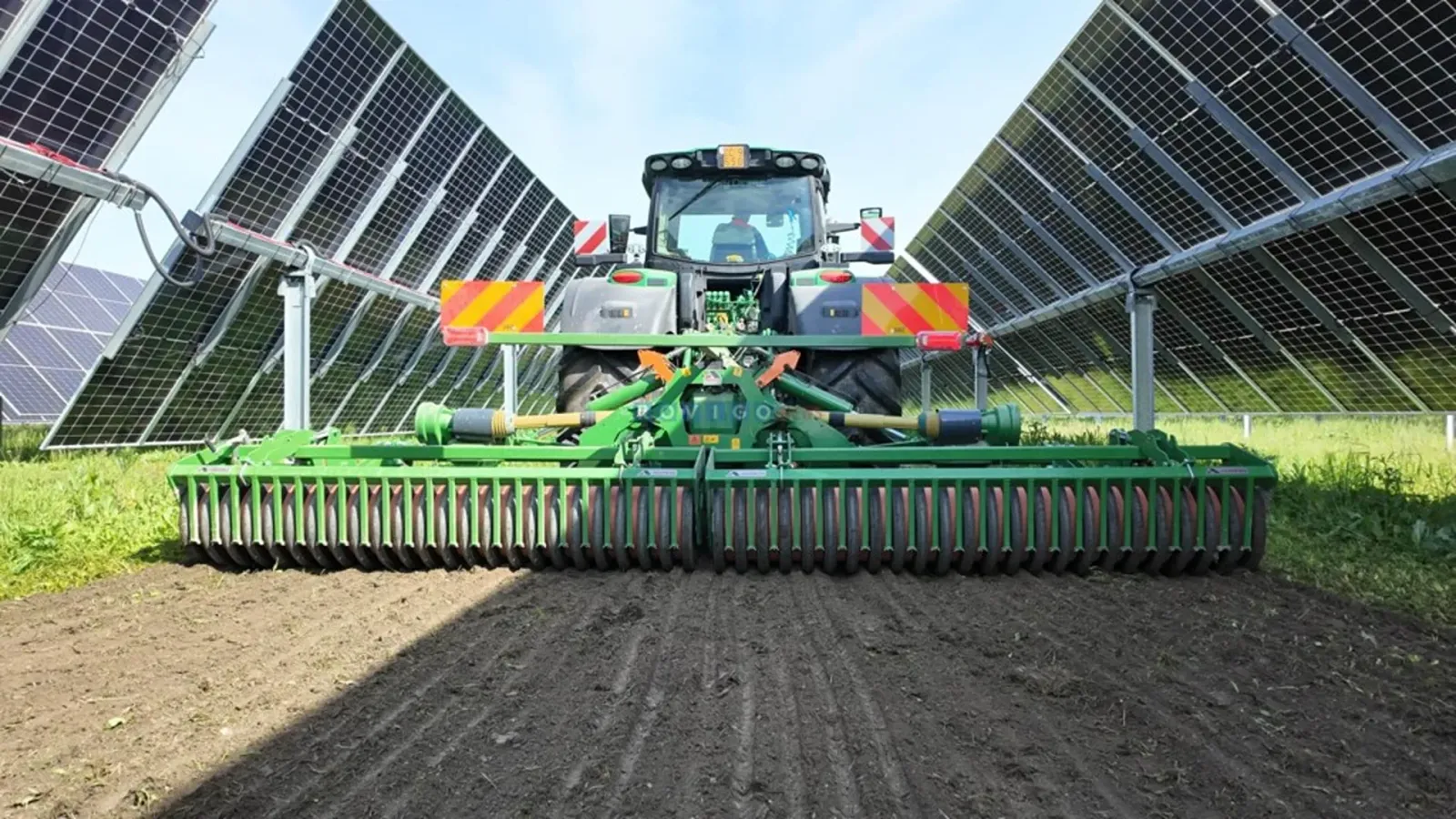
"The electrification of agricultural machinery and equipment, along with the introduction of energy storage systems, enables more efficient energy management and a gradual reduction in emissions. This integrated approach also provides greater operational flexibility and better control over a company’s energy needs." The Pnrr fund allocated to the agri-solar sector also covered batteries and charging infrastructure. It is reiterated that "the adoption of renewable energy sources and energy efficiency measures not only addresses environmental needs but also serves as a strategic element for the competitiveness of the sector." Especially in a world where countries like South Africa, at very low costs, are beginning to produce high-quality red oranges, and Tunisia is competing with us in artichokes. But the examples are endless."
The oil industry uses 90% of electricity in its supply chain
We return to the issue of competitiveness regarding energy costs. “According to Rse’s analysis of the production chains in the agri-food sector, energy costs represent one of the main factors affecting the final price of products in various agri-food industries, alongside labor costs. For many companies in the pasta, oil, milk, fruit, and wine sectors, the impact of energy expenses exceeds 10% of their revenue, directly affecting the competitiveness of these businesses and the prices of products sold to consumers.”
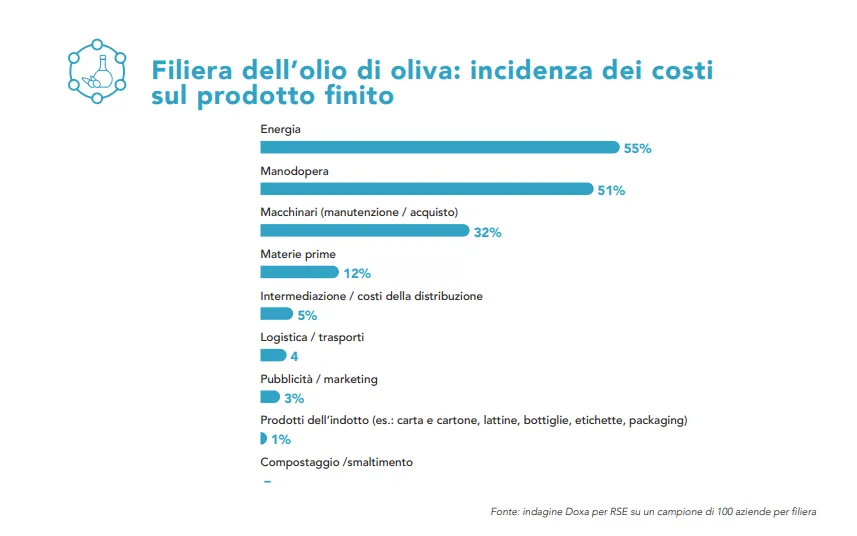
The chart above highlights the importance of energy in the olive oil industry, where renewable sources could not only make working conditions healthier for those currently exposed to exhaust fumes. Among the costs affecting the final product, energy accounts for the highest share at 55%.
From waste and residues: biogas
"Collaboration in research efforts between Rse and Crea is strategic given the role that agriculture, forestry, and all food industries play in harnessing energy from by-products of agroforestry systems and food waste," said Franco Cotana, CEO of Rse. "We’re thinking of biogas, whose potential could reach 10 billion cubic meters per year."
Setting aside the production of oils derived from oilseeds in marginal lands for biodiesel production, HVO, and SAF—which require specific further discussion—we look at biometane. We are within a circular economy that utilizes livestock waste, wastewater, manure, agricultural residues, agroindustrial byproducts, and the organic fraction of municipal solid waste. Through anaerobic digestion, biogas is produced, which is then converted into biometane that can be used to meet corporate needs, while the solid and liquid residues from digestion become fertilizer.
Companies too small to invest in the transition
There are various paths to energy transition, but it proves complex in a sector dominated by small businesses. “In Italy, 74% of agricultural companies have an economic size of less than 25,000 euros, while 84% of food and beverage companies employ fewer than nine people. These are often entities with limited resources to invest in innovation and need adequate financial, technical, and training support.” The challenge is not simple despite the good results in renewable energy production. “The energy transition for the food industry is not just an environmental challenge: it is a crucial factor for corporate competitiveness and supply chain resilience, especially in a period marked by rising costs and the effects of climate change,” said Andrea Rocchi, president of
the Creator.