
Solar charging: 29 cents/kWh on the A7 when it’s sunny
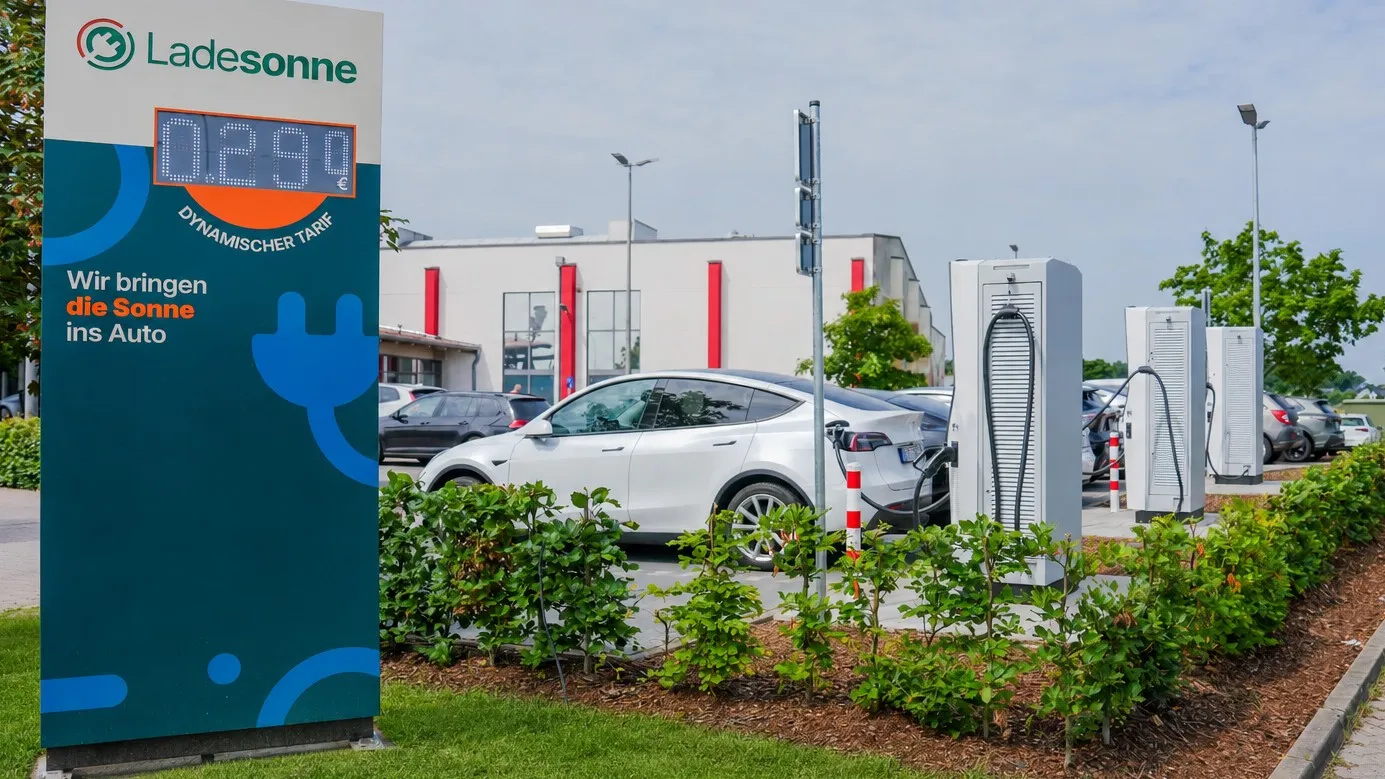
At the Autohof Schwarmstedt on the A7, charging using Ladesonne costs 29 cents per kWh as long as a nearby 4.6-MWp solar park supplies the electricity. When there is no sunlight, a dynamic spot market price applies, with a price board at the entrance showing the current rate.
Advertisement
The Bremen-based company Ladesonne operates a charging station at the Autohof Schwarmstedt in Buchholz (Aller) using a rate based on the output of a neighboring solar park. The location is situated directly on the A7 between Hannover and Hamburg. If the rooftop solar installation provides enough electricity, the cost per kilowatt hour is 29 cents. In the absence of solar power, the price follows the spot market rate.
The solar power plant has a capacity of 4.6 MWp and is located about 300 meters away from the charging park. The electricity generated there is not fed into the public grid but is sent directly to the charging stations. Both the power generation site and the charging park are situated behind the same grid connection point.
Three pricing tiers depending on the power source
The so-called Sun Shop tariff essentially has three states. If the solar park meets the demand, a fixed price of 29 cents per kWh applies. When no self-generated power is available, charging is done dynamically based on the spot market price. If electricity comes from both sources simultaneously, Ladesonne calculates a proportional mixed price. According to the operator, this makes the charging cost during the day significantly lower than what is typically charged at fast chargers on highways. The company does not provide specific prices for spot market or mixed mode operation.
Similar to a gas station, a price board at the entrance shows the currently valid charging price. This allows drivers to determine in advance whether solar power is available before turning in.
Advertisement
Over 70 percent solar contribution since April
The charging park has been in operation since April. According to Ladesonne, over 70 percent of the energy used at its own charging stations has come directly from the solar park since then. Even on cloudy days, solar power is generally available during the day. The company also notes that charging occurs at a particularly high rate at highway locations during sunny hours, ensuring good alignment between energy production and demand. The statement does not provide details on the number of charging stations and points, nor on the charging capacity at these locations.
Messkonzept und Abrechnung
The technical basis of this tariff is a measurement and billing system that complies with calibration laws. It assigns the charged electricity amounts every quarter hour either to the solar park or to grid supply. Based on this, each kilowatt-hour is assigned to its respective price. Customers are unaware of this process; they only see the displayed price.
Since the solar installation and charging points are connected at the same grid connection point, the electricity charged directly from solar panels can be counted as renewable energy in terms of THG quotas. According to the company, this results in significantly higher revenues compared to using grid electricity. The remaining demand is met by solar power supplied through a grid electricity supply contract. Excess solar energy is fed back into the grid and sold through a direct marketer.
Applicable to other locations
Ladesonne was founded in Bremen in 2021 and operates over 150 public charging stations according to its own claims. In addition to managing charging parks, the company also develops solar parks along German highway corridors. This combination allows it to address issues related to the shared grid connection point, measurement methods, and separate billing for solar power and grid electricity within a single company.
Schwarmstedt is intended to serve as a model for further projects. This includes both existing charging parks without their own power generation and new locations that are planned from the start in conjunction with a solar park. Ladesonne acts not only as a charging park operator but also as a pure developer and operator of solar parks, supplying power to other operators through long-term power purchase agreements (PPAs).
The company sees particular potential in charging electric trucks, whose energy demands are many times higher than those of electric cars. CEO Matthias Roidl announces that the service will now be rolled out, both through its own charging stations and as a solar partner for other operators. Ladesonne will handle the complexity of measurement concepts, calibration regulations, and billing.
Advertisement
