Electric cars will cost the state billions: should we bring back the toll sticker?
Electric cars do not consume fuel. This is good for the climate. It’s less so for public finances. Road taxes generate nearly 68 billion euros per year today, but this revenue stream will decline as vehicles become more electric. How can the French government make up for this loss? Here are some suggestions from the Institute for Mobility in Transition (IMT).
The transition to electric cars raises a question that is still discussed relatively little: what will happen to the billions of euros that drivers pay today for each liter of gasoline or diesel? The problem may seem distant. Yet, as vehicle fleets become more electric, this source of revenue is set to decrease.
The amounts involved are substantial. The Institute for Transitional Mobility (IMT) examined this issue in its 2026 Road Tax Barometer. Over 80 pages, the organization analyzes taxes related to roads and proposes 38 recommendations (just that). It includes a particularly significant proposal... to reintroduce, in a revised form, an annual tax on vehicle ownership. In other words, a distant relative of the old vehicle license fee.
Cars generate nearly 68 billion euros per year
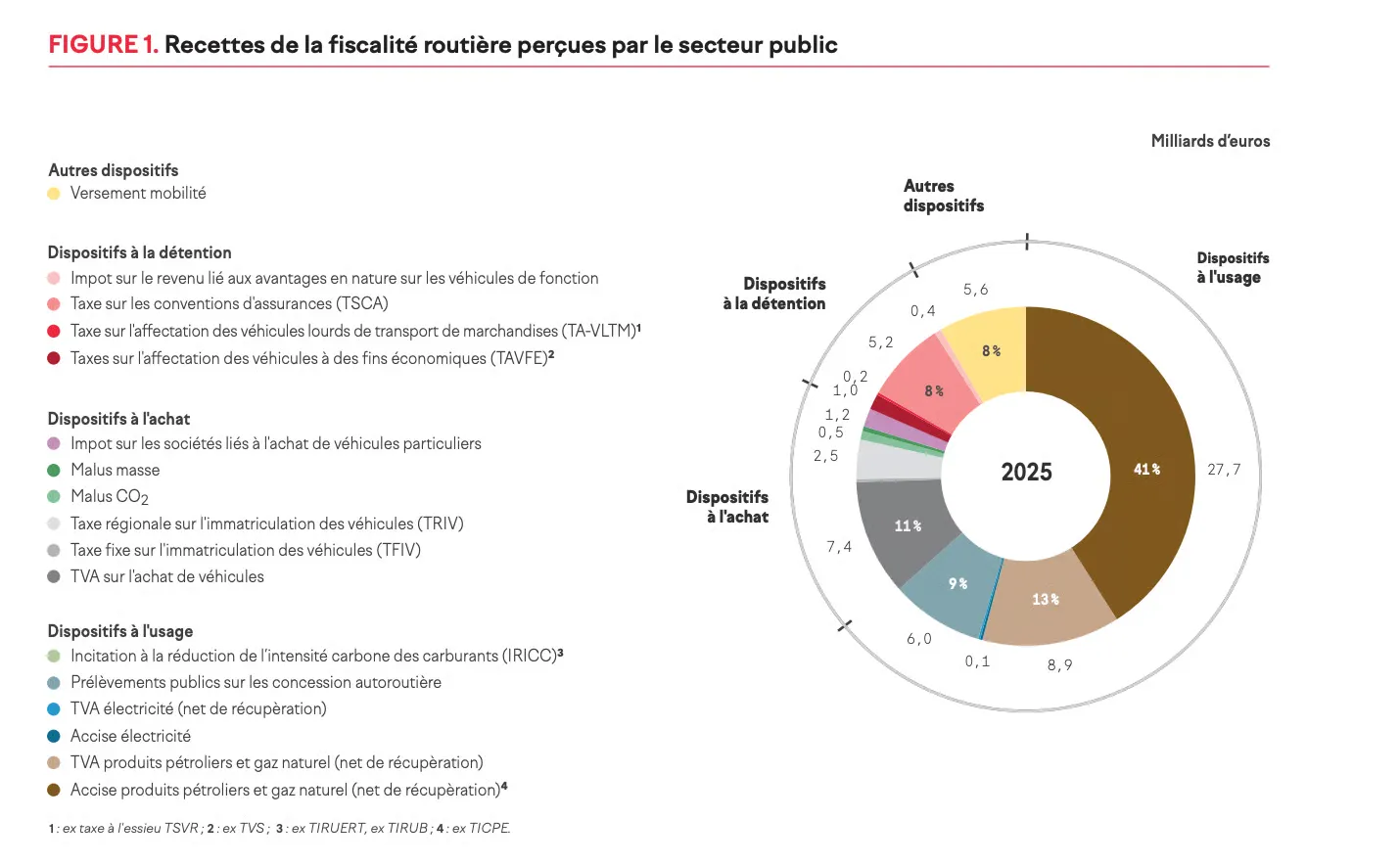
The first finding of the report is that vehicle taxation does not consist only of fuel taxes. There are VAT on vehicle purchases, insurance fees, registration costs, tolls, and corporate taxes... In 2025, the IMT generated 67.5 billion euros in revenues related to roads for the state, local authorities, and social security.
This is enormous. It accounts for 4.6% of total public sector revenues. The IMT even notes that this amount is comparable to the operating budget of the Ministry of Education. However, one source dominates by a large margin: namely, the excise tax on petroleum products and natural gas, which succeeded the TICPE. It alone accounts for 27.7 billion euros, or 41% of the total revenues analyzed.
An additional 8.9 billion in VAT must be added to fuels. Regardless of one’s views, gas stations are thus formidable tax collection machines. And that is precisely where the problem lies.
22 billion euros to be recovered by 2035?
An electric car consumes neither gasoline nor diesel. It is thus exempt from much of this usage-based taxation. The electricity used for charging is indeed taxed, but far less heavily than fossil fuels. With unchanged taxes, the IMT estimates that the share of road tax revenues in public revenue would drop from 4.6% in 2025 to 4.2% in 2030, and then only to 3.4% in 2035.
Also read
Batteries for electric cars: Europe may have only three years left to save its industry
To maintain a contribution equivalent to that of 2025, around 8 billion euros would be missing by 2030 and 22 billion euros by 2035. However, care must be taken not to blame electric cars alone for this issue. According to the institute’s calculations, electrification of the vehicle fleet accounts for about half of this decline. The other half stems from certain taxes not being adjusted for inflation and from the development of fuels with reduced taxation.
This nuance is important. The problem isn’t simply that “electric cars don’t pay the TICPE.” It’s the entire French road taxation model, built around fuel consumption, that is declining.
Why not tax charging more?
The most obvious solution would be to gradually shift taxes from gasoline and diesel to electricity. But this would create several problems. First, a general increase in taxes on electricity would affect households that use electric heating as well as businesses.
A specific tax on charging would require the ability to distinguish between the kilowatt-hours sent into a battery and those consumed by the rest of the home. More importantly, high taxes on charging would reduce one of the main economic advantages of electric vehicles: their lower operating costs compared to conventional models.
The state might thus subsidize the purchase of electric vehicles on one hand while discouraging their use on the other. IMT therefore rules out this solution, at least during the current transition phase.
What about a per-kilometer tax for electric cars?
This is another approach that is often discussed. The idea seems appealing on paper: the more a car is driven, the more its owner contributes. The United Kingdom is indeed moving toward imposing a per-kilometer tax on electric and plug-in hybrid cars. Yet IMT sees several drawbacks here as well. First, it would be necessary to accurately determine the mileage of vehicles. Such a tax would place a greater burden on those who drive a lot, even when they have no alternative options.
The issue is sensitive in rural and suburban areas. According to the report, households living in sparsely populated regions already pay an average of 26% more in road taxes compared to others, mainly because they drive more and often own multiple vehicles. The IMT therefore recommends not imposing further burdens on those who rely on their cars.
The return of a vignette, but not as before
What if we gradually shifted part of the taxation from usage to ownership? This is the key proposal by the Institute for Transitionary Mobility, which calls for introducing an “annual vehicle fee” starting in 2030. In essence, the principle resembles the old vehicle tax sticker. However, its operation would be much more complex. This time, all motorized vehicles would be covered, including 100% electric ones, with the fee amount potentially depending on numerous factors.
Factors such as engine power, weight, energy consumption, place of manufacture, and repairability could all play a role in determining the fee. But the calculation wouldn’t stop at just the car. Household income, place of residence, and the number of vehicles owned would also be taken into account. It’s a real puzzle.
From 30 to 910 euros per year depending on the situation
IMT even estimates what this tax could generate. For a private car owned by an individual, the average contribution would be around 140 euros per year by 2030, rising to 260 euros by 2035. This is not a pre-determined scale but rather order-of-magnitude figures corresponding to the desired revenue.
The variations would be significant. A very low-income household living in rural or suburban areas, with only a lightweight electric car assembled in Europe equipped with a European battery, might pay only 30 euros per year by 2030. For a household with an older, average-sized conventional car, those in the bottom 20% of income levels in rural or suburban areas would pay around 70 euros.
Also read
This small French town became the hub for fast charging this summer
At the other end of the spectrum, IMT envisions a household among the top 20% most affluent of the population, living in the city center, owning several vehicles, and using an especially heavy old internal combustion engine car. The cost could then reach 910 euros per year... With the return of the “toll sticker,” it would essentially serve as a new tool for redistribution and environmental incentives.
This reflection also hides a social issue. In 2025, a French household pays approximately 1,540 euros in road taxes per year under the IMT system, which is 940 euros per vehicle. Wealthier households pay more in absolute terms, especially because they own more vehicles and purchase more expensive models. However, the tax burden as a percentage of income reverses: road taxes account for 1.9% of the disposable income of the lowest half of households, compared to 1.3% for the highest half.
This is one of the reasons why the institute prefers a modifiable annual contribution over an increase in fuel taxes. At the gas pump, it’s impossible to tell whether a driver of an old diesel Clio travels 25,000 kilometers per year by choice or simply because they live 40 kilometers from their workplace. With a registration tax, lawmakers could theoretically include such factors in the calculations.
17 billion euros in savings by 2035?
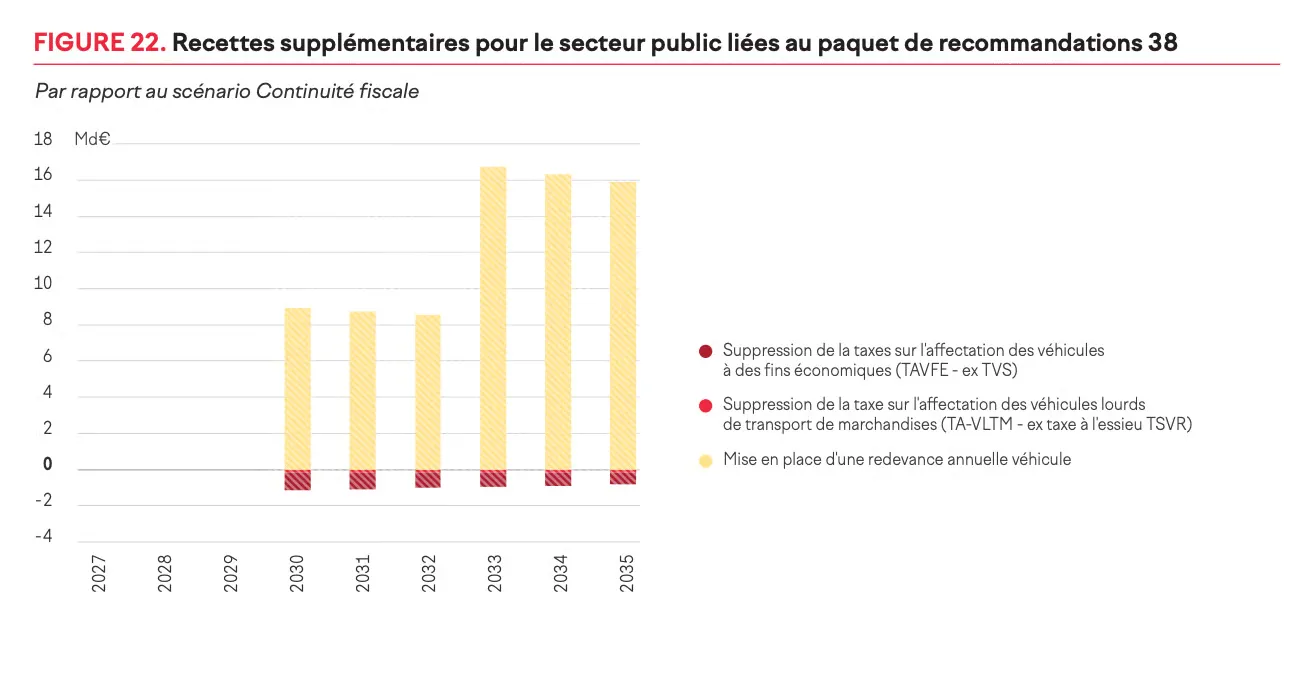
To meet the target set by IMT, the fee is expected to generate around 9 billion euros per year starting in 2030 and 17 billion by 2035. Part of this revenue would replace existing registration taxes, particularly for businesses. This is currently only a proposal, but the idea is gaining traction. The Council on Mandatory Levies, an organization affiliated with the Court of Auditors, has also examined the merits of an annual tax applied to the entire vehicle fleet.
Therefore, this issue is likely to reappear frequently in public debates. Behind the highly sensitive topic of a new tax lies a rather difficult problem to overcome: France has based part of its revenue on the consumption of a product, fossil fuel, whose use it is now actively seeking to reduce.
The real debate is probably no longer whether automobile taxation needs to evolve with electric cars. It must. What remains to be determined is who will pay, how much, and most importantly, based on what criteria.