
The revolution in electric car batteries: they recover up to 95% of their capacity through a simple process
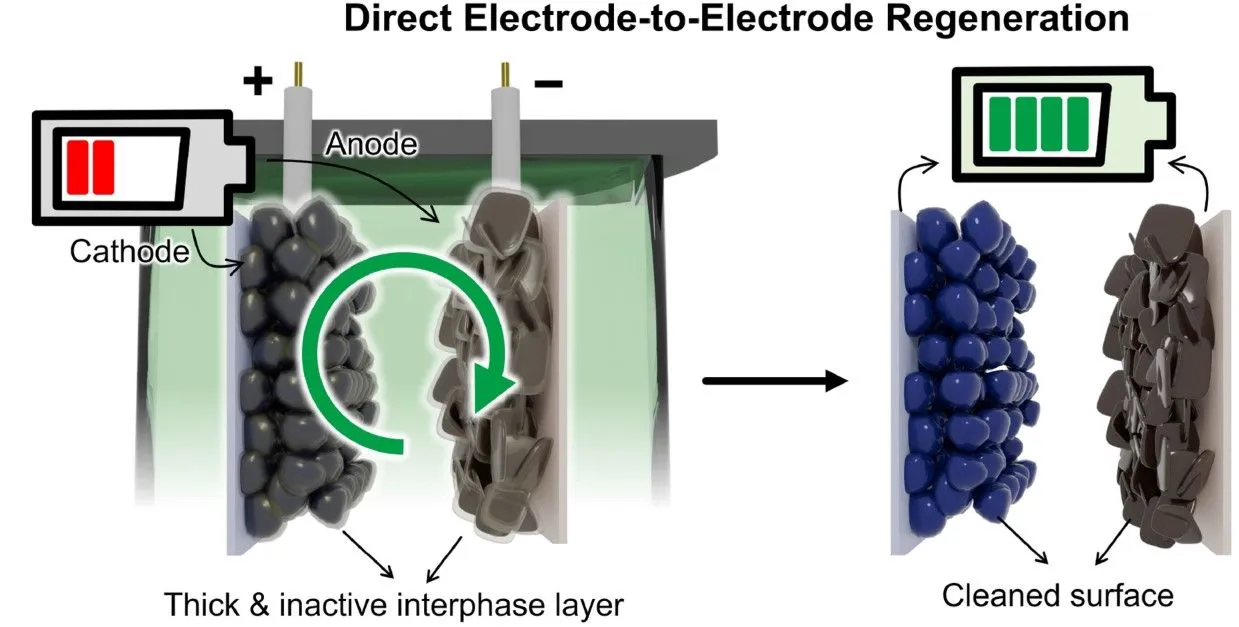
The key lies in one of the common mechanisms of lithium battery degradation. With each charge and discharge cycle, a layer known as SEI accumulates on the electrodes—a solid interface that performs a necessary function for battery operation—but it eventually grows too thick, hindering the movement of electrons. As this layer becomes thicker, resistance increases and the available capacity begins to decline.
Researchers at Cornell have developed a process called Direct Electrode-to-Electrode Regeneration (DEER) that targets exactly that layer. To do this, they remove the electrodes from used cells while keeping them intact and place them in an electrochemical bath containing 1,3-dimethyl-2-imidazolidinone, known as DMI. This compound allows for the dissolution of much of the accumulated interface without destroying the electrode structure.
After treatment, the electrodes can be reused to manufacture a new cell. This is a significant difference from conventional recycling, where batteries are crushed and turned into a mixture known as black mass. Materials such as lithium, nickel, cobalt, manganese, copper, or aluminum are recovered from this mass through high-temperature processes or chemical treatments, but the original electrodes cease to exist during this process.
The results obtained by Cornell are particularly interesting. Cells regenerated using DEER recovered up to 95% of their initial capacity, and they also showed slower degradation compared to the used batteries that did not receive the treatment. In the tests, the capacity loss decreased from 0.072% per cycle in degraded cells that were not regenerated to 0.042% per cycle after treatment. This reduced degradation persisted for about 800 cycles before the rate increased again.
The experiment also opens the door to allowing the same electrodes to have more than one lifespan. The researchers performed a second treatment on a battery that had already been regenerated and managed to recover around 90% of its original capacity. This doesn’t mean any battery can go through the process indefinitely, but it does show that regeneration could be repeated when the main issue is the accumulation of that layer on the electrodes.
And here we see one of the most interesting applications for electric cars. Cornell worked with batteries that were at 70% to 80% of their health level, a stage that may correspond to when a battery stops being suitable for certain requirements of a vehicle. However, just because a battery has lost capacity doesn’t necessarily mean its electrodes are damaged. If the degradation is mainly due to interface buildup, there may still be a significant portion of the material that can be recovered.
That doesn’t mean DEER will replace conventional recycling. This method has a fairly specific range of applications. If a battery has suffered lithium loss, cracked particles, structural damage, or mechanical problems, removing the surface layer won’t solve the issue. In such cases, processes capable of recovering materials from a damaged battery will still be necessary.
In addition, there is still a major obstacle to bringing this technology to mass-produced electric cars. Researchers found that inserting DMI directly into an intact cell did not yield good results. It is necessary to disassemble the battery, remove the electrodes, treat and clean them before reusing them. What works in the laboratory must be transformed into a safe, repeatable industrial process capable of handling large quantities of batteries.
The economic aspect is also noteworthy. The study estimates that producing recycled cells using DEER would cost around $15.25 per kilogram, compared to $26.31 using pyrometallurgy. Based on the exchange rate as of September 21, 2026, this translates to approximately 13.3 euros per kilogram versus 22.9 euros per kilogram. Cornell’s analysis further predicts a 56% reduction in the manufacturing cost of recycled cells compared to conventional methods.
But there is an important small detail. DMI accounts for about 63% of the process cost in the published estimate, and the calculation does not yet include its recovery for reuse. If the industry can recover and reuse this compound efficiently, the system’s economy could improve, although this will need to be proven outside the laboratory.
For now, the next step for Cornell’s team is to test DEER with larger batteries from real-world applications, as well as try to address other degradation mechanisms such as lithium loss. If they can overcome these challenges, this idea could change the way we understand battery recycling: there would be no need to wait until the end to recover their materials, because in certain cases it might be more worthwhile to repair what is still usable first.
Source | Pubs.rsc.org