
The ‘other contamination’ from wind turbines that isn’t inhaled, but which the EU considers a “priority issue”

Infrasound is defined as sound with very low frequencies (below 20 Hz), typically outside the range of human hearing, although it can manifest as perceptible pressure or vibration.
A recent scientific analysis by Uppsala University has revealed that large-scale wind turbines produce significantly higher levels of infrasound than previously thought, a finding that has sparked debate in the European Parliament regarding the need to revise community regulations on environmental noise.
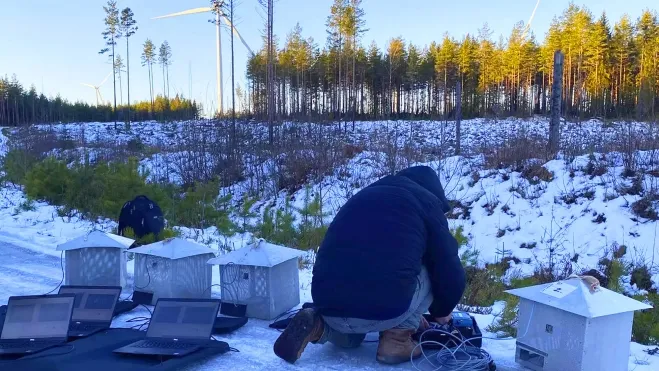
A Very Loud Investigation
A team of researchers from Uppsala University, led by Ken Mattsson and including Gustav Eriksson, Leif Persson, José Chilo, and Kourosh Tatar, has published a study based on advanced 3D models and real measurement data. Their findings show that the emission of infrasound and low frequencies from modern wind turbines has been “significantly underestimated” by traditional assessment methods.
The research, which validates new acoustic propagation models using data from wind farms, indicates that current turbines generate and transmit infrasound over greater distances than classical models suggest. This raises doubts about the accuracy of previous environmental studies and their ability to rigorously assess noise impacts on nearby communities.
In light of these scientific findings, French MEP Virginie Joron submitted a written question to the European Parliament on January 6th, addressed to the European Commission, asking whether there are plans to support research—even with public funding—to “examine the acoustic and infrasonic pollution associated with wind turbines.” Joron emphasized that the current directive 2002/49/EC on environmental noise assessment and management does not specifically address the latest scientific data on infrasound.
Jessika Roswall, Commissioner for the Environment, Water Resilience, and Circular Competitive Economy, in her written response not only acknowledges the validity of the Swedish study but also highlights the data gap resulting from infrasound being excluded from the standard noise metrics currently in use. Roswall states that wind turbines generate infrasound that may not be “fully addressed by standard noise metrics,” and she identifies this issue as a priority for the Commission.
The commissioner recalls that although existing legal frameworks do not explicitly cover these aspects, the EU has accepted recommendations from the European Court of Auditors to assess the feasibility of introducing noise limits, including for infrasound, into the Environmental Noise Directive (END).
The END requires that each wind project undergo an Environmental Impact Assessment that describes noise emissions and the measures planned to prevent or reduce adverse effects. However, the review proposed by Brussels would go beyond audible acoustic parameters to include low frequencies that have so far been excluded from community records.
This debate fits into a broader context of concern over noise pollution in Europe. According to data from the European Environment Agency, millions of citizens are exposed to noise levels that exceed the limits recommended by the WHO, with negative health effects such as sleep disturbances, stress, or cardiovascular problems.
Acoustics experts point out that the main technical challenge is to reliably incorporate the measurement and assessment of infrasound into existing standards. Current guidelines for environmental acoustic evaluation of projects were not designed with the specific characteristics of low-frequency sound in mind, and traditional methodologies may underestimate its actual range.
Critics of regulatory changes argue that the scientific evidence regarding direct adverse effects of infrasound on human health is inconclusive, and that many levels measured around wind farms are below thresholds for hearing or physical perception.
However, the European Commission and some member states believe that a preventive approach and an update of metrics are necessary to ensure that energy planning and environmental permits do not overlook potential impacts on local communities.

In his response, Roswall emphasizes that any regulatory changes must balance the need to promote renewable energies such as wind power, which are crucial for Europe’s climate goals, with the protection of public health and citizens’ well-being.
The parliamentary initiative and the Commission’s response have now initiated a debate process that could result in legislative proposals over the coming months. Environmental parties and civil society organizations have already expressed interest in setting specific limits for infrasound from industrial sources, which would require amending the current directive or introducing supplementary regulations at the community level.
With this move, Brussels implicitly acknowledges that acoustic assessment tools must evolve with scientific advancements, and that including infrasound in official metrics could have implications for both wind farm planning and future environmental guidelines.
