
The Moon is back in the energy race: a company is already testing how to extract one of its most promising resources.
05/09/2026 10:30
Updated to
05/09/2026 10:30
Recreating on Earth the conditions that a team will encounter on the Moon’s surface is one of the main obstacles to developing space mining technologies. Regolith simulators can replicate its composition or the size of its particles, but so far a fundamental ingredient has been missing: the gases that solar wind has been depositing on the lunar surface for thousands of years.
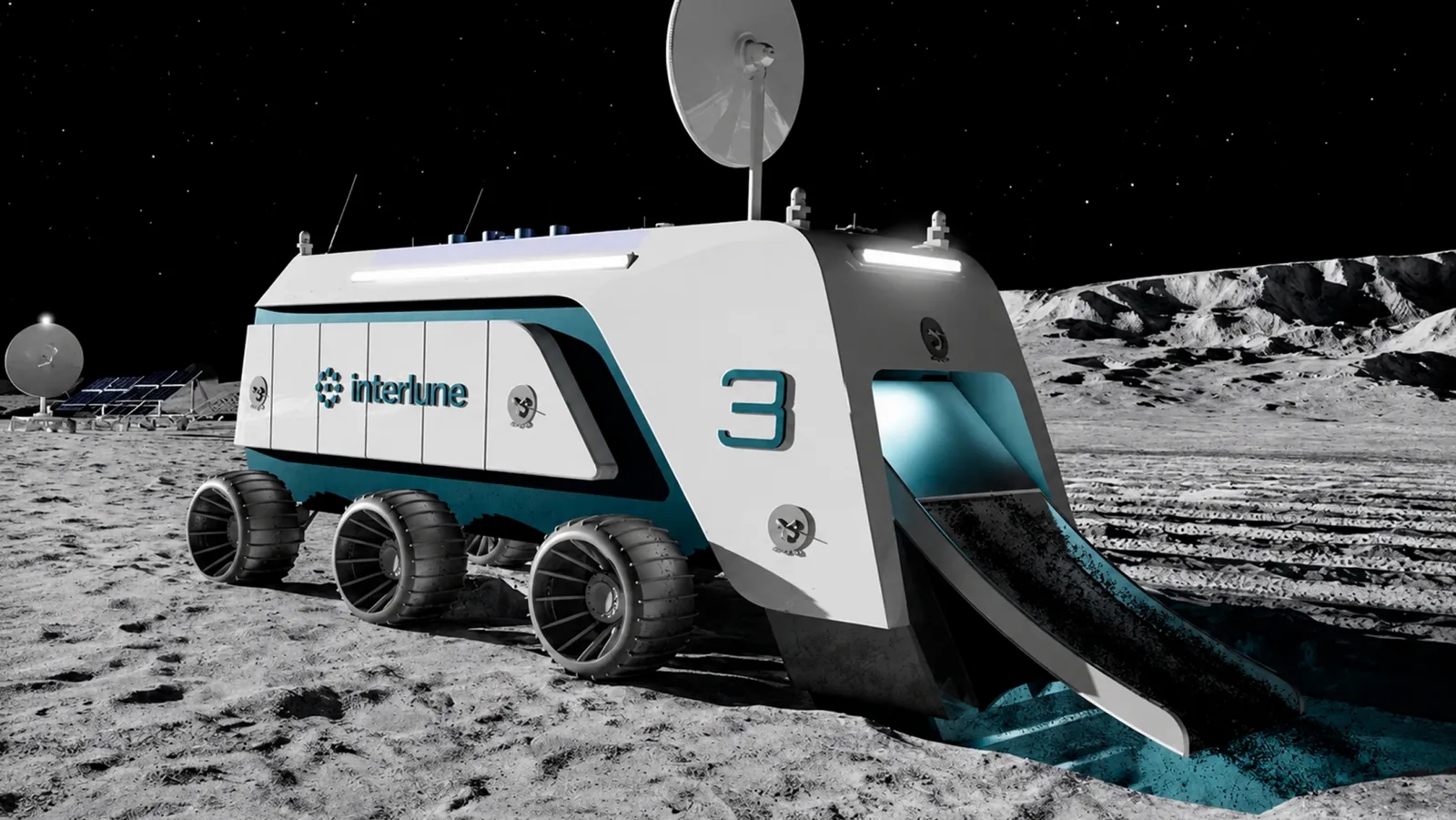
Interlune claims to have resolved part of this issue with a new process that enables the artificial introduction of helium into a material similar to lunar soil. This technique will allow for much more representative testing of the extraction system the company is developing to recover resources directly from the Moon’s surface, with the goal of using them as fuel to generate energy with fewer radioactive residues than other fusion reactions.
Four hours to simulate 15,000 years of events on the Moon
The experiment was conducted using ilmenite, a mineral found in lunar regolith that is particularly important because it can retain gases from the solar wind. Interlune placed the material in a vacuum chamber, generated plasma from helium, and then accelerated its ions against the particles to alter their structure in a manner similar to what occurs naturally on the Moon.
The main difference lies in speed. According to data published by the company, the laboratory was able to apply an ion dose equivalent to about 15,000 years of lunar exposure in roughly four hours. In terms of particle flux, the process was about 32 million times faster than the phenomenon caused by the solar wind.
After introducing helium, the researchers gradually heated the samples and analyzed the gases released using mass spectrometry. Helium began to leave ilmenite at temperatures around 300 to 800 °C, a range consistent with results obtained decades earlier from studying lunar samples collected during the Apollo missions.
The next step is to verify whether their mining system actually works.
The new material will be used to test Interlune’s so-called Harvesting System, a technology designed to separate gases trapped in large amounts of regolith. Unlike proposals that primarily involve heating lunar soil to temperatures near 1,000 °C, the company is developing a mechanical process that it claims can reduce energy consumption by up to ten times.
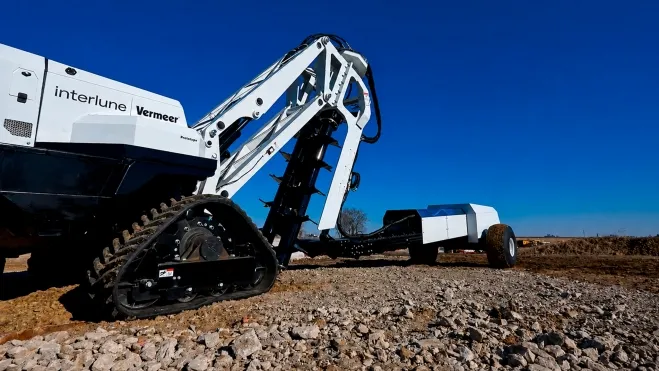
A key component of that system will be excavation. Interlune and the American manufacturer Vermeer have already demonstrated a full-scale prototype designed to process up to 100 metric tons of regolith per hour through continuous operation: collecting the soil, processing it, and depositing it back on the surface without stopping the process.
The company can currently produce this new helium-enriched simulator in quantities ranging from grams to kilograms, and it plans to offer both the material and testing services to companies, research institutions, and government agencies. The next goal will be to incorporate hydrogen as well and adjust the composition of the samples to replicate different regions of the lunar surface.
Helium-3 is the ultimate goal, and contracts have already been signed
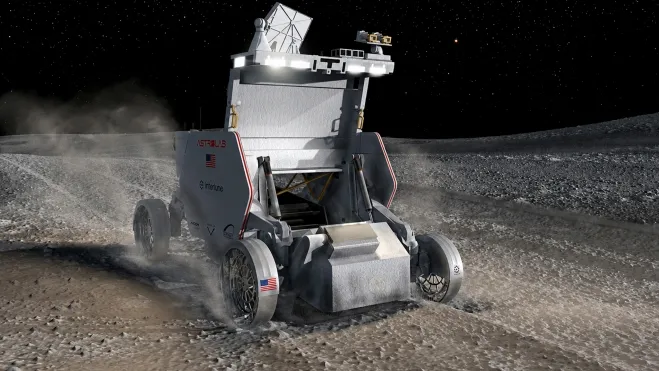
Although this initial demonstration was carried out using helium-4, Interlune’s commercial project focuses specifically on helium-3. This isotope is extremely rare on Earth and is used, among other applications, in cryogenic systems employed in quantum computing—one of the markets where the company hopes to find demand for material recovered from outside our planet.
Interlune claims to have secured nearly $500 million in binding agreements to supply helium-3 to public and private clients. These include Maybell Quantum and the U.S. Department of Energy’s isotope program, though the timelines indicate that the project is still in the development stage: the first deliveries are scheduled for 2029.