
The date of 2035 is becoming outdated: Germany already aims for 100% electricity much earlier.
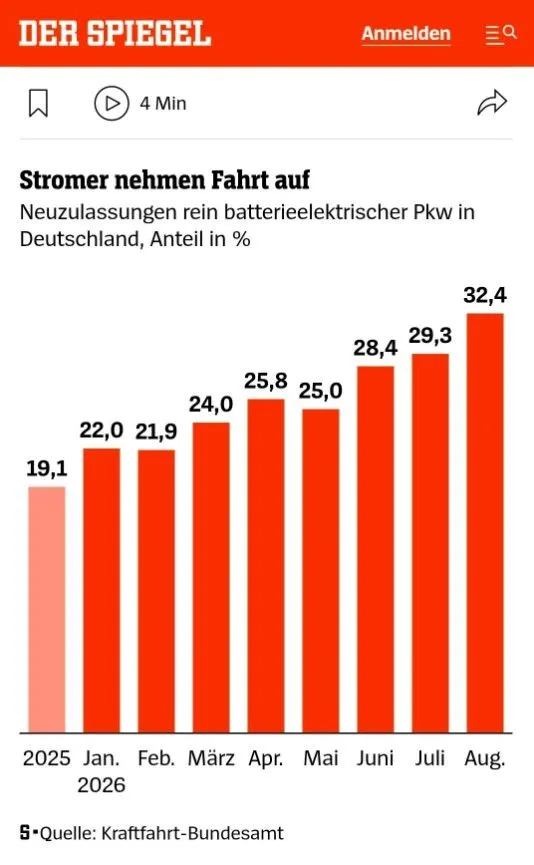
The German market is changing at a pace that would have been hard to imagine just a couple of years ago. The country, which for decades has relied on the automotive industry as one of its major economic drivers, is seeing electric cars gain ground month after month, while gasoline and diesel models are losing share in new registrations.
The data from the German market also show a fairly clear trend. The growth isn’t limited to any single month, and although there are fluctuations, the share of electric cars has been on the rise since late 2025. In fact, there was another significant jump in August, putting Germany in a very different position compared to just one year ago.
According to official data, in August 2026, electric cars accounted for 32.4% of all new passenger car registrations in Germany, with 68,930 units out of a total of 212,563 new cars. This represents almost one in every three cars sold. Additionally, the number of electric vehicles increased by 75.1% compared to August 2025, when 39,367 units were registered.
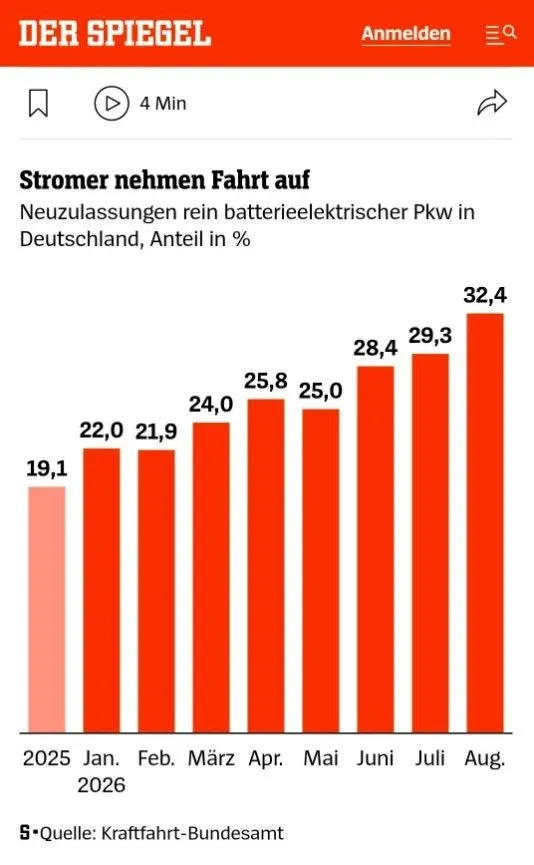
The monthly progression is even more striking. In January 2026, electric cars made up 22.0% of registrations, a figure that rose to 21.9% in February, 24.0% in March, 25.8% in April, 25.0% in May, 28.4% in June, and 29.3% in July. Finally, 32.4% was reached in August.
Comparing it to the previous year helps to better understand the change. In August 2025, electric vehicles accounted for around 19% of Germany’s market, compared to 32.4% currently. In just twelve months, they have gained more than 13 percentage points and, most importantly, grown at a much faster rate than the overall market. In the same month, gasoline vehicles held 16.7% and diesel vehicles 10.6%.
And here comes the most interesting part. If we make a very simple mathematical extrapolation using the relative growth in the share of electric vehicles recorded between August 2025 and August 2026, and assume—purely as an exercise—that the same rate continues, 100% of new registrations would be achieved in about 26 months. That is, around fall 2028.
Of course, that is assuming the brutal growth this year continues, which has been particularly high due to geopolitical tensions. But even if we are slightly less optimistic, with growth of “only” 15% per year, Germany would already account for 90% of electric car sales by 2023. And 15% per year isn’t that extreme, as there is an 17% year-on-year difference between 2025 and what we’ve seen so far in 2026, with the final quarter yet to come—usually the busiest period for vehicle registrations.
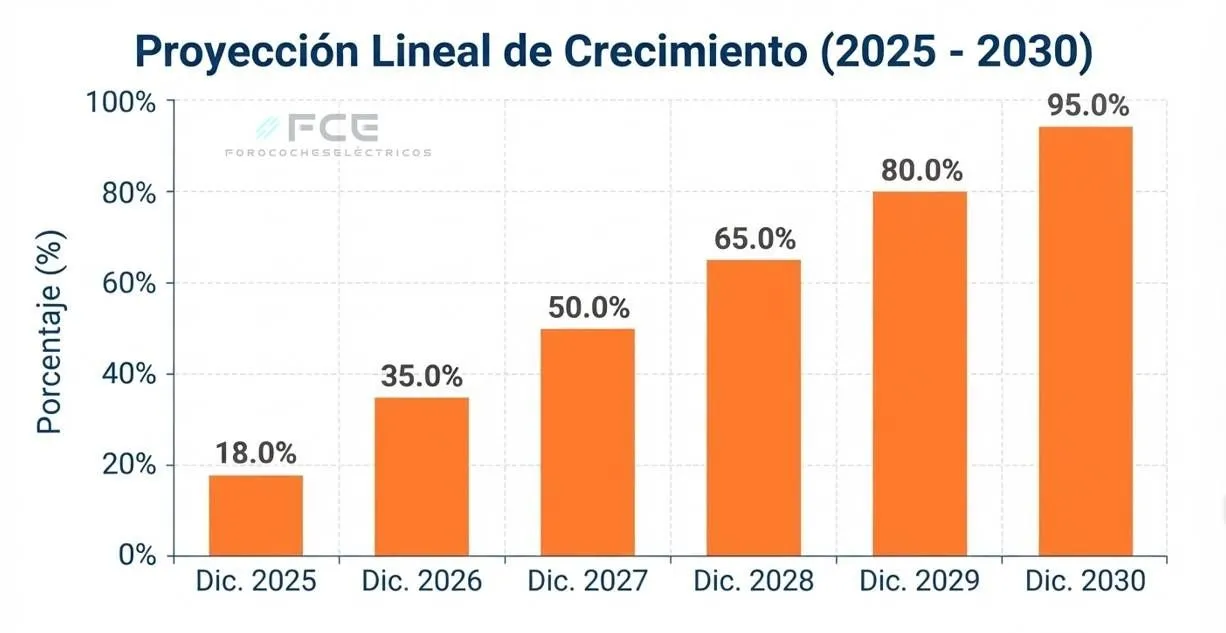
Obviously, this doesn’t mean we can guarantee that no internal combustion engines will be sold in October 2028. Such a progression can’t continue at the same pace indefinitely, as there are factors such as prices, available supply, government subsidies, or obstacles imposed by the state. But it helps put the speed of change into perspective.
In addition, this transformation is already reaching German factories directly. A particularly significant example is BMW. The company has just started mass production of the new BMW i3 from the Neue Klasse in Munich and confirmed that, starting in 2027, its historic production site will manufacture only electric models. The transformation of the facility was carried out while production continued, involving an investment of 650 million euros.
Volkswagen already produces more electric cars than gasoline-powered vehicles at its Wolfsburg plant, which is a symbolically significant milestone.
That doesn’t mean the entire German automotive industry will abandon internal combustion engines all at once. But it does show the direction production is moving, and at a faster pace than expected.
The question is whether German manufacturers can adapt to this new reality, or if the market will eventually become electrified without them, with Chinese firms and Tesla taking control.