
Solar power from space now has a date: this is how they plan to send electricity to Earth from satellites
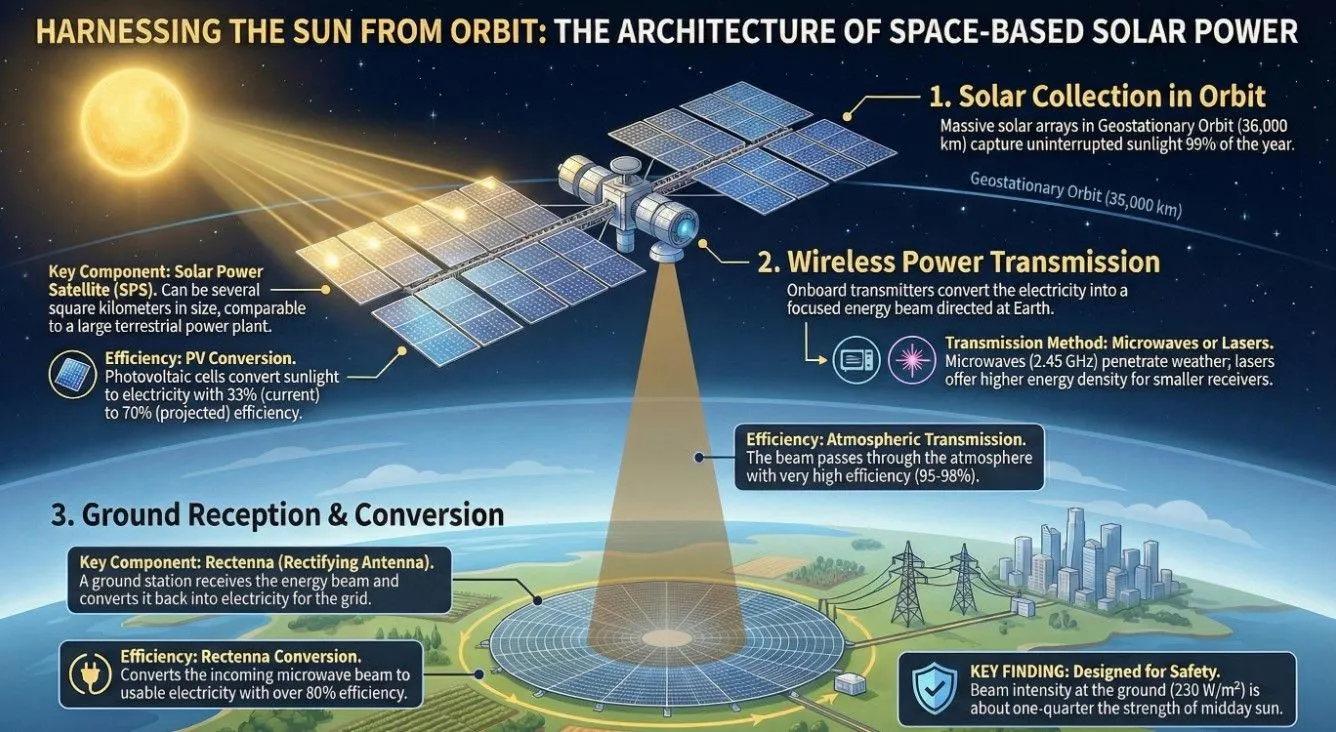
Spatial solar energy has long been in the realm of futuristic projects, but some initiatives are beginning to bring it closer to more practical applications. The idea is simple in theory: capture sunlight outside the atmosphere and then transmit that energy to facilities on Earth.
Now, an American company has received support from authorities to advance one of the key elements needed to make this concept a reality. The project aims to solve precisely one of the most significant problems: ensuring that energy sent from space reaches its intended destination accurately and safely.
The company aims to use satellites capable of capturing solar radiation almost continuously and converting it into an infrared light beam that can be directed toward receiving installations on the Earth’s surface. By being outside the atmosphere, the system could take advantage of much longer generation periods than those of a conventional solar installation.
A system to deliver energy where it’s needed
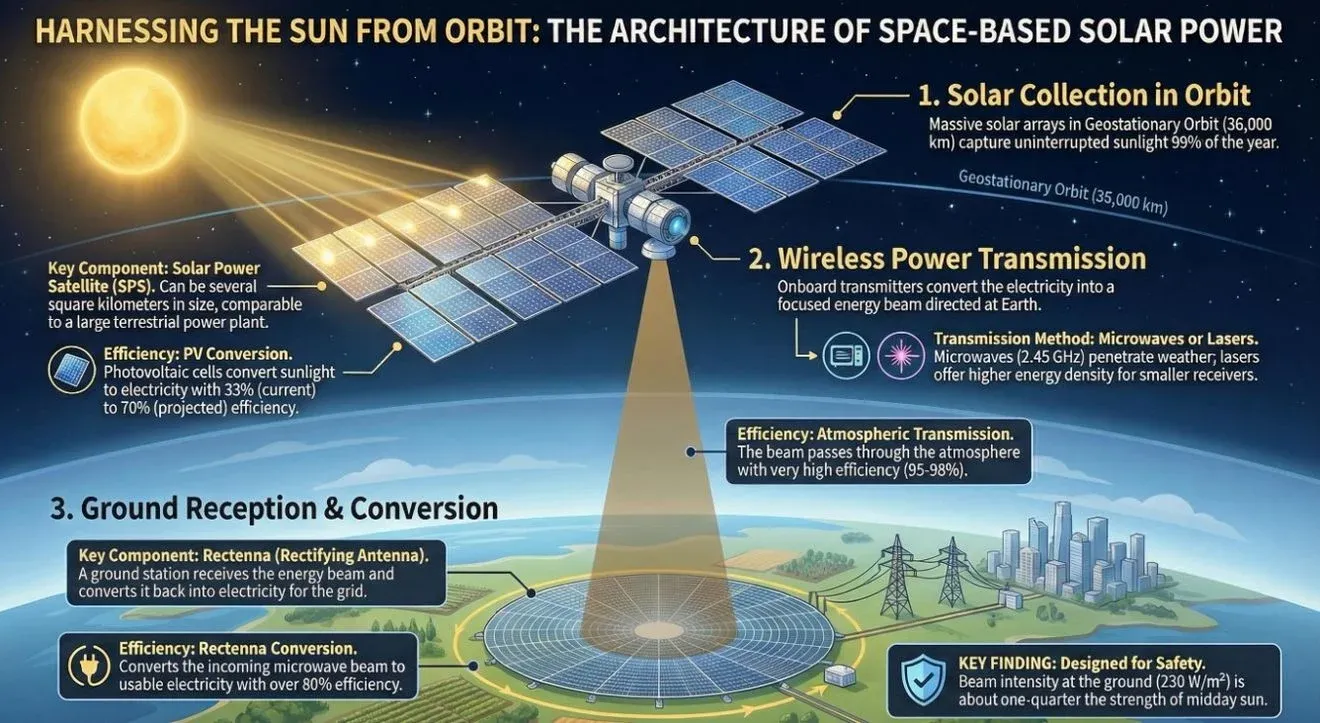
The core component of the new project is a small signaling and positioning system installed at the receiving facilities. Its purpose is to enable the satellite to identify the destination, verify that it is an authorized receiver, and establish a precise connection before starting to transmit energy.
This is particularly important because it’s not simply a matter of directing a beam at a fixed coordinate. The system must be able to confirm that it is sending energy to the correct location and prevent signals from being falsified or used to divert the transmission. The company ensures that transmission can only begin when there is an active and authenticated signal.
Although the project has a military aspect, its potential applications extend far beyond that. One of the main advantages of space-based solar energy would be the ability to supply electricity to remote locations where building conventional infrastructure is difficult, expensive, or simply impossible.
In an isolated installation, for example, having a power source from space could reduce the need to continuously transport fuel. This would allow for reducing some of the trips required to maintain conventional generators, while simultaneously providing a source of electricity that is not directly dependent on the solar conditions at that specific location on the surface.
This technology could also be useful for remote areas, critical infrastructure, or regions with underdeveloped electrical grids. In theory, a satellite constellation in geostationary orbit could receive sunlight for most of the time and direct energy to different locations on Earth as needed.
The company has already conducted preliminary tests of a key component of the system using a mobile aerial platform to demonstrate the beam tracking and steering capabilities. The next step will be to develop this technology into a system ready for operation from space.
The planned schedule includes integrating the signaling system into the company’s first demonstration satellite, whose launch is scheduled for 2028. After that, the company aims to begin deploying a constellation of satellites in geostationary orbit around 2030.
The ultimate goal is ambitious: to have an infrastructure capable of capturing solar energy in space and sending it wherever it is needed on Earth. There are still significant technical and economic challenges to overcome before it can become a large-scale source of electricity, but advances like this enable the transition from theory to tests that bring us closer and closer to real-world application.
The military sector is one of the first areas where its use is being explored in this case, but the most interesting aspect lies in the possibility of having a new way to deliver energy to places where bringing electricity is particularly difficult. If the systems for capturing, transmitting, and receiving energy achieve the necessary efficiency and reliability, space-based solar power could end up having much broader applications than initially envisioned.
Source | Prnewswire
