
KIRA’s successor, KIRA+, relies on autonomous shuttles from Holon
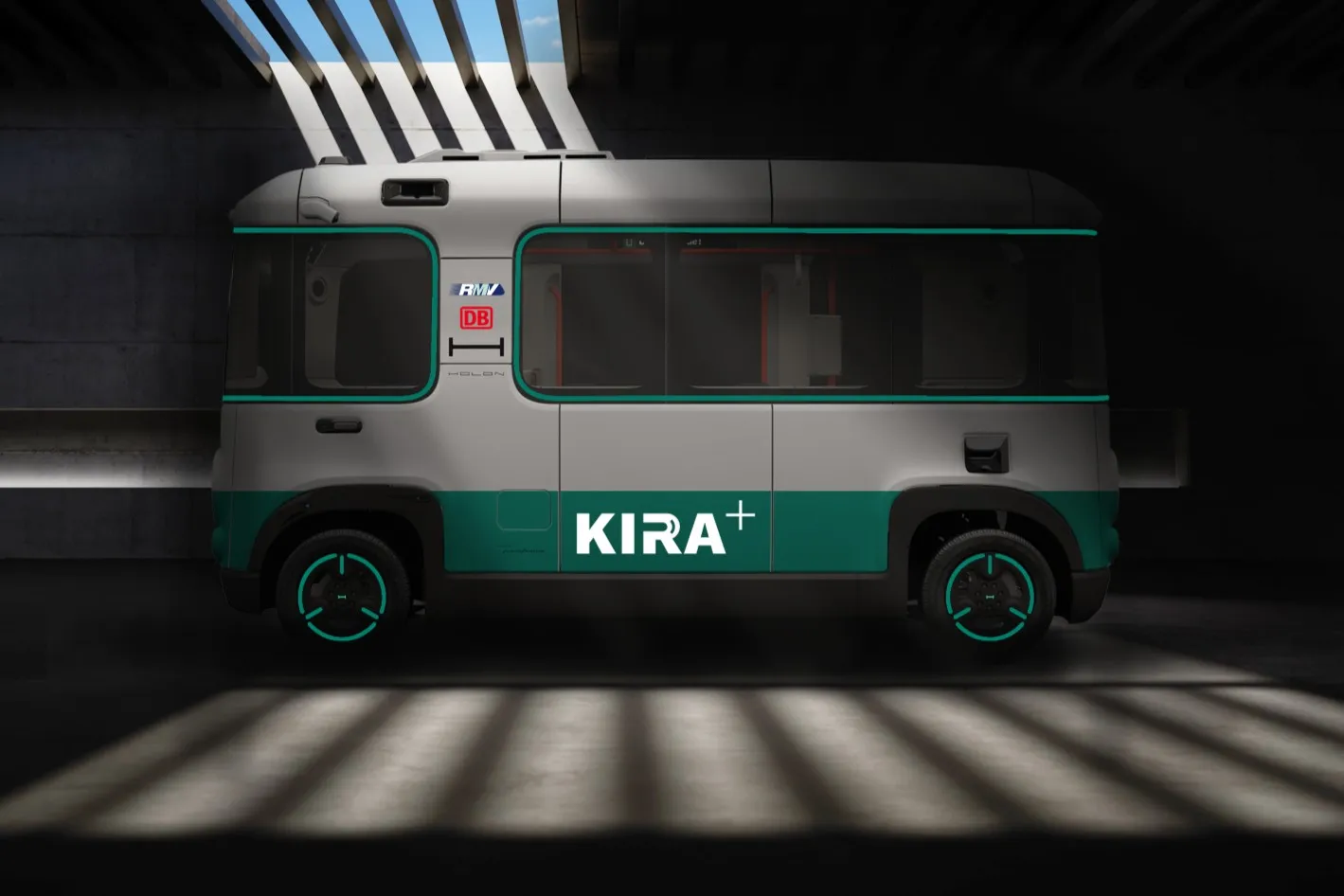
The Hessian robotaxi project KIRA will have a successor: With KIRA+, Deutsche Bahn, RMV, and manufacturer Holon plan to soon test autonomous e-shuttles on public roads. The goal is to implement on-demand transportation using barrier-free vehicles.
Holon Urban is planned to be used in KIRA+
Image: Holon
Since May 2025, robot taxis have been operating on German roads for the first time as part of the KIRA project. The vehicles used are Nio’s ES8 electric SUVs, equipped with additional Lidar sensors, cameras, and Mobileye software. Test users could initially book these robot taxis in the town of Langen and the municipality of Egelsbach in the Offenbach district through the special KIRA app. Later, parts of Darmstadt were also added as operating areas. Although the robot taxis drive autonomously in principle, a safety driver is always on board during testing. Additionally, the vehicles’ driving maneuvers are monitored by technical supervisors in a control center.
The funding provided by the Federal Ministry of Transport and the state of Hessen, amounting to around 2.2 million euros, will expire at the end of 2026. However, the project partners Rhein-Main-Verkehrsverbund (RMV) and Deutsche Bahn (DB) have now announced a new project to test and establish autonomous driving in public transportation, and have already launched it: KIRA+.
Prof. Knut Ringat, head of RMV’s management board, says: “With KIRA+ we build on the experience gained so far with autonomous driving and test the advanced technology in vehicles designed for use in public transportation. This brings us a significant step closer to the model region we aim to establish within RMV. The goal is to integrate autonomous services into regular public transportation in the near future. Unmanned transport offers a great opportunity to provide an attractive and financially viable public transportation service everywhere and at all times, with appropriate political support.”
KIRA+ aims to integrate autonomous vehicles into public transportation
Harmen van Zijderveld, CEO of DB Regio, added: “Autonomous driving offers the opportunity for a faster, cheaper, and more digital mobility service. But to ensure we don’t end up with just more cars on the roads, we need to integrate autonomous vehicles wisely into public transportation. That’s exactly what we’re testing with KIRA+. It meets all the requirements that a modern, autonomous public transit system must have — from being usable for customers with mobility limitations to reliable technical oversight at control centers under real-world conditions.”
In KIRA+, however, the Nio electric SUV will no longer be used; instead, the barrier-free electric shuttle Holon Urban from Paderborn-based Benteler’s subsidiary Holon will be employed. Like the Nio vehicles, it is equipped with autonomous driving technology from Mobileye. The Holon Urban is a familiar sight, as it was already one of the two vehicle models used in the ALIKE project in Hamburg. Designed from the ground up for Level 4 autonomous operation and developed for public transportation, it offers five passenger seats plus one wheelchair space during testing. If the wheelchair space is used, three passenger seats are available.
Third Holon test site after Hamburg and Paderborn
Holon CEO Sven Herzig says, “KIRA+ is an important step for us in Germany: Following Hamburg and Paderborn, the Holon Urban will now operate on public roads in a third German region. What matters most to us is the direction we’re heading. Here, RMV and DB Regio, two of Germany’s major public transport operators, are working together on a model region where autonomous vehicles will become part of the regular service in large numbers. This scale is the benchmark by which autonomous mobility must be measured. To achieve this, we need vehicles designed for continuous operation, and that’s exactly what the Holon Urban is built for.”
The planned operation area builds upon the previous project KIRA. This allows existing capabilities for autonomous operation, such as the control center, to be continued to be utilized. Experience from KIRA and other previous autonomous driving projects is also incorporated into booking processes, operational procedures, and vehicle equipment. On this basis, KIRA+ aims to gain further insights for the future use of autonomous vehicles in regular public transportation, including aspects related to technical oversight. The first test drives to map out the areas will take place in parts of Darmstadt and the Offenbach district throughout 2027. There is no yet set start date for public testing.
KIRA+ is one of five test sites in the MILA.mobility project, which is funded by the Federal Ministry for Research, Technology and Space (BMFTR) and focuses on “middleware integration of control and dispatch systems for autonomous mobility.”
A separate project aims to speed up approvals
Before KIRA+ was launched, DB Regio, RMV, Holon, Mobileye, along with other partners such as the Munich Transport and Tariff Association (MVV) and the Federal Motor Transport Authority (KBA), initiated efforts to simplify and shorten the approval process for autonomous shuttles. The consortium is working together to develop frameworks that allow for quick and efficient issuance of operational permits once the first vehicles hit the market.
The goal is to create the conditions necessary to obtain an operational permit for autonomous vehicles within about three months. This will help keep the “time to market” for driverless services in public transportation low. The results of this project are intended to directly inform future approval processes in Hesse and Bavaria, paving the way for comfortable and reliable shuttle services.