
Kia to build EV3 in Mexico from August
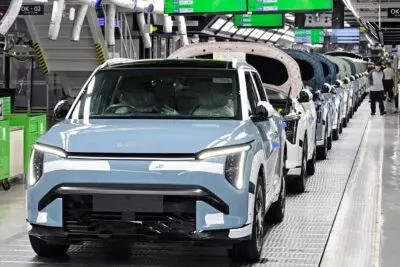
Kia will also produce the EV3 in Mexico in the future. Starting August 4, the compact electric car will roll off the production line at the Pesquería plant in the state of Nuevo León. Kia also plans to sell the EV there and is therefore investing locally in charging infrastructure and renewable energies.
The start of EV3 production in Mexico marks a milestone for Kia. The company announced the investment package on Wednesday at the National Palace during President Claudia Sheinbaum’s daily press conference, attended by Economy Minister Marcelo Ebrard and Kia México’s leadership team. Until now, the EV3 had been built exclusively in South Korea. Mexico now becomes the model’s second production location.
Kia is not building a new factory for the EV3. Instead, the company is adapting its existing production line, allowing the model to be built at the current facility. Kia México President Horacio Chávez said this approach avoids the need for a new plant. For an automotive group navigating tariffs, ongoing negotiations over the North American trade agreement and fluctuating demand, integrating a battery-electric model into an existing production line is also the more capital-efficient option. Kia expects to create 500 additional jobs this year and a further 1,500 by 2030.
Kia describes the move as a first for the company. According to Horacio Chávez, it will mark the first time Kia both manufactures and sells a battery-electric vehicle in Mexico. However, the claim requires context. Ford has been producing the electric Mustang Mach-E at its Cuautitlán plant for several years. Kia’s distinction is that it plans to sell a locally built electric vehicle in significant volumes on the Mexican market. President Claudia Sheinbaum said a substantial share of production will remain in Mexico to support the government’s efforts to accelerate electric vehicle adoption, while the remaining vehicles will be exported from the Pesquería plant to other regional markets.
EV3 production in Mexico reaches 27% local content
According to Economy Minister Marcelo Ebrard, the EV3 will launch with a local content share of 27 per cent, with that figure expected to increase over the course of the investment. High-value components, particularly the battery, will initially continue to be imported from Asia. Mexico will therefore carry out vehicle assembly, but not yet large-scale production of key components. Increasing the domestic value added is a central objective of the government’s industrial strategy, known as Plan México.
The 27 per cent local content also has political significance. During negotiations to revise the North American trade agreement, the US proposed in May that at least 50 per cent of the value of vehicles produced in North America should originate in the United States. If adopted, the proposal would fundamentally change the current rules of origin, which count value added across the entire region and therefore treat production in Mexico and Canada on an equal footing.
Ebrard argued that Mexico is pursuing the opposite strategy in response to growing protectionism from its largest trading partner. Rather than shifting production abroad, the government wants to attract advanced technologies such as battery manufacturing and electric vehicle production to strengthen domestic industry and reduce imports. Against that backdrop, while manufacturers including Toyota and General Motors are relocating production capacity to the United States, Kia is expanding its manufacturing footprint in Mexico.
Charging network, solar power, and a drought-stricken state
The investment package also includes the development of an EV ecosystem that Kia says it will build alongside local vehicle production. This includes home and public charging solutions along urban routes and motorways, dedicated support services for EV drivers and mobile charging units to assist stranded vehicles. As charging infrastructure in Mexico remains limited, Kia is pairing the launch of its first locally produced electric vehicle with the rollout of charging services intended to support its adoption.
The investment package also includes measures to reduce the plant’s environmental footprint. Kia will build a solar park with an initial capacity of 2 MW on the factory site, with plans to expand it to 8 MW by 2030. According to the company, this would generate enough electricity to cover the annual consumption of more than 4,000 Mexican households. In addition, a second wastewater treatment plant will process around 1,050 cubic metres of industrial water per day, allowing approximately 70 per cent of the water used at the site to be recycled. The investment is particularly significant in Nuevo León, a region that has experienced repeated droughts in recent years.
From EV9 rumours to the EV3
The announcement follows plans first revealed more than three years ago. In May 2023, electrive reported that Kia intended to expand its Nuevo León plant for electric vehicle production, based on statements by the state government and a social media post from Governor Samuel García rather than an announcement from the company itself. At the time, images released by the governor showed the larger EV9 rather than the EV3. García initially referred to an investment of up to one billion dollars before later deleting that figure from his post. While the plant was already described as a future electromobility hub, no production timeline was announced.
Three years later, the project has taken shape. Instead of the EV9 shown in 2023, Kia has selected the smaller EV3 for local production, while the investment announced is also below the initially reported figure. Unlike the earlier plans, however, the project now has a defined production schedule. The Pesquería plant, which began operations in May 2016 with an annual capacity of 400,000 vehicles, currently builds internal combustion models including the Forte and Rio.
The timeline also illustrates how long large-scale automotive projects can take to materialise. In the same spring of 2023, Tesla announced plans for Gigafactory Mexico near Monterrey, also in Nuevo León. More than three years later, no series-production vehicle has yet been built at the site.
For Mexico, Kia’s investment comes at a strategically important time. As trade tensions reshape global supply chains, the country continues to attract manufacturing investment. According to the Ministry of Economy, 1,186 investment projects with a combined value of 404 billion US dollars are currently at various stages of planning. More than 2,000 South Korean companies already operate in Mexico, while Mexico and South Korea agreed earlier this year to deepen their economic cooperation. Kia’s decision to expand local EV production therefore aligns with the Mexican government’s strategy to strengthen domestic manufacturing despite an increasingly protectionist trade environment.
The technical specifications of the EV3 in Mexico remain unclear. In Europe, the compact model is available with a 58.3- or 81.4-kWh battery, offering a range of up to 600 kilometres under WLTP, a 150-kW front-wheel drive, and a 400-volt onboard system. Kia has not yet disclosed which variants will roll off the production line in Pesquería.
mexicobusiness.news, news.sbs.co.kr, reuters.com