
Kia EV2 Earth: A Fuel-Efficient Space Wonder in Testing
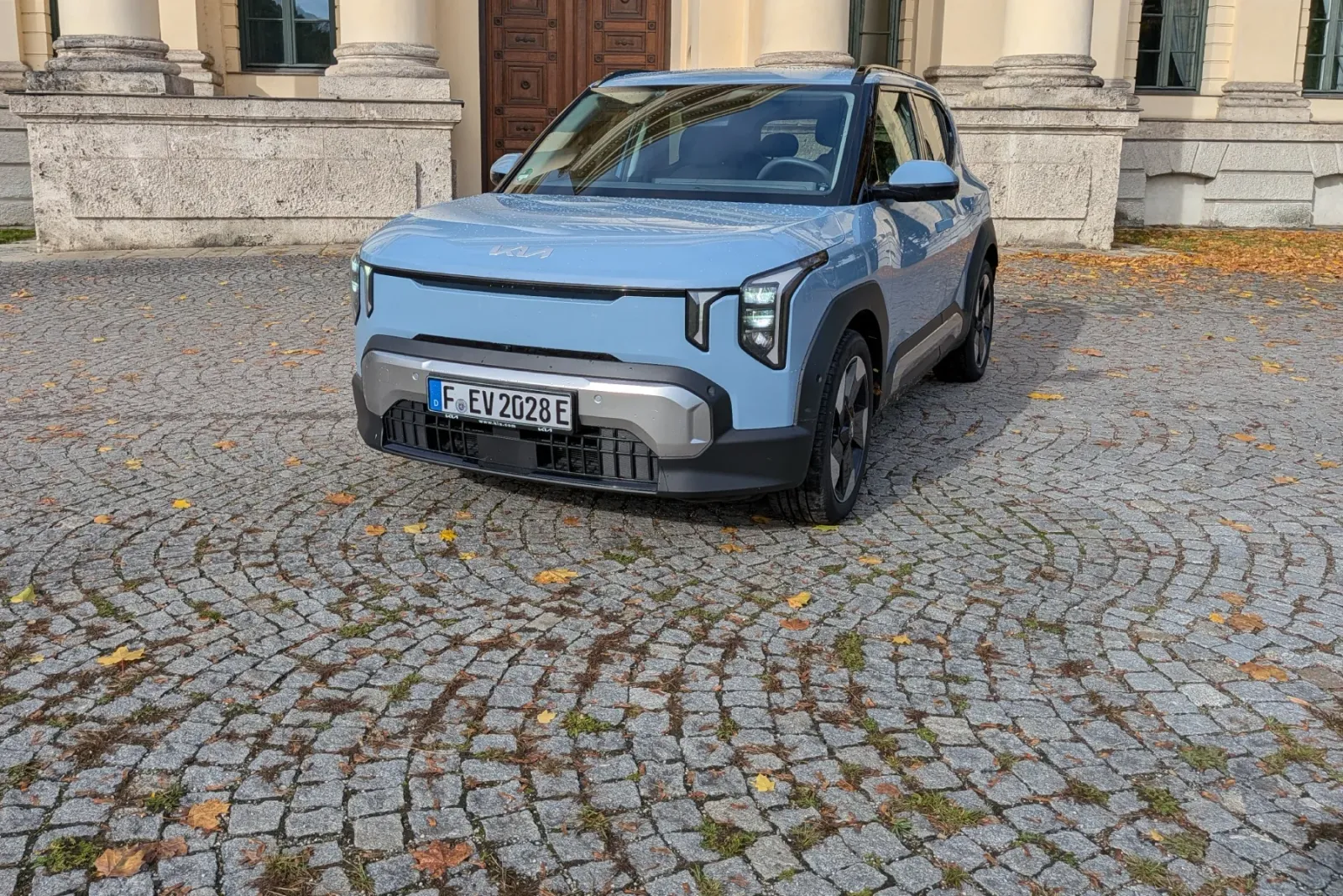
Electric mobility for the general public remains the cornerstone of the automotive industry. While other manufacturers often promise affordable and practical electric vehicles only for the future, Kia is already taking the next step in electrifying its fleet with the EV2. Our test reveals what this small Korean vehicle offers that other compact electric cars lack.
Visually, the EV2 offers no surprises, fitting predictably among its larger siblings from EV3 to EV9. Its sharp lines give the EV2 a rather boxy appearance, almost like a rolling moving box. For a vehicle of its size, it stands out unusually prominently, appearing much larger than it actually is. The front and rear bumpers, along with the fenders that stand out in matte silver from the rest of the vehicle, are particularly distinctive. The wheel arches also appear robust. Yet the EV2 isn’t overly aggressive; it’s simply a cute compact vehicle, though it’s easier to take it seriously than other models in this size category.
Proven Kia Interior
The typical Kia design language continues inside the vehicle. The steering wheel, cockpit, and dashboard are all familiar from other models. This is meant as a positive point, as the display setup and steering wheel are also used in high-end luxury models like the EV6 and EV9. Kia’s adherence to this design philosophy is appreciated, especially because the EV2 stands out so much: many Chinese vehicles in this segment look similar across brands, but Kia distinguishes itself. The use of plenty of hard plastic is forgivable at this price point, thanks to the flawless construction.
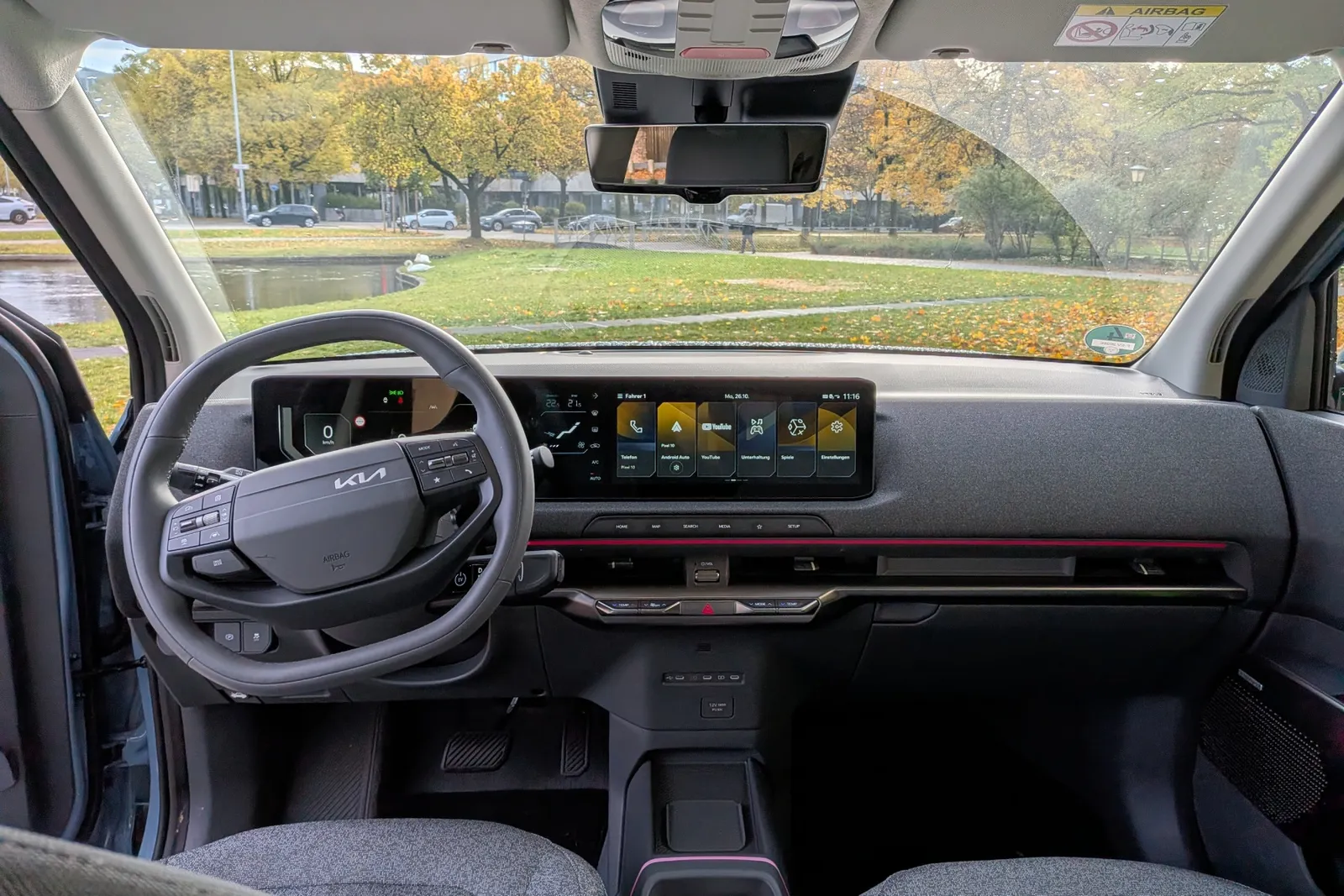
Photo by Robin Engelhardt
- 1/2
- 2/2
Many aspects of the user interface are cleverly designed, and the number of buttons is reasonably chosen. The cockpit doesn’t appear cluttered, yet there’s a physical button for the most important functions. Kia handles the shortcut bar below the screen and the climate control better than the typical touch-only solutions found in other vehicles.
Overall, the software feels a bit outdated and complicated. Some settings take an unnecessarily long time to find, and voice control isn’t helpful in this regard. Spotify is missing (but Amazon Music is available), and the navigation system falls short when it comes to filters and options.
However, since the standard wireless Android Auto and Apple Carplay are now available here as well, this criticism loses some weight—especially when considering the price. The customization options are also commendable: users can assign custom functions to various buttons, thus avoiding lengthy menu navigation.
With five USB-C ports, an inductive charging pad, and two 12-volt outlets, no one will run out of power even when the vehicle is fully occupied. Additionally, Vehicle-to-Load is naturally included.
How much space is allowed?
The individually adjustable rear seats are simple yet brilliant. Depending on the setting, they turn the EV2 into three different vehicles: with the rear seat pushed forward and the backs upright, it becomes a 2+2 seater with a huge trunk space. Children still have plenty of room in the back, but adults don’t—at least not comfortably. On the other hand, it can hold a lot of luggage, a stroller is no problem, and six drink crates fit easily as well.
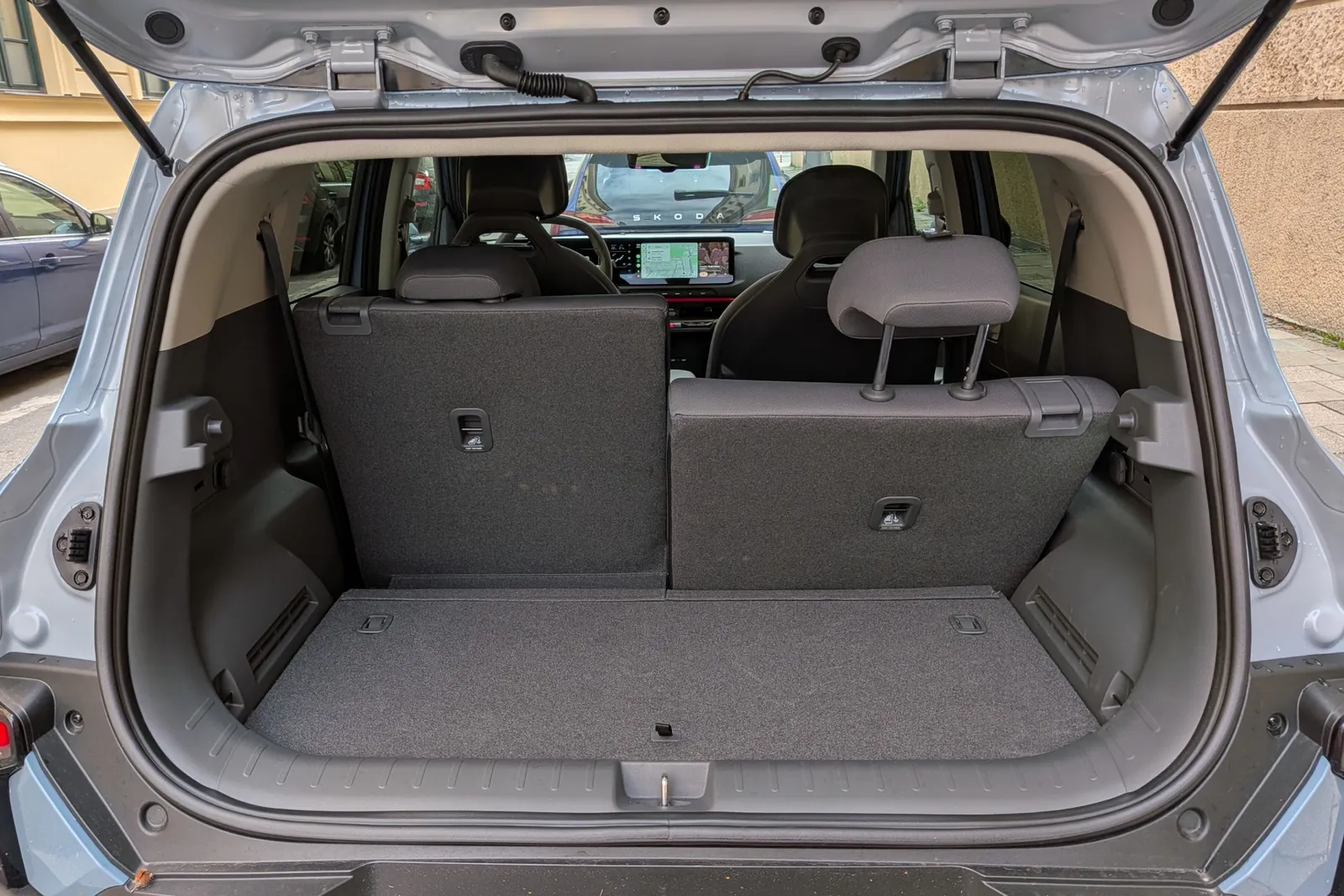
Photo by Robin Engelhardt
- 1/2
- 2/2
When the seats are fully reclined and the backs are tilted, a comfortable relaxing seating position is created with ample head and leg space, making it almost seem like a chauffeur-driven limousine. This luxury comes at the cost of a reduced trunk space, as it’s not possible to carry much luggage this way.
Thirdly, there are various intermediate settings available. Thanks to the different adjustment and folding options, countless combinations can be created.
There are two ISOFIX points, three handholds (one for each seat except the driver’s), and even a mini-frunk — but nothing larger than the charging cable fits in there. In terms of volume, with the seats folded down, the EV2’s trunk can hold up to 403 liters, and with them folded forward, it can hold up to 1,200 liters. Kia charges an extra 450 euros for the smart rear seat; standard is a non-removable, 60:40 foldable five-seater bench.
Impressive driving performance and assistance systems
For a vehicle of this class and size, the EV2’s driving performance is exceptionally reliable. It strikes a perfect balance between comfort and road feedback, with the steering and pedals responding in harmony. There is a wide range of options for regenerative braking: in addition to four levels (zero to three), there’s also the i-Pedal (which enables braking to a stop in one-pedal drive mode) and an automatic mode that uses radar to adjust braking based on distance from the vehicle ahead. The steering assist and adaptive cruise control operate at a level on this small Kia that would have been considered “luxury-class” just a few years ago. It maintains its lane and distance well, and automatic lane changes generally work flawlessly. On longer drives, the assistants are a real relief, and thanks to the capacitive steering wheel, there’s no more constant shaking of it—just a light touch is enough for the car to know the driver is still focused. Additionally, there’s a 360-degree camera, and the rearview camera can also be used while driving. This is particularly useful when the trunk is loaded to the top, blocking the view in the conventional rearview mirror. The downside remains the emergency lane assist, which the Korean manufacturer stubbornly refuses to include.
Charging and Fuel Consumption: Solid for this Class
The boxy shape makes us pessimistic about fuel consumption, as the EV2 isn’t particularly aerodynamic. Yet, the actual fuel consumption surprises us positively. Despite a high proportion of highway driving, a brisk driving style, and autumn temperatures, the overall consumption after over 1,000 kilometers of testing was 19.6 kWh/100 km.
If one limits speed to at most 120 km/h, the consumption drops to 17.5 kWh/100 km. Kia does not officially disclose the battery’s net capacity, but based on a gross capacity of 61 kWh, this theoretically yields a range of 350 km. In reality, we managed well over 300 kilometers without issue. In urban areas, it can also be driven easily with a consumption of 11.2 kWh/100 km, and even when pushing the top speed of 170 km/h (according to the speedometer), the consumption remains just under 30 kWh/100 km.
The charging performance is also perfectly fine. The peak power of 112 kW isn’t extremely high, but the average charging power of nearly 90 kW during the 10 to 80 percent charge range is quite solid. The manufacturer’s claim is 30 minutes, and we achieved the same figure in our tests.
For AC charging, the standard output is 11 kW, which is sufficient to charge the smaller battery in a reasonable amount of time. With the optional 22-kW charger (additional cost: 990 euros), even the larger battery can be fully charged in just over three hours, making the EV2 particularly attractive for those who park near streetlights.
Prices and Specifications
The base version of the EV2 is available for 26,600 euros, and it already comes equipped quite well. The main reason most people opt for the more expensive “Air” version is likely the option for a larger battery. If that battery is included, the price rises to at least 33,490 euros.
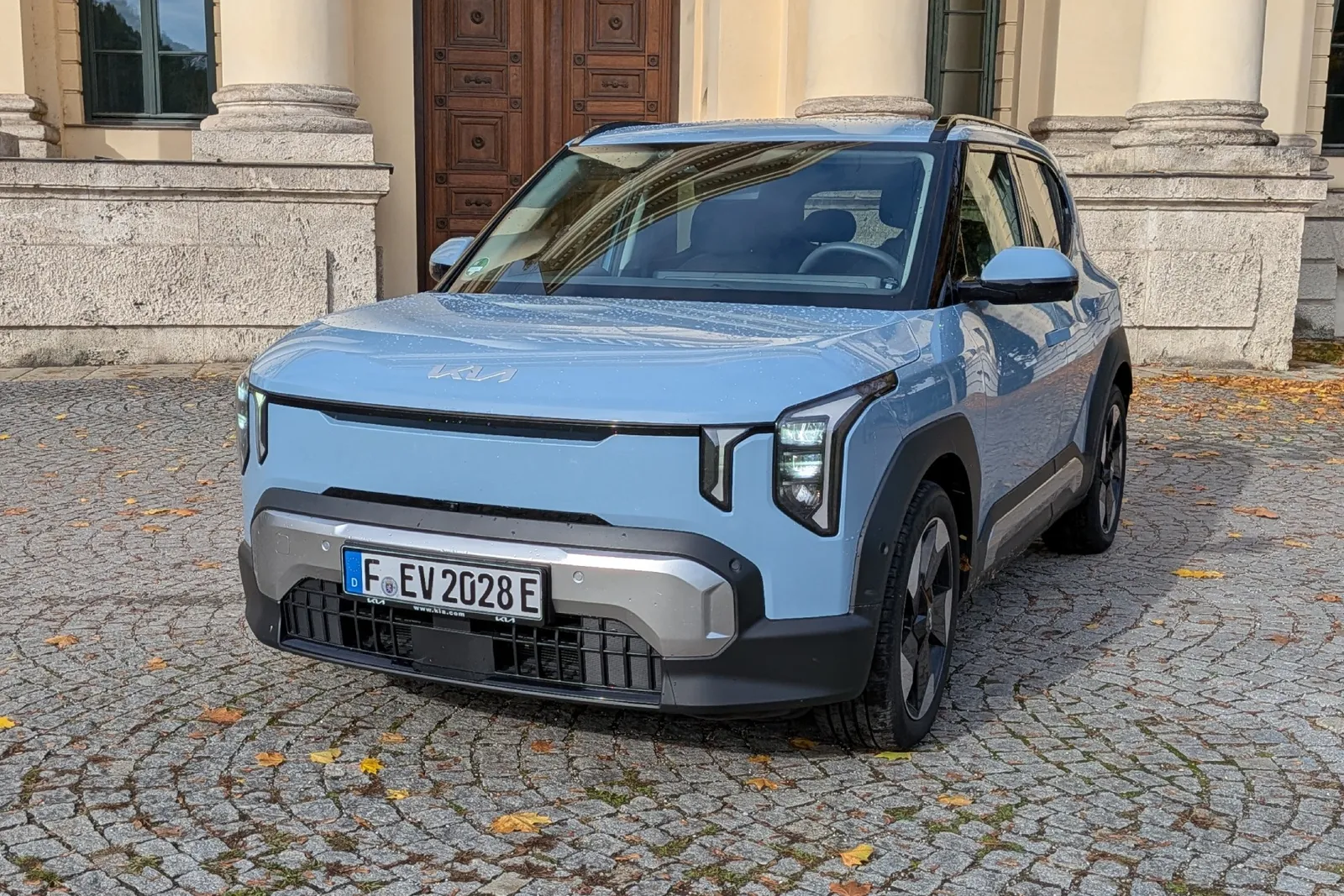
Image: Robin Engelhardt
- 1/3
- 2/3
- 3/3
Our test vehicle’s configuration, costing at least 35,790 euros, is quite far from the base version. In addition to the larger battery, it includes seat and steering wheel heating, a frunk compartment, more LED lighting inside, and electric seat adjustment. Note that this applies only to the driver’s seat; the passenger seat still needs to be adjusted manually.
Conclusion
Just as with its flexible interior, Kia also demonstrates through pricing and equipment options that the EV2 is designed for a very broad audience. From a compact city car with a straightforward setup to a fully equipped model suitable for long-distance travel, Kia’s smallest electric vehicle can be customized to fit individual preferences.
It fits into any parking space in the city yet drives just as confidently at 170 km/h like a larger vehicle.
Kia strengthens its position in the market and represents a significant competitor not only to the ID.Polo but also to various Chinese models. While the rest of the automotive industry has been in constant turmoil for years, Kia is doing many things right in a calm and thoughtful manner.