
Japanese Green Science Alliance opens battery recycling laboratory in Switzerland
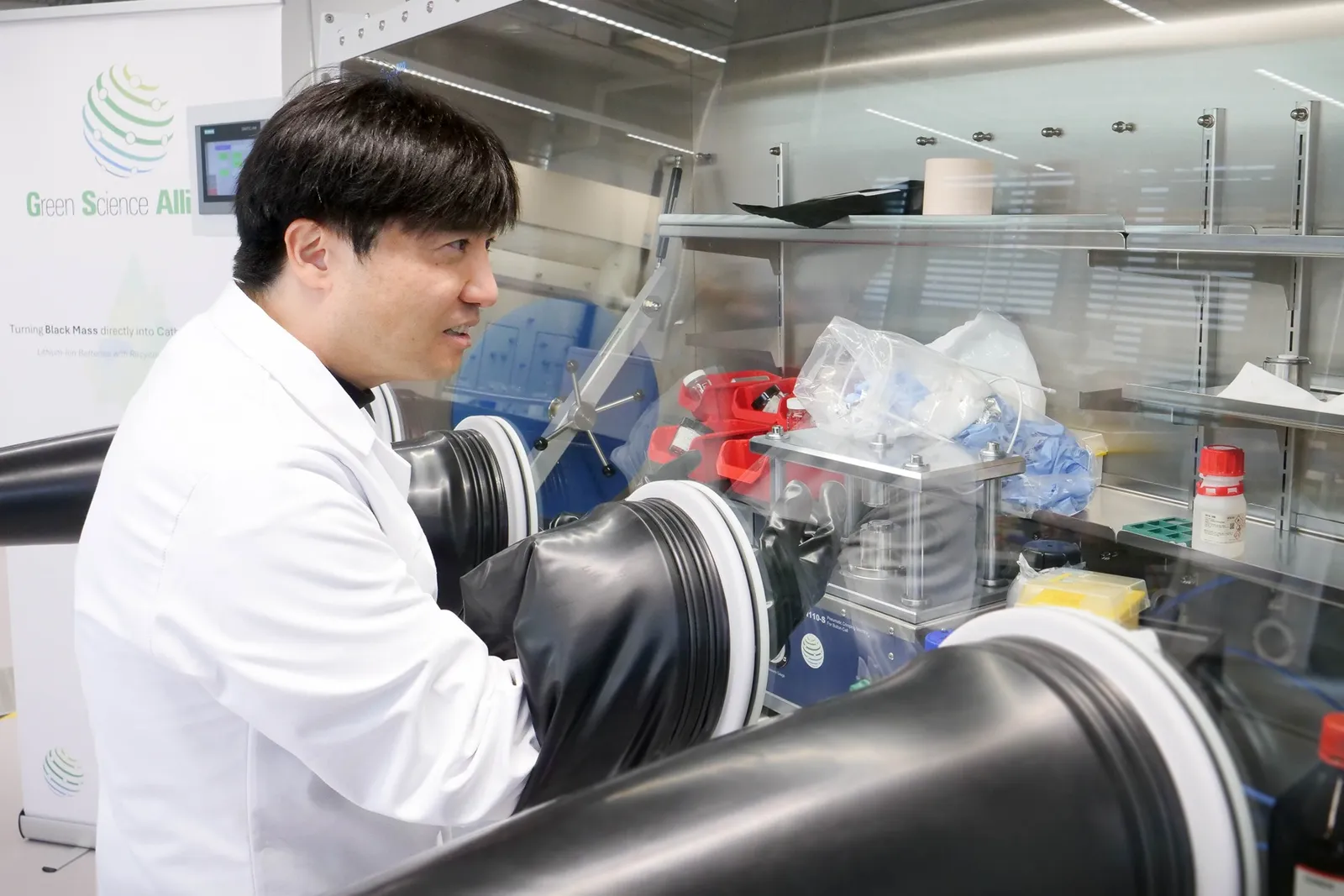
The Japanese chemical and green technology company Green Science Alliance (GSA) has opened a battery recycling laboratory at the Switzerland Innovation Park Biel/Bienne (SIPBB) in the canton of Bern. In partnership with the Swiss Battery Technology Center (SBTC), the company aims to extract cathode materials from used lithium-ion batteries that can be directly reused in new cells, eliminating the need to process individual metals first.
The laboratory was inaugurated on Monday, in attendance among others were GSA chief Ryohei Mori and SBTC head Christian Ochsenbein. The GSA is based in Kawanishi, Japan, and focuses on areas such as quantum dots, metal-organic framework compounds (MOFs), and deep eutectic solvents. Biel is set to serve as the company’s hub for operations in Europe. The SBTC will handle material analysis, electrode manufacturing, battery cell development and testing, as well as recycling there.
Black mass as a raw material
The focus is on the so-called black mass. When used batteries are crushed and mechanically processed, a dark powder remains. This powder contains the active materials that store and release energy in the cell. In the traditional recycling process, individual metals such as lithium, nickel, or cobalt are extracted using acids or alkalis. Several additional processing steps are required before it can be turned back into cathode material. The extent to which the black mass varies depending on cell chemistry, battery age, and processing methods is examined by the SHERLOCK research project, which aims to develop quality grades for black mass.
GSA will shorten this chain. The company does not break down the cathode material from the black mass to its individual elements, but rather prepares the material and reuses it. Experts refer to this as direct recycling. This approach aims to save processing steps and resources. If successful, manufacturing new batteries would require fewer newly mined raw materials. However, the partners do not reveal how the process works in detail.
Initial results are already available: Batteries with regenerated cathode material from GSA achieved over 90 percent of the initial capacity of comparable batteries using conventional materials. This sounds impressive, but it is a laboratory figure provided by the researchers. Information on the number of charge cycles, cell format, or independent measurements is lacking. The technology is being developed for nickel-manganese-cobalt batteries (NMC) and lithium-iron-phosphate batteries (LFP). For LFP in particular, a cost-effective method is crucial, as these cells contain neither nickel nor cobalt, making it significantly less economical to recover individual metals.
Currently only a preliminary study
The division of labor in Biel is clearly defined: GSA provides its recycling technology, while SBTC, one of the four applied research centers of SIPBB, offers expertise, infrastructure, and laboratory space. Together, the partners aim to examine the processed materials, use them to create electrodes and cells, and test these components. The goal is to determine whether the process can be scaled up industrially.
Public funding so far remains limited. The first phase is funded through an innovation grant from Switzerland’s funding agency Innosuisse. This grant covers the costs of a Swiss research partner up to 15,000 francs (approximately 16,200 euros) and is intended for preliminary studies that must be completed within six months. The partners themselves describe it as a first step toward joint research.
Europe Needs Recyclables
The need exists. The EU Battery Regulation mandates higher recovery rates for lithium, nickel, and cobalt and requires minimum amounts of recycled material in new vehicle batteries starting in August 2031. However, recycling remains economically challenging at present: According to the EU’s Safeloop study, the current loss amounts to around 1.90 euros per kilogram of battery pack. Processes with fewer steps could help address this issue. The partners claim that this method would also reduce dependence on newly mined raw materials on a large scale and make Europe’s battery supply chains more resilient.
Research institutions are also seeking partners across national borders for this purpose. For example, Fraunhofer FFB in Münster signed letters of intent with partners from South Korea at the beginning of October, focusing on topics such as recycling and the implementation of the EU Battery Regulation. GSA aims to bring its technology from the laboratory to industry through SIPBB’s network. It remains to be seen whether 90 percent efficiency can also be achieved at larger scales.
ggba.swiss (GGBa report), pressebox.de (SIPBB press release), sbtc.sipbb.ch (SBTC media statement), innosuisse.admin.ch (Innovation voucher), ecb.europa.eu (ECB exchange rate, 19.10.2026)