
How to lightly electrify heavy transportation
The electrification of trucks is inevitable, but simply replacing the fleet is not enough. Will Poland be able to build charging networks and energy infrastructure in time before a lack of sufficient power starts limiting carriers’ competitiveness?

Table of Contents
Poland is the largest market for road freight transport in the European Union. The electrification of trucks does not mean that the entire fleet will switch to electric power within a few years, but the ability to offer low- and zero-emission transportation will become an increasingly important factor in carriers’ competitiveness.
Large industrial, logistics, and retail companies are increasingly setting emission reduction targets across entire supply chains. As a result, transportation emissions may begin to hold significance for clients similar to price, delivery timing, or service quality.
If infrastructure for electric trucks develops more rapidly in Germany, the Netherlands, or France, it will be harder for Polish companies to compete for European contracts. Therefore, electrifying transportation is not only part of climate policy but also a matter of maintaining the position of Polish freight carriers.
The biggest challenge is not simply the availability of electric trucks. Vehicles and chargers can be ordered relatively quickly, whereas bringing sufficient capacity to a large eHDV hub may require a multi-year investment process.
An facility of this kind requires several, and ultimately even a dozen, megawatts. Therefore, network investments and the securing of suitable locations must begin before the development of the fleet.
NFOŚiGW has launched a program for operators of distribution systems to support the expansion of networks needed to power high-capacity stations. However, coordination between charger operators and OSDs remains crucial.
The station operator works according to the schedule of the subsidy program, land agreements, and equipment supply contracts, while network investments often have a completely different timeline. Without synchronization, there can be stations waiting for power supply as well as network infrastructure remaining unused for years.
Another limitation is location. A truck hub requires a large area, suitable site geometry, easy access in and out, parking spaces, and facilities for drivers. There is a limited number of such sites along major roads.
A mere subsidy for trucks is not enough
The program to support the purchase of electric trucks has a budget of 2 billion zł, with the maximum subsidy for an N3 category vehicle reaching up to 750 thousand zł. However, current interest shows that reducing the price difference alone is insufficient, as carriers make decisions based on the total cost of operation.
An electric truck remains significantly more expensive than a diesel one. In addition to the purchase price, financing costs, energy and insurance expenses, charging arrangements, the impact of range and downtime on vehicle usage, as well as its future value must all be considered.
Leasing holds special significance as it forms the backbone of financing in Poland’s transportation sector. The residual value is also an issue. For gasoline-powered vehicles, the market can relatively accurately estimate the price of a multi-year-old car.
The secondary market for electric trucks is still in its infancy, and rapid battery technology advancements increase risks for banks and leasing companies. These risks could be mitigated by factors such as manufacturer-backed buybacks, residual value guarantees, or other risk-sharing mechanisms.
From the carrier’s perspective, purchasing a vehicle, access to chargers, and the availability of sufficient power are all part of the same business decision. Before investing, a business owner must know where they will charge their vehicle, how much it will cost for electricity, whether they can obtain adequate power at the depot, and whether they will be able to complete routes using public infrastructure.
Subsidy for hubs won’t ensure profitability
Infrastructure for trucks must be established before the market reaches a large scale. This implies high investment costs and fixed expenses during periods of low utilization. NFOŚiGW recommended supporting 170 projects involving 843 publicly accessible stations for heavy transport, but subsidies for CAPEX alone do not solve the profitability issue.
The other element are distribution tariffs. The hub must already have sufficient capacity from the start, although it may only utilize a small portion of it during the first few years. High fixed costs related to capacity thus place a significant burden on the project in its early stages.
A possible solution could be a transitional tariff for eHDV infrastructure, where network costs are initially more closely tied to the actual usage of the stations, gradually shifting to a standard model as volume increases. The system should also encourage capacity management, the use of energy storage, and shifting charging to hours when network load is lower.
A truck hub isn’t just a larger charger for cars
The eHDV infrastructure requires a separate technical and spatial approach. The charging stations should enable safe passage for heavy trucks, ideally without reverse driving, and must account for the vehicle’s length, turning radius, waiting areas, and facilities for drivers.
For many years, CCS and MCS systems will operate alongside each other. CCS charging with several hundred kilowatts is sufficient where a vehicle stays for a few hours or overnight. However, for long-distance transportation and during mandatory breaks, drivers will need MCS charging at megawatt levels. Therefore, charging hubs should offer different power levels and various types of stations.
Systems for reserving spaces and the ability to physically control access to stations will also be necessary. Unresolved issues remain regarding the movement of passenger cars on parts of the MOPs designated for trucks, as well as proper signage for infrastructure used by different vehicle categories.
An additional barrier are the investment procedures. If achieving AFIR goals is to be strategic, simplifications may be required for infrastructure related to powering the hubs, including obtaining property rights, administrative approvals, or agreements with road managers. Meanwhile, in MOPs, logistics centers, terminals, and large parking lots, space and capacity for future chargers must already be reserved today.
Capital has become more cautious
A few years ago, investors often assumed that as electrification grew, infrastructure utilization would increase automatically. Today, achieving positive EBITDA and cash flows is far more important.
The reason is that some of the existing stations are reaching profitability more slowly than expected. Capital remains interested in electrification but expects better-secured projects. Predictable demand, certainty of connection timelines, regulatory stability, the ability to phase investments, and additional ways to utilize infrastructure in the early years are all crucial factors.
The role of the state does not have to be to replace private capital with public funds. It is more important to limit risks that investors do not have full control over. If, at the same time, demand-side, integration, regulatory risks, and several years of underutilization of infrastructure are left on the investor’s side, financing the development of eHDV may prove too difficult precisely in the initial, most capital-intensive phase of the market.
Rafał Czyżewski is the president of Greenway Polska, a company involved in vehicle charging infrastructure and owner of the largest network of car chargers in Poland.
From the editorial team
The Chinese are holding on tight. Even in electric trucks.
The electric truck market in China is growing very rapidly. In 2025, around 232,000 zero-emission heavy trucks were sold, nearly three times more than the previous year. Their share of new heavy vehicle sales reached about 28 percent.
Electrification began primarily with applications that involve predictable routes and long driving distances — in ports, mines, steel mills, cement plants, and transportation between logistics hubs. Meanwhile, infrastructure is developing as well: from charging stations with capacities of 300–400 kW to megawatt-level systems and battery swap stations.
The government supports this market at several levels. Subsidies for replacing old trucks and purchasing new electric vehicles can amount to 140,000 yuan per vehicle (approximately 79,000 zł).
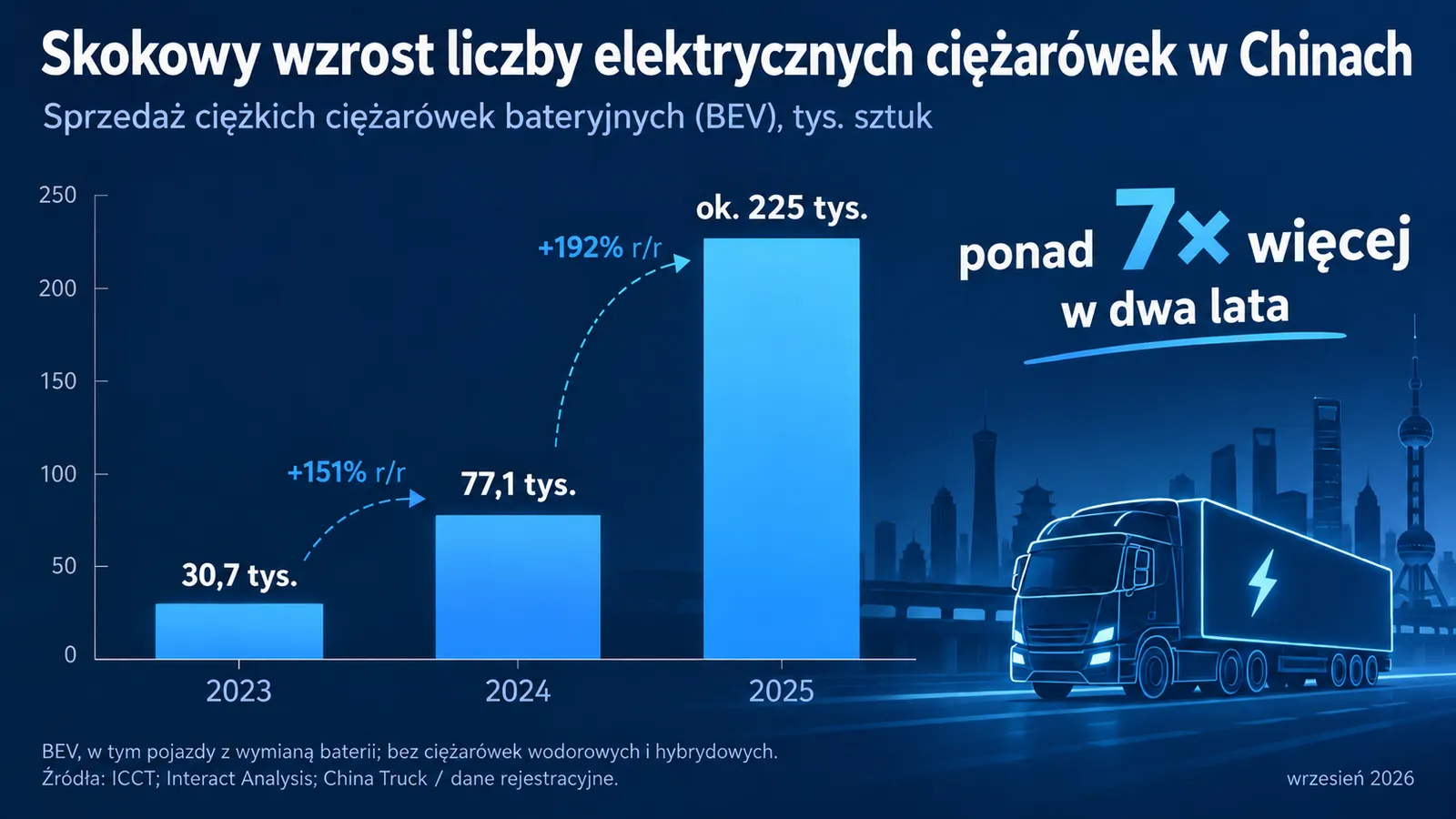
The government is also funding the development of charging and battery swapping networks, planning for around 3,000 such stations by 2030 along with approximately 30,000 kilometers of transport corridors equipped with infrastructure for eHDVs.
Important elements of support include network and financial incentives. By 2030, some large charging and battery swapping stations are expected to be exempt from fees related to the contracted power capacity, reducing costs in the early years when usage of these hubs is still low.
The state also supports investment financing, leasing, models that separate vehicle and battery ownership, as well as the development of infrastructure near ports, industrial facilities, and major routes.
The Chinese model is therefore not based solely on a subsidy for the vehicle. The support includes the car itself, infrastructure, the power grid, financing, and creating demand for zero-emission transportation.