
Is MCS the final word in megawatt truck charging?
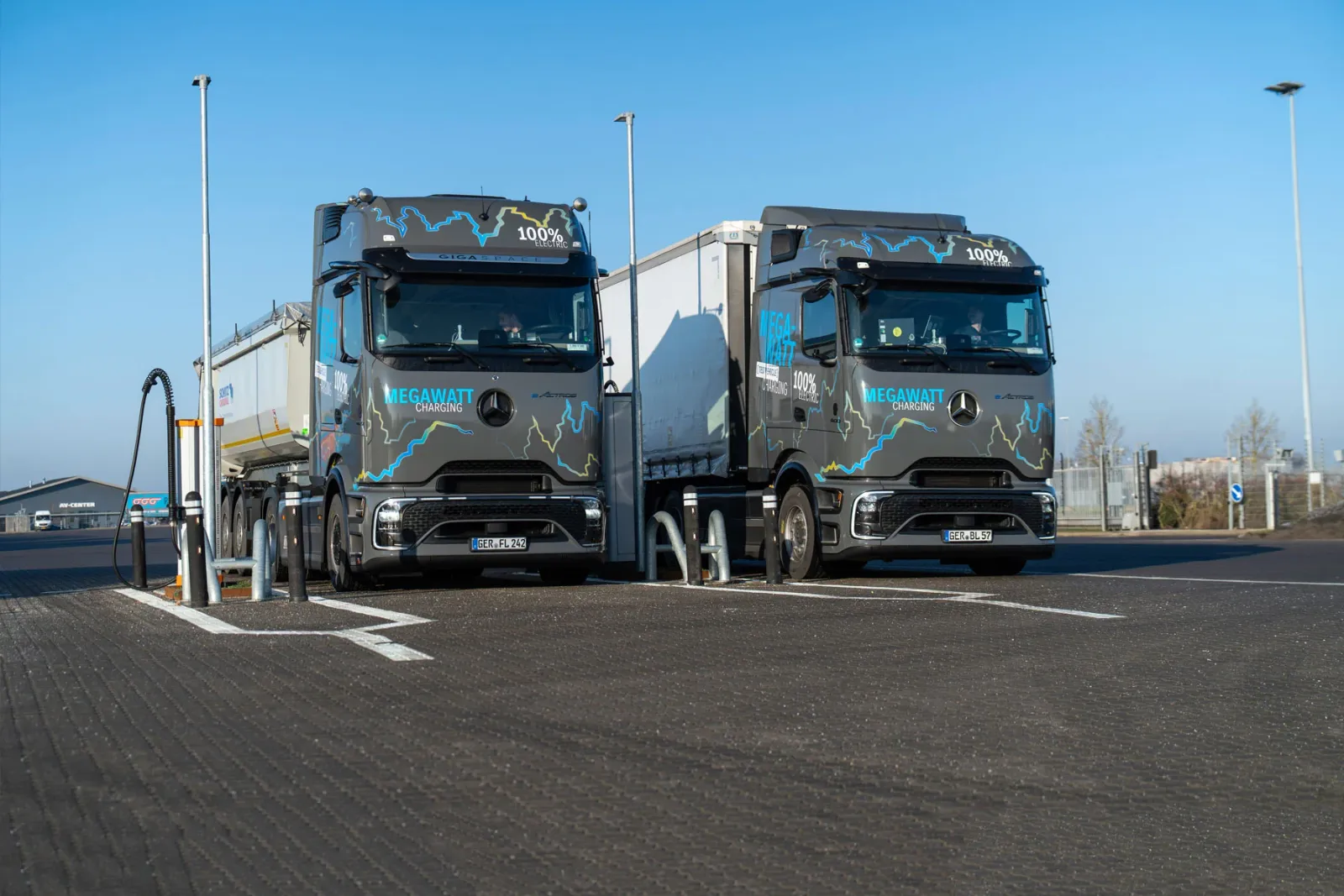
With the first MCS-compatible trucks and charging stations now entering commercial service, it may seem premature to ask whether the Megawatt Charging System (MCS) will remain the dominant charging interface for heavy-duty transport.
MCS has only just moved beyond the development stage and is now entering the market while the final steps of international standardisation are being completed. Truck manufacturers are launching MCS-compatible vehicles, charging equipment, cables and vehicle inlets, and the first truck charging hubs are already operating with installed hardware. With technical specifications converging globally, MCS appears well on its way to becoming the standard interface for ultra-fast charging of battery-electric heavy-duty trucks.
However, alternative concepts are already emerging. At Power2Drive Europe trade fair in Munich in June, several companies presented solutions designed either to exceed the capabilities of MCS or to eliminate the conventional charging connector altogether. Start-up akroVA, for example, demonstrated a manually operated charging plug rated for up to six megawatts. At the same event, the Fraunhofer Institute for Transportation and Infrastructure Systems (IVI) unveiled an automated underbody charging system for electric trucks that is designed to deliver up to 4.5 megawatts.
This is not a replay of the charging connector battles seen in the early days of electric cars. Instead, the debate is shifting towards whether a single interface such as MCS can meet the full range of charging requirements in heavy-duty transport—from public motorway charging hubs and depot operations to autonomous vehicles operating in ports and logistics terminals.
MCS currently sets the standard
For public high-power charging, MCS currently has no viable alternative. Development of the Megawatt Charging System began in 2018 under the umbrella of the industry association Charging Interface Initiative (CharIN). In early 2026, the central technical specification for the MCS connector, IEC TS 63379, was published. It defines operating voltages of up to 1,250 volts and currents of up to 3,000 amperes, allowing peak charging power of up to 3.75 megawatts.
MCS combines this charging performance with a key advantage: it is designed as a uniform, cross-manufacturer standard. In principle, any MCS-compatible truck should be able to charge at any MCS charging point, regardless of the vehicle or charging infrastructure supplier, provided both comply with the specification. The interface also builds on the communication and safety architecture established by the Combined Charging System (CCS), reflecting lessons learned from the passenger car market.
The MCS connector is still connected manually. Despite the high currents, liquid-cooled cables and the size of the connector, the system is designed to be operated without robotic assistance or other technical aids. Anyone who has handled an MCS connector, however, knows that it is far from lightweight. Even so, the concept is well suited to long-haul transport: drivers can connect the truck during a legally required rest break, charge the vehicle and continue their journey once charging is complete.
Heavy-duty transport, however, extends well beyond motorway rest stops. Depot operations, ports, loading bays and autonomous logistics environments pose different challenges. Does a driver still need to connect a charging cable? How can charging infrastructure be integrated into space-constrained sites? And as battery capacities continue to grow and charging windows become ever shorter, will a maximum charging power of 3.75 megawatts remain sufficient in the long term?
akroVA aims to deliver 6 MW through a single plug
The most direct alternative to MCS is another charging connector. At Power2Drive Europe, akroVA, a German start-up spun out of paXos Solar presented a system capable of delivering up to six megawatts at the GLS Mobility stand. The technology is based on paXos’ Cool-Load Megawatt Plug (CLMW), which received the Power2Drive Award in 2023. electrive spoke to developer Peter Hakenberg when the system was first unveiled, and he demonstrated the technology.
The key difference from conventional charging connectors lies in the contact design. Instead of elongated pins and matching sockets, the system uses multiple ring-shaped contact surfaces. This allows the connector to be inserted in any orientation. Once connected, the contacts are mechanically closed and pressed together with high force.
According to paXos, the large contact area reduces electrical resistance and, in turn, heat generation. The contacts and cables are also actively cooled. Despite its large cross-section, the cable is designed to remain flexible by using multiple smaller, braided conductors rather than a single solid cable.
According to test documentation published by paXos, the system has demonstrated power transmission of 4,000 amperes at 1,500 volts, equivalent to six megawatts. The complete setup, comprising the connector, socket and a four-metre cable, operated continuously for 46 minutes. According to the manufacturer, the scalable concept is designed to support charging capacities ranging from three to twelve megawatts.
From a technical perspective, akroVA targets the same use case as MCS. The driver still connects the truck to the charging station using a cable, but the system is designed to deliver substantially higher charging power. At the same time, the connector is intended to require very little insertion force and no precise alignment before connection. According to the company, the connector has a smaller diameter than a CCS2 Combo plug at 72 millimetres while supporting non-proprietary ‘HyperCharging’ at up to 6 MW with liquid cooling or 1.5 MW with air cooling.
The greater challenge, however, extends beyond contact resistance and cooling. A charging connector only becomes an industry standard if vehicle manufacturers integrate the corresponding vehicle inlet, charging equipment suppliers offer compatible hardware and charging network operators invest in the required infrastructure. This is where MCS already has a significant head start, backed by international standardisation and broad support across the commercial vehicle and charging industries.
akroVA therefore faces a challenge beyond demonstrating that charging at six megawatts is technically possible. The company must also persuade vehicle manufacturers, charging equipment suppliers and infrastructure operators that a second physical charging interface is needed alongside MCS. Initial applications are likely to be found outside the public truck charging network, for example in large industrial vehicles, construction equipment, ships or specialised electric vehicles with extremely short charging windows. Peter Hakenberg expressed confidence at Power2Drive: ‘The market demands it, and we can now deliver,’ he told electrive.
To support the market launch, Hakenberg secured investment through FunderNation, leading to the creation of the spin-off akroVA GmbH. The company has since continued development of the technology under the name CLMW-2C. Although akroVA has not yet published images of the new connector, it says the design will be fully compatible with the CCS2 Combo form factor while retaining the same dimensions. If achieved, that would be a notable milestone, as maintaining the size of the CCS2 connector was one of the original design goals for MCS.
Fraunhofer IVI eliminates the need for manual connection
The Underbody Charging System developed by the Fraunhofer Institute for Transportation and Infrastructure Systems (IVI) takes a fundamentally different approach. Rather than improving the charging connector itself, the system is designed to eliminate manual plug-in charging altogether.
To charge the vehicle, the truck drives over a charging unit integrated into the ground. Once it is correctly positioned, protective covers in the road surface open and a contact module connects to an interface mounted on the vehicle’s underbody. Unlike wireless charging systems, the UBCS transfers energy conductively by establishing a direct electrical connection between the vehicle and the charging infrastructure.
The Dresden-based researchers use what they describe as a surface-contact coupling. During charging, the contact surfaces are pressed together with high force and locked electromagnetically. According to the developers, the resulting low contact resistance enables high current transfer at the interface without the need for active cooling.
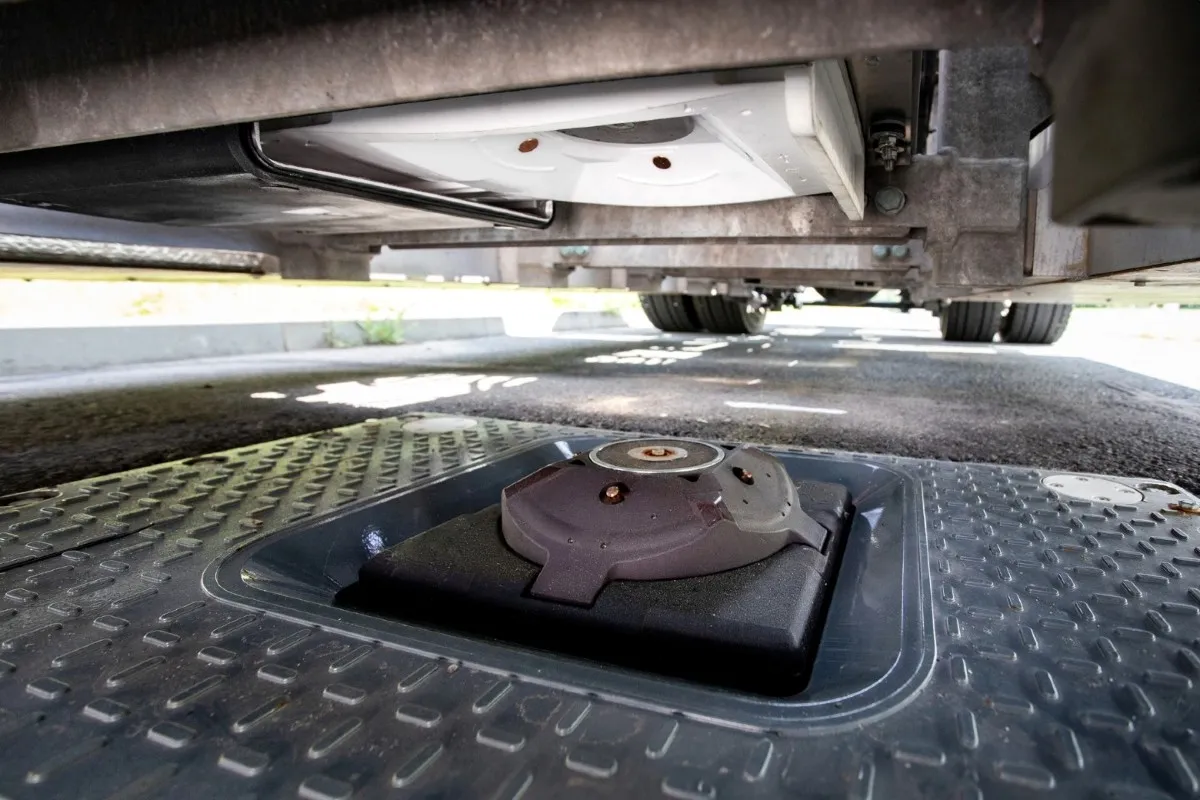
For heavy-duty commercial vehicles, the system is designed to support voltages of up to 1,250 volts and charging capacities of up to 4.5 megawatts. According to Fraunhofer IVI, the same vehicle interface can accommodate charging power ranging from 22 kW to 4.5 MW. The Underbody Charging System (UBCS) also complies with IEC 61851-26, the standard covering automatic conductive connection systems mounted on a vehicle’s underbody.
The concept offers particular advantages wherever vehicles repeatedly stop at the same locations. An electric truck, for example, could begin charging automatically while loading or unloading at a loading bay. In a depot, charging could start immediately after the vehicle is parked, without requiring an employee to connect a cable.
The system is also well suited to autonomous vehicle applications. A driverless terminal tractor or automated yard vehicle would be unable to operate a conventional charging connector without additional robotic equipment. By integrating the charging connection into the parking process, the underbody system enables charging to become part of the automated workflow.
Because the charging system is fully integrated into the ground, it requires no additional space above the road surface. Fraunhofer IVI sees potential applications in depots, logistics centres, municipal fleets and dedicated charging hubs. The technology could also be deployed at major long-distance coach terminals, where conventional charging cables could create operational and safety challenges.
However, the technology is not yet at the same stage of market maturity as MCS. The system was demonstrated in a German government-funded research project that concluded in late 2024. According to Fraunhofer IVI, the system is now undergoing field trials with industry partners. One example is a municipal refuse collection fleet in Germany, which is testing a lower-power version in day-to-day operations. While current applications operate at lower charging capacities, the interface has already been designed for future expansion into the megawatt charging range.
The next milestone for the UBCS is standardisation. At the beginning of 2026, IEC TS 61851-26:2026 ED1, titled ‘EV supply equipment with automatic docking of a vehicle coupler located at the underbody of an electric vehicle’, was published. “Work is currently underway at the IEC level on standardising the associated charging interface(s),” Dr Sven Klausner, Head of Charging Infrastructure at Fraunhofer IVI, told electrive. According to Klausner, a first version of the interface standard is expected in the first half of 2027.
Klausner is directly involved in the process as both a developer of the system and a member of the relevant national and international standardisation committees. If the standardisation timeline is maintained, underbody charging technology could be ready for market introduction as early as next year. Fraunhofer IVI is therefore already looking for industrial partners to support the industrialisation of the system.
Pantographs as a proven alternative
Pantograph systems represent a less radical alternative to plug-based charging. The technology has been established in the electric bus sector for years. Depending on the design, either a current collector mounted on the vehicle roof rises to meet the charging infrastructure, or a pantograph integrated into the charging station lowers onto contact rails on the vehicle.
Schunk offers automated pantograph systems with charging capacities of up to one megawatt, targeting not only electric buses but also trucks, ports, airports and industrial applications. According to the company, the electrical connection can be established within seconds.
For fleet operations with fixed routes and defined charging locations, pantographs can provide a robust and highly automated solution. However, the technology requires additional hardware on the vehicle roof and precisely defined parking positions. In public long-haul trucking, where vehicle heights and trailer configurations vary considerably, integration is likely to be more challenging than in the standardised environment of a bus depot.
Multiple plugs instead of a single MCS connection
Chinese manufacturers, in particular, are taking a more pragmatic approach by distributing charging power across multiple cables and vehicle inlets. Sany, for example, says its battery-electric semi-trailer truck can charge at up to 800 kW using either two or four charging connections, depending on the configuration.
Using multiple connectors reduces the current carried by each individual cable and contact. The trade-off is increased operational complexity: drivers must connect several cables, vehicles require multiple charging inlets and the charging station must provide several outputs simultaneously.
A similar concept underpins ChaoJi, also known as CHAdeMO 3.0, which supports charging at up to 900 kW with voltages of up to 1,500 volts and currents of up to 600 amperes. Its successor, Ultra-ChaoJi, has been designed for charging capacities of up to 1.8 MW by using two parallel current paths. However, both standards remain focused on the Chinese and Japanese markets. In Europe, a comparable ecosystem for public heavy-duty charging has yet to emerge, while MCS continues to establish itself as the leading standard.
Not every alternative requires a MW connection
More fundamental alternatives take a different approach altogether. Overhead line systems, inductive road charging and battery swapping do not seek to increase the amount of energy transferred through a single charging connection during a short stop.
Instead, overhead catenary systems and inductive roads supply vehicles with electricity while they are driving, at least along equipped sections of the route. Battery swapping replaces the depleted battery with a fully charged one, allowing the removed pack to be recharged over a longer period. All three concepts reduce the need for extremely high peak charging power but require far more extensive changes to vehicles, infrastructure and operating models. As such, they are better viewed as alternatives to the MCS-based charging ecosystem than as competing charging interfaces. Several European field trials have produced mixed results and, in Germany in particular, overhead line projects have lost political momentum following field trials, as Professor Markus Lienkamp pointed out in his interview with electrive.
The application determines the interface
MCS is likely to establish itself wherever publicly accessible charging infrastructure must serve vehicles from multiple manufacturers, particularly at motorway charging hubs, truck stops and public truck charging parks. In these environments, interoperability is likely to outweigh the potential benefits of alternative systems capable of delivering even higher charging power.
The picture may be different in depots and closed logistics operations. Where vehicles return to the same loading bay or parking space every day, automated underbody charging or pantograph systems could justify their higher vehicle and infrastructure costs through more efficient operating processes. As autonomous vehicles become more common in ports, mines and logistics terminals, the ability to establish a charging connection without human intervention is also likely to become increasingly important.
The six-megawatt connector developed by akroVA demonstrates that the technical limits of manual conductive charging have not yet been reached. Whether it evolves into a viable alternative for road-going heavy-duty vehicles, however, will depend less on peak charging performance than on standardisation, cost and support from vehicle manufacturers. If akroVA succeeds in building that ecosystem, the technology could offer European suppliers an opportunity to differentiate themselves in specialised charging applications.
Rather than replacing MCS, many of these technologies are likely to occupy distinct roles. Public motorway charging requires interoperability above all else, while depots, ports and autonomous logistics operations may prioritise automation or even higher charging power. The future of heavy-duty charging may therefore involve several complementary interfaces rather than a single universal solution.