
Is It A “Bloodbath”? Aussie New Car Market Reacts
Support CleanTechnica's work through a Substack subscription, on Patreon, or on Stripe. Help us produce all of the high-quality, original content we publish week after week despite the challenges of content-scraping AI, antisocial media, inflation, and other hurdles.
After Fiat withdrew from the Australian market, and a Peugeot dealer handed in his franchise, even long-time motoring “gurus” are asking the question. The metaphors abound — “tip of the iceberg,” “bloodbath,” “annihilation,” “juggernaut.” What is of no doubt is the structural change going through the Australian car sales industry. Although conservative commentators want to blame the Australian government’s Fuel Efficiency Standards, the reasons for change are more complex. Citroen and Infinity have already left.
Added to the influx of affordable, tech packed, quality Chinese cars (most of them electric), we have the increase in fuel insecurity caused by the Iran–US war. As a buffer, the government has sought and received extra shipments of both petrol and diesel, and decreased the fuel excise. The extra shipments are coming, but the price at the bowser is creeping up. The fuel excise relief is over. Prices are set to rise by 30%. And the price of oil is up — which will lead to even more price increases. In a country blessed with massive renewable energy potential and cursed (?) with lack of oil, the average Joe is now considering the EV choice.
Readers of CleanTechnica will be aware of the rising market penetration of plug-in vehicles in Australia. Just this year it has gone from January’s 16% to June’s 36%. Next week the figures for July will be out and I am hoping we will edge close to 40% penetration — catching up to the UK!
Paul Wildman and I have been writing for a few years about the decline of the western auto industry. In Australia, we are watching it unfold in real time. European and Japanese brands are in trouble in Australia now.
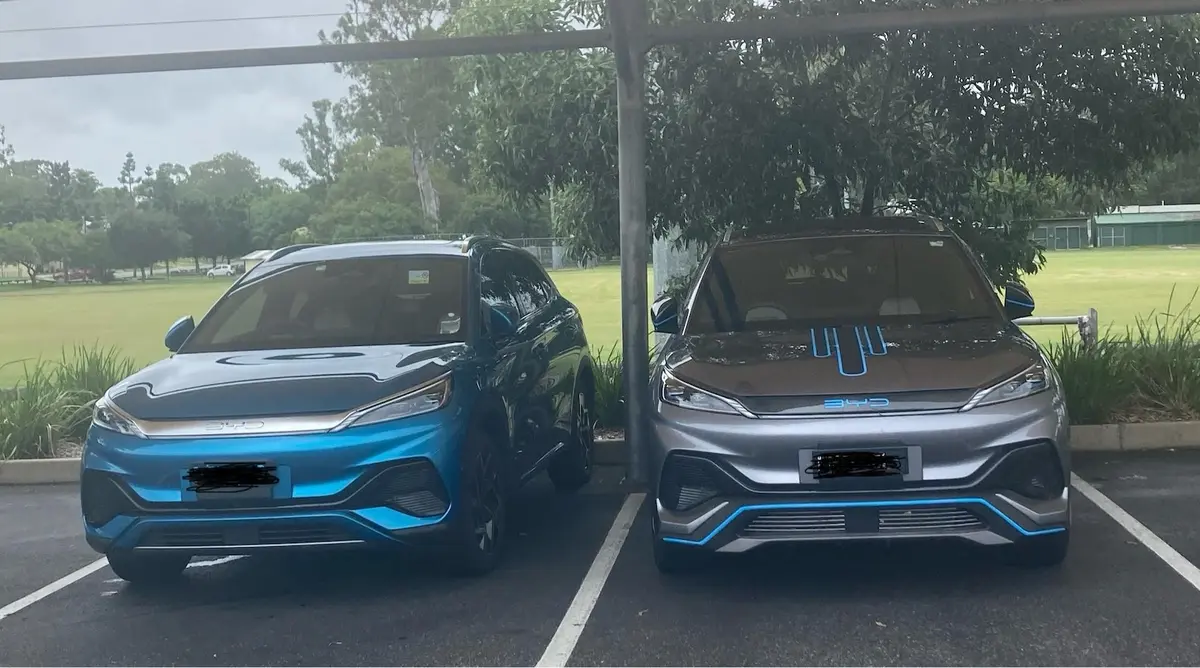
It’s not just stats — we play “Spot the Electric Car” as we drive our grandchildren around Brisbane. Most of them are BYDs and Teslas, but others are also appearing more often. You can identify them by the lack of a grille — no radiator to cool — and the lack of an exhaust pipe — no harmful emissions. Shopping today we found two Teslas, one Geely EX 5, one MG ZS EV, and an electric Volvo. We call it the car park test — similar to a politician’s use of the “pub test.” Can an idea/product thrive in the real world of the car park or the pub? Then it is valid.
Here’s some more hard data from Australia for our discerning readers: “In 2026 so far, Toyota’s sales are down 21.4 per cent; Mitsubishi’s 25.7 per cent and Mazda’s 17.2 per cent.” The increases in sales for Chinese EVs have to come from somewhere.
Loyalty only goes so far when Aussies are counting their car-buying dollars. “China has shown Australians will ditch allegiances for the unproven … as long as they’re cheap.” But the point is: they are not just cheap, they are value for money. And the new car buying appears willing to put up with some of the growing pains associated with rapid expansion.
More well-known brands may exit the Australian market. Peter Jones, chief executive of the Victorian Automobile Chamber of Commerce, suggests: “If you actually look at the market share and you look at anything under five per cent market share, they’re the ones that would be at risk…. There’s lots of brands in that space.”
He sets the bar at 5% penetration — “only car brands with over are 5% safe.” Under threat are Jeep (0.1 per cent); Skoda (0.3 per cent) and Cupra (0.2 per cent); Suzuki (1.1 per cent); Honda (1.3 per cent); Volkswagen (1.9 per cent); Nissan (2.3 per cent); Subaru (2.4 per cent); Isuzu (3.4 per cent); and even Mitsubishi (4.1 per cent market share this year). Some of these are big names which themselves disrupted the Australian market not long ago and led to the demise of the manufacturing of Ford, Holden, and British Leyland in Australia.
Volkswagen’s 2025 sales have declined by 20.6% to 28,970, adding to the 2024 decline of 16.8%. Mitsubishi sales in Australia have been on a downward trend for the past 5 years, dropping from roughly 77,000 units down to around 61,198 units by the end of 2025.
Jones declares that the only brands that are truly safe are: Toyota (15.7 per cent market share for the year to date), Ford (7 per cent), Kia (6.9 per cent), Mazda (6.7 per cent), and Hyundai (6.5 per cent). For now! Among the top 20 best selling brands in Australia, 7 are Chinese.
Majella and I recently visited the local Bartons’ dealership to look at the GAC Aion and the Geely EX 2 — two of the prime suspects in the case of the alleged “bloodbath.” The managing director of Bartons Motor Group expects more change to come. “These aren’t isolated decisions. They’re evidence that Australia’s automotive market has fundamentally changed.”
“Newer market entrants, particularly Chinese manufacturers, have rewritten the rules. They’re delivering exceptional value, advanced technology and strong warranty offerings, and many traditional brands are finding it increasingly difficult to compete,” he says. “The manufacturers under the greatest pressure are many of the traditional Japanese brands, which are competing head-to-head with Chinese vehicles in the fastest-growing segments of the market.”
Brand heritage and consumer loyalty only go so far, as we saw when superior Japanese cars arrived on our shores and dealerships in the late ’60s and South Korean cars brought even better deals in the ’90s.
Of course, these changes to the market will have ramifications in the global context. Can Japan’s car industry survive without exports? Can the US continue to block out new technology? Australia is a small market, but at this moment, it may be the canary in the coal mine that is getting ill from carbon monoxide, or the bell weather sheep heading for another pasture.
The winner is, of course, the Australian consumer. On the highways and in the supermarket car park, the future is bright and electric.
Sign up for CleanTechnica's Weekly Substack for Zach and Scott's in-depth analyses and high level summaries, sign up for our daily newsletter, and follow us on Google News!