
IRU and T&E call for new political momentum for clean trucks
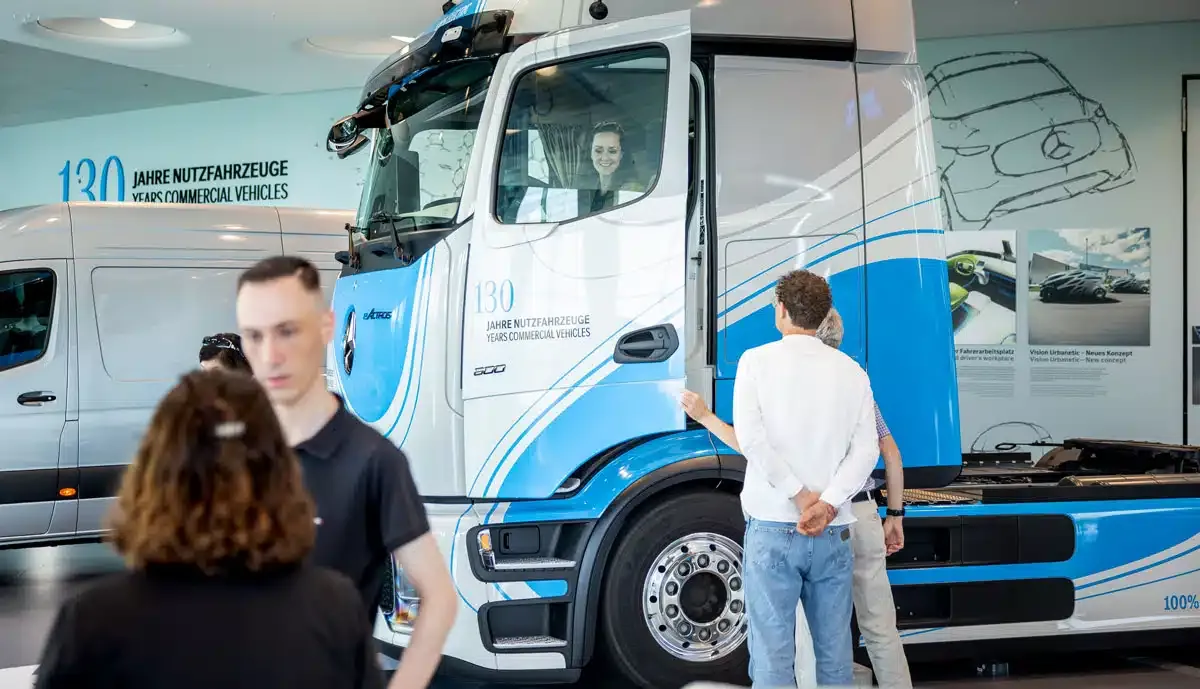
Image: Daimler Truck (illustrative)
The International Road Transport Union (IRU) and Transport & Environment (T&E) are urging EU Commission President Ursula von der Leyen to initiate a strategic dialogue on the decarbonization of heavy commercial vehicles. This call comes ahead of an upcoming review of key EU regulations and amid rising energy and cost pressures. According to T&E, the goal is to facilitate high-level exchanges among transport companies, vehicle manufacturers, infrastructure and energy providers, as well as civil society.
Europe’s road transport is under increasing pressure. The energy and geopolitical crisis triggered by the wars in Iran and Ukraine has caused diesel prices to soar, raising concerns about Europe’s energy security. Moreover, weather extremes resulting from climate change are increasingly affecting communities and livelihoods, disrupting transportation operations and placing greater strain on infrastructure, according to the authors.
According to IRU and T&E, they aim to address the practical and economic barriers to a rapid shift to zero-emission trucks through dialogue. Raluca Marian, IRU’s EU Advocacy Director, said, “The transition in heavy transport requires new political momentum at the highest level.” EU-wide and national efforts must go hand in hand, while the operational and economic conditions of transport companies should be taken into account in further decisions.
T&E CEO William Todts describes the diesel crisis as a “wake-up call for Europe.” Dependence on imported oil must be reduced quickly. The best way to achieve this is through more electric trucks powered by clean electricity produced in Europe. Regarding the EU’s planned measures on charging infrastructure and CO₂ standards, T&E calls for a transparent and inclusive process involving all key stakeholders.
The joint appeal comes ahead of the review of two key EU regulations. The Alternative Fuels Infrastructure Regulation (AFIR) promotes the development of charging and hydrogen infrastructure, while the CO₂ standards for heavy commercial vehicles set reduction targets for new vehicles. IRU and T&E also emphasize the importance of sufficient network and charging capacity, competitive energy prices, financing, and demand for emission-free transportation.
Also interesting
About the author
Thomas Langenbucher is an expert in electromobility with professional experience in the automotive and financial industries. Since 2011, he has been covering electric vehicles, sustainable technologies, and mobility solutions for ecomento.de. Learn more.
Reader interactions