
Ionity will deploy 50 energy storage facilities by 2027. The first one is operational in Wertheim.
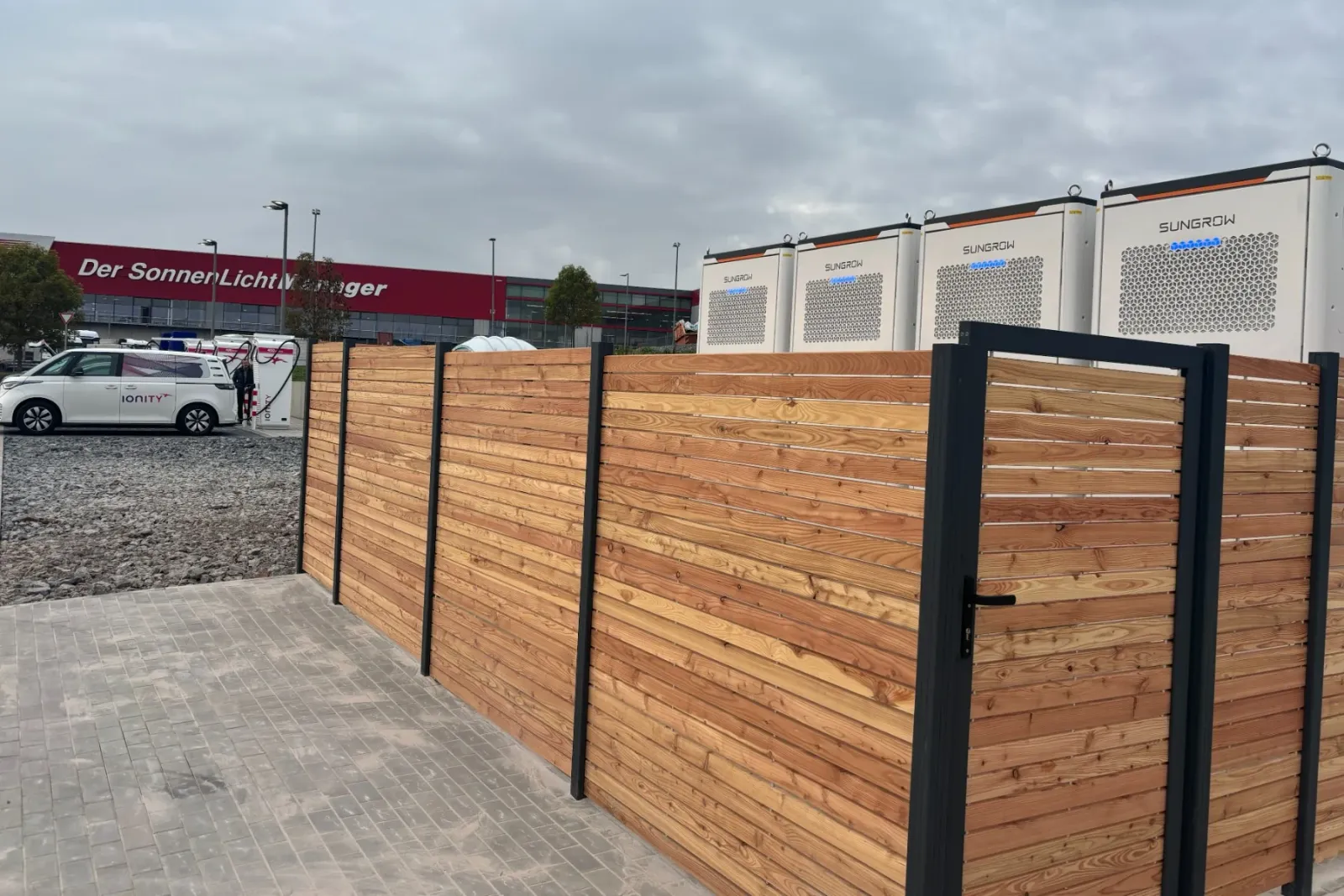
Ionity has launched the first charging park with an energy storage facility in Wertheim, Baden-Württemberg. By 2027, the operator plans to have around 50 such installations in Europe, with a total capacity of over 20 MWh. For drivers, this means more charging points where the power grid cannot keep up.
Wertheim: 1028 kWh instead of waiting for an electricity connection
The park is located at the exit from highway A3, next to McDonald’s and the Wertheim Village outlet. It originally had four charging stations; now it has six, all of which are Alpitronic HYC400 units. Two more stations with ABB chargers capable of 350 kW peak power will be added soon.
The storage system supplied by Chinese company Sungrow consists of four modules with a total capacity of 1028 kWh and a maximum power output of 500 kW, installed in cabinets on site. Their role is to provide power until the medium-voltage connection can be expanded. According to Ionity, this process could take up to three years, so the battery helps reduce the time during which the park operates with limitations.
The energy management system distributes power among the grid, storage, and chargers. During peak demand, the battery adds charging capacity and helps reduce peak loads on the grid.
Hemsbach: the first park with PV and storage
In Hemsbach, in the same state, a park is being built from scratch. It will feature a shelter with photovoltaic panels having a capacity of over 223 kWp and a storage system with a capacity of over 2 MWh. Power from the sun will flow into the battery and from there to twelve fast charging stations. There are no photovoltaic panels in Wertheim.
Plan for 2027: Over 20 MWh and Energy Trading
Scaling is set to begin next year. The output is approximately 400 kWh per location on average, which is less than in Wertheim and significantly less than in Hemsbach. As a result, some of the installations will be noticeably smaller than the first one.
Ionity is also considering making money from storage facilities. The company is working on services for the energy grid and views energy trading as a possible direction. To this end, it is developing its own energy management system that will connect connections, storage units, PV systems, and chargers.
Christoph Strecker, head of rollout at Ionity, told electrive:
We’re not just aiming to build more charging points, but to create the right infrastructure in suitable locations. Energy storage plays a crucial role here: it allows us to open new sites, use electricity more efficiently, and actively participate in the energy system in the future. Wertheim is just the beginning.
An interesting detail: Ionity uses only external storage units, even though there are chargers with built-in batteries on the market. The company explains that external storage can power many stations regardless of the equipment and fits various scenarios. It doesn’t rule out integrated solutions either and is evaluating them.
For drivers in Poland, this is for now a signal from Germany, as the source doesn’t mention any Polish locations. Will a battery behind the station be a factor for you when choosing a specific charging park, or is only the number of available chargers important?
LovEV Newsletter
Want more content like this?
Sign up — we’ll send you a weekly roundup once the newsletter starts.