
Interview: Why software will define electric truck charging
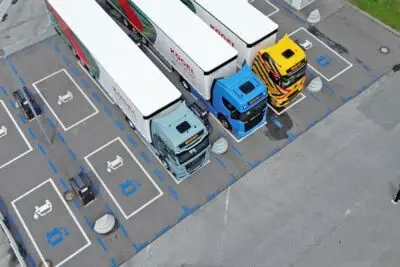
With the recently launched e-truck charging ecosystem by dragonize, chargecloud has further strengthened its position in the growing market for commercial vehicle charging infrastructure. German charging software provider chargecloud acts as the technology partner for the initiative and provides the chargecloud OS as the Charge Point Management System (CPMS) for the network. This enables logistics companies to share and jointly use depot charging points.
For Managing Director Markus Bach, the project exemplifies how the requirements for charging electric trucks differ from those in the passenger car sector. As logistics fleets electrify, charging shifts from a simple infrastructure issue to one of operational management. Reservation systems, energy management and integration with fleet operations are becoming increasingly important. In this interview with electrive, Bach explains the challenges that arise when transitioning from pilot projects to large depot charging parks, why intelligent software is becoming the decisive success factor, and what role chargecloud aims to play in the future of networking charging infrastructure, vehicles, and energy systems.
The electrification of commercial vehicle fleets is gaining significant momentum across Europe. What role does chargecloud currently play in the transformation of logistics, bus, and service fleets?
Yes, demand is growing. This is particularly evident in the increasing number of e-truck projects we are involved in. chargecloud provides a software platform with core charging management functions as a foundation for networking the relevant stakeholders. These include route planning, predictive maintenance, reservation, and energy management.
In logistics, it’s not just about ensuring vehicles can charge. In commercial operations, availability, planning reliability, load management, and billing are the truly critical issues. Our role is to manage this complexity through software in a way that is so reliable and precise that operators can run their infrastructure economically and scalably.
Where do you currently see the biggest differences between managing passenger car charging infrastructure and charging electric commercial vehicles?
Reliability and predictability are important in the passenger car sector too, but charging is generally more flexible: dwell times are longer, usage is less scheduled, and the failure of a charging station usually has no direct impact on the vehicle’s economic value.
For commercial vehicles, the situation is fundamentally different. Here, charging is part of the operational process. Dependencies on deployment schedules, routes, or dwell times must be taken into account. If something goes wrong, it’s not just a technical issue—it can significantly disrupt operations.
Another difference lies in the power and energy requirements for commercial vehicles. A dispatcher doesn’t just want to reserve a charging point for a truck; they also want to secure the charging power. To achieve this, the operating system must interact seamlessly with various third-party systems. When charging en route, additional requirements come into play that are irrelevant for passenger cars: truck-specific location data, such as parking space dimensions, entry conditions, or the position of the charging connection, must be stored in the system and accessible to drivers. The chargecloud OS already supports these extended POI data.
Many fleet operators start with just a few electric trucks and scale up gradually. What challenges do you observe when transitioning from pilot projects to large depot charging parks?
The central prerequisite—and thus the biggest challenge—when scaling up to large depot charging parks is the availability of sufficient grid capacity. A complete transition of a fleet to electric trucks typically requires new energy procurement concepts, such as solar PV systems, battery storage, or a new grid connection.
Such a transition always happens gradually, not least due to investment costs and the ongoing operation of the existing fleet. Starting with one truck and one charger is a good beginning. However, this also involves changing business processes and workflows, which requires bringing drivers and staff on board and convincing sceptics. Those who seek professional advice from the outset and consider future expansion—including energy supply and system architecture—in their planning will be well-prepared for the next phase.
The real leap doesn’t come with the second or third vehicle, but when the pilot project becomes an operational business. At this point, operators realise that it’s not just about adding more charging points; processes, responsibilities, and system landscapes must also evolve. The right scaling logic is crucial here.
Another critical aspect is operational reliability. In a pilot project, disruptions can often be resolved pragmatically. In a large depot, standardised processes are essential, including monitoring, clear roles, and a digital solution that provides transparency and facilitates interventions. As the number of vehicles increases, so does the dependency of daily operations on a stable charging infrastructure. For this, hardware, backend systems, billing, user management, service partners, and—prospectively—energy management must work together much more closely.
In short: the transition from a pilot to a depot charging park is not a linear expansion but a qualitative shift—from a test operation to a software-managed, business-critical integrated system.
How important does intelligent load management become when charging no longer involves ten but 100 or more electric commercial vehicles at a single location?
At this scale, smart charging is no longer optional—it is decisive for whether a site can be operated reliably and economically. The goal is to distribute available power in a way that ensures vehicles are ready for use on time without creating unnecessary load peaks.
This means prioritising and controlling charging processes must be adapted to the specific requirements of each site. The more vehicles in use, the more varied the charging priorities may be. For example, a vehicle on a routine tour must be fully charged at a different time than one with a longer dwell time. Insufficient energy availability or excessively long charging cycles can also negatively impact driver acceptance.
Avoiding load peaks also has economic implications, as it prevents unnecessary grid costs that can quickly undermine any TCO calculation.
In my view, intelligent load management should therefore be a central component of the system landscape. Ideally, it should be linked with route planning and dispatching to ensure power is available when it is truly needed.
What data does a fleet operator need today to optimally align charging infrastructure, vehicle deployment, and energy costs?
The foundation consists of operational data, including deployment schedules, departure and arrival times, dwell times, and priorities. In addition to the number of vehicles, their charging-related data—such as state of charge (SOC), energy requirements, charging power, or general availability—is also required. The third component comprises energy data, such as connection power, load peaks, power allocations, and the electricity supply contract at the site. Forecast data is also becoming increasingly relevant for working with energy volumes, allowing challenges to be anticipated early.
The key lies in the interplay of these three data layers: operations, vehicles, and energy—including energy procurement. Those who orchestrate this data can align charging times, power distribution, and costs, maximising the utilisation of their charging points without overloading the grid or disrupting operations.
What features do your customers most frequently expect from chargecloud OS for operating electric commercial vehicle fleets?
Four topics are currently at the forefront for our customers: network charging, interoperability for end-to-end operational control, cost transparency at the vehicle level—key for TCO—and truck-specific location data.
To ensure sufficient and truck-compatible charging infrastructure, depot operators and logistics providers want to share their sites through networks, which can also improve the utilisation of their own charging points. However, this is not about the familiar roaming approach; instead, it involves functions for direct B2B billing between parties. No truck driver will pay for charging sessions by credit card. Our customers can therefore use their own business accounts to settle payments via commercial invoicing.
As mentioned earlier, interoperability for commercial vehicle fleets also plays a central role: it’s about seamlessly controlling the entire ecosystem around truck charging, including energy management, booking calendars, reservations, predictive maintenance, and more.
Thirdly, cost transparency is critical, as—unlike in the traditional CPO business—the vehicle, rather than the charging point, is the focal point for electric commercial vehicle fleets. All costs must be calculable per truck.
Additionally, integrating truck-specific location and POI data into the operational software is an operationally relevant feature for many fleet operators.
The Megawatt Charging System (MCS) is on the verge of market introduction. What demands does MCS place on backend systems compared to today’s HPC solutions?
From a software perspective, the requirements of MCS are manageable: the new connector type must be integrated into the system so that it is available as a filter in apps and planning tools. The real challenge lies not in the backend but in the grid connection capacity and how sites can effectively manage the enormous energy volumes that MCS enables. Intelligent load management plays a central role here. However, we see the primary use case in the public domain. In depots, charging times typically align with drivers’ rest periods, so 400 kW charging speed is usually sufficient.
What new use cases does MCS enable from a software provider’s perspective?
MCS significantly shortens charging times. This also changes the planning logic in depots. If a truck is fully charged in 30 minutes instead of 90, reservation requirements, slot planning, and prioritisation logic must adapt. From a software perspective, this means more dynamism, shorter planning horizons, and higher demands on real-time control. Otherwise, it has little impact from a software provider’s point of view.
Are today’s charging parks and software platforms already prepared for charging capacities exceeding one megawatt, or are fundamental adjustments necessary?
Charging capacity is initially irrelevant for software. Nearly ten years ago, we supplied ships on the Rhine in Cologne with 900 kW shore power. Even pantographs for electric buses have proven reliable for years—and they are ultimately just another form of connector. The backend is therefore prepared for these use cases and charging capacities. The issue in many places is the lack of grid connection capacity.
This directly affects charging parks: what grid connection capacity can be relied upon today, and how long-term can it be planned? Sites should generally be designed with the most generous grid connection possible or with expandability in mind. While we expect the actual demand for MCS to be lower than currently anticipated—due to more efficient motors and more powerful batteries reducing energy consumption per kilometre—charging parks must still be able to grow with the rapid ramp-up of electric trucks. Building a charging park today that will still meet requirements in ten years is hardly feasible or economical, as utilisation is not yet sufficient.
New grid connections are increasingly becoming a limiting factor in the development of large e-truck depots. How can software solutions help utilise existing grid connections more efficiently?
Software addresses this issue on two levels: firstly, it can control load management within the depot, and secondly, a solution with the appropriate functionality enables networking and the sharing of grid connections.
Load management in the depot must not become a limiting factor. Electric trucks should not charge at reduced power, and routes must not be restricted by the switch to electric. Good planning and reservation—including power reservation—as well as adequately dimensioned hardware help avoid this. Solar PV systems or battery storage can make a difference if the grid connection is insufficient, provided the software synchronises them effectively with charging planning.
The second approach is the efficient utilisation of existing connection capacities beyond one’s own operations: reliable software for billing and access management enables sites to be shared or charging parks to be built centrally in industrial parks instead of realising each depot individually.
Through networking, automated billing, and chargecloud’s internal roaming hub, logistics providers can share their limited connection capacity and support each other. The question will therefore also be: do I need my own large depot, or can I use another operator’s depot?
Dynamic electricity tariffs are considered a key lever for the economic efficiency of electric fleets. How significant is the actual savings potential for e-trucks and e-buses today—and how much of it remains untapped by fleet operators due to a lack of the necessary software intelligence?
For operators of e-truck fleets, dynamic electricity tariffs are currently not yet a priority, as their business is primarily based on predictability, reliability, and clearly calculable energy costs. A prerequisite would be dynamic energy procurement in the background to intelligently align purchasing and consumption. However, this form of dynamic procurement is still rare in the B2B sector, as many companies work with fixed supply contracts, simple tariff models, and conservative procurement processes. As long as the procurement side is not flexible enough, dynamic prices on the sales side often create more complexity than real economic added value.
Currently, it is more important to avoid load peaks and prevent high-load time windows within the framework of avoiding demand peaks that increase grid charges to benefit from lower grid fees.
Which technological developments will most significantly transform the operation of electric commercial vehicle fleets over the next five years?
On the vehicle side, larger batteries and more efficient drivetrains will increase range and reduce charging requirements. From a software perspective, we expect the integration of energy management systems, fleet tools, and charging infrastructure to become even closer—moving away from isolated solutions towards fully networked operational platforms. Additionally, the data quality and networking of public charging parks must improve to enable reliable route planning for electric trucks beyond depots.
The technology for operating electric commercial vehicle fleets already exists. Over the coming years, the main shift must occur in the mindset of fleet managers and drivers. However, we are seeing a very positive development here, and we expect this trend to continue and strengthen.
Will the charging of electric trucks primarily take place in depots in the long term, or do you expect public fast-charging infrastructure to play an equally significant role as in the passenger car sector?
We expect the majority of charging to take place in depots. However, both infrastructures are important depending on the use case: classic distribution logistics with frequently standardised routes will predominantly charge in their own depots due to better planning and cost advantages.
For longer tours, rest areas with good truck-charging facilities will become relevant. For this use case, the development of logistics networks—where depots are mutually opened—will also gain importance. Due to limited grid capacities, charging at third-party depots is likely to play a role in all use cases.
Looking ahead to 2030, what capabilities will a modern charging and energy management system for commercial vehicle fleets need to offer that are still receiving little attention today?
A detailed look into the crystal ball would go too far. However, some developments are already clearly emerging.
In my view, the most important function of our system—today and certainly in 2030—is interoperability. This allows all services that can be linked to the core functions of the CPMS to be seamlessly integrated. The orchestration of a broad system landscape within companies must be feasible, and we must be perceived as part of the digital operational control. Only then is future-proof operation of charging infrastructure possible.
Another important factor will be to no longer view sites in isolation but to optimise them as part of a network and holistically consider the fleet’s requirements. This also includes being able to bill cost-effectively at scale and having financially stable partners. In our volatile market, the core system on which everything else is built must continue to run reliably even in ten years.
An underestimated but very important point is service management. Especially at the beginning of the transition from combustion to electric vehicles, it will be crucial how quickly users of vehicles and systems adapt to the new approach. Professional handling of disruptions must be an integral part of this process. Failures, delayed returns, changing energy availability, or priority conflicts occur and must be managed professionally. Of course, everyone wants a smooth operation at all times.
However, this does not reflect the reality in companies. Therefore, an operating system that reliably and unobtrusively functions in the background when things deviate from the ideal is all the more important. This also includes—often underestimated—the availability of spare parts for charging infrastructure and SLAs with technical service partners.
Mr Bach, thank you very much for the conversation.