
Automobile industry: Europe risks losing 185,000 jobs in its bid to save internal combustion engines


What if trying to save internal combustion engines ends up costing Europe thousands of jobs? As Brussels considers relaxing the CO2 targets imposed on automakers, a new study by ICCT warns of the consequences of such a move. Up to 185,000 jobs could disappear by 2035.
For several months now, the future of European automobiles has been the subject of intense discussions in Brussels. Under pressure from parts of the industry, the European Commission has proposed reviewing the CO2 emission reduction targets. The idea is to allow more room for internal combustion engines after 2035. But this strategy could have unintended consequences for employment.
Also read
Canada reverses stance on electric cars to save its auto industry
Up to 185,000 jobs at risk in Europe
In a study published on October 27, 2026, ICCT evaluated the impacts of three regulatory pathways on European auto employment. The results do not necessarily support the arguments put forward by automakers.
According to the researchers, delaying the targets by five years could result in a 6% decline in employment in the studied sectors by 2035, meaning up to 185,000 jobs lost compared to 2025. Conversely, sticking to the current timeline would help maintain overall employment levels, with even a slight 2% increase.
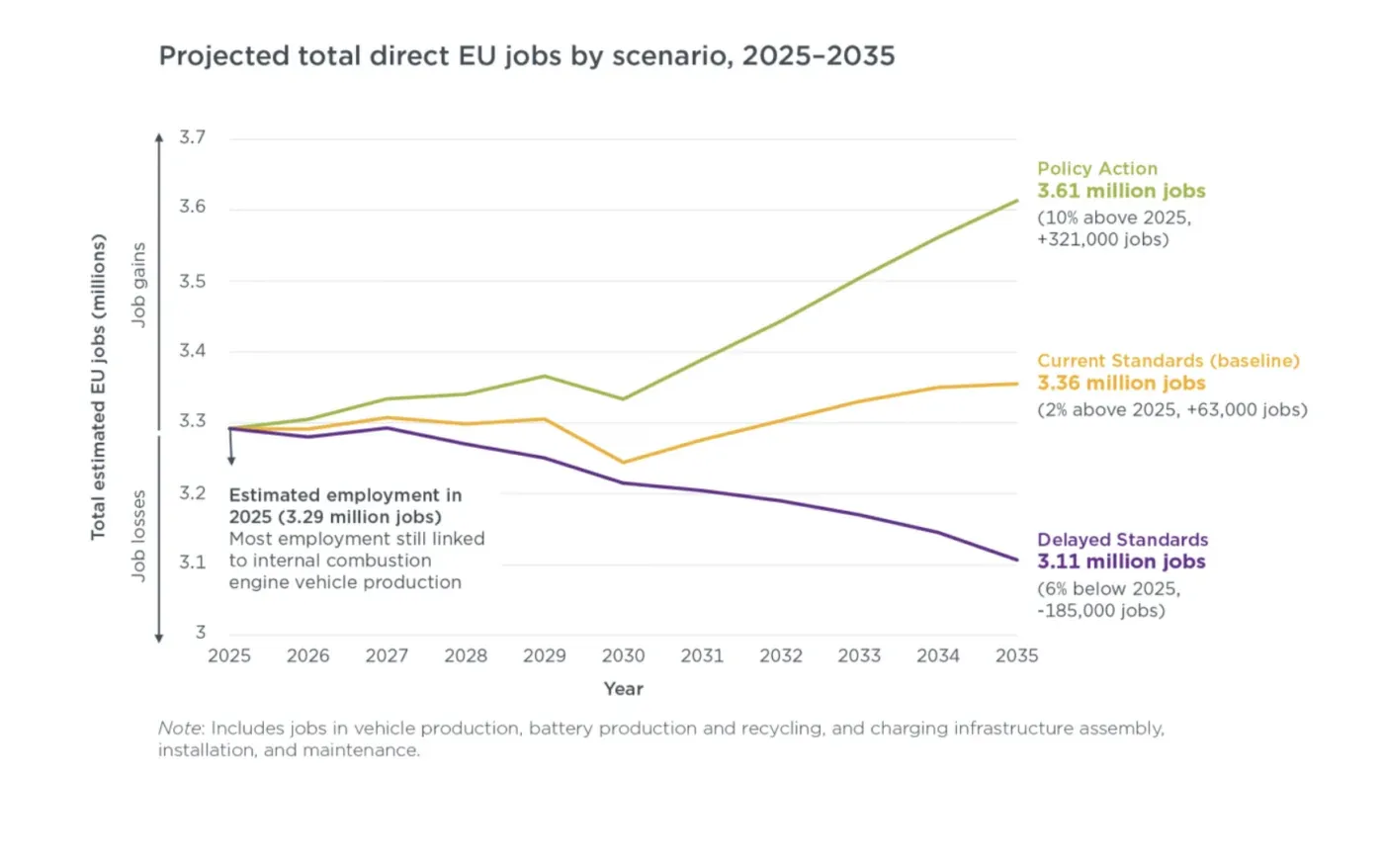
Why such a difference? Slowing down electrification might indeed allow jobs related to internal combustion engines to be preserved temporarily, but it would also hinder hiring in new sectors. Battery manufacturing, recycling, electric vehicle production, and charging infrastructure are all activities that could offset job losses in traditional industries.
Producing an electric vehicle requires fewer workers
The study highlights a paradox, however. According to ICCT calculations, manufacturing an electric car requires about 30% fewer jobs than manufacturing a conventional vehicle. This difference is largely due to the simpler mechanics of electric motors, which consist of fewer components.
But researchers believe this reduction could be offset by the development of new industrial activities. It is still necessary, however, that vehicle and component production remain in Europe. This is actually one of the main findings of the study. Under a scenario that maintains current rules, researchers estimate that 68% of electric and plug-in hybrid cars sold in Europe would be produced on the Old Continent by 2035.
This proportion would drop to only 56% if the targets are delayed. In other words, slowing down the transition could also increase Europe’s dependence on imports.
Electric cars could also create jobs
The study goes even further. By maintaining current targets while providing more support for European production, employment could increase by 10% by 2035. This would represent 320,000 additional jobs compared to 2025. These findings align with those presented by Transport & Environment a few days ago. The NGO estimates that accelerating the electrification of corporate fleets could support up to 344,000 additional jobs in Europe by 2030.
Also read
The electric vehicle industry could become a real job creator in Europe.
To achieve this, electric vehicles and their batteries need to be manufactured more in Europe. Otherwise, some of the economic benefits of this transition might go to foreign manufacturers. France is among the countries most at risk of a slowdown in electrification, along with Germany, Italy, Spain, and Poland.
These figures are still projections. The ICCT does not take into account factors such as automation, digitization, or global economic trends. The study emphasizes one important point: protecting today’s jobs does not guarantee the preservation of jobs in the future.