
India: JSW Greentech enters the electric commercial vehicle market with Ampstar
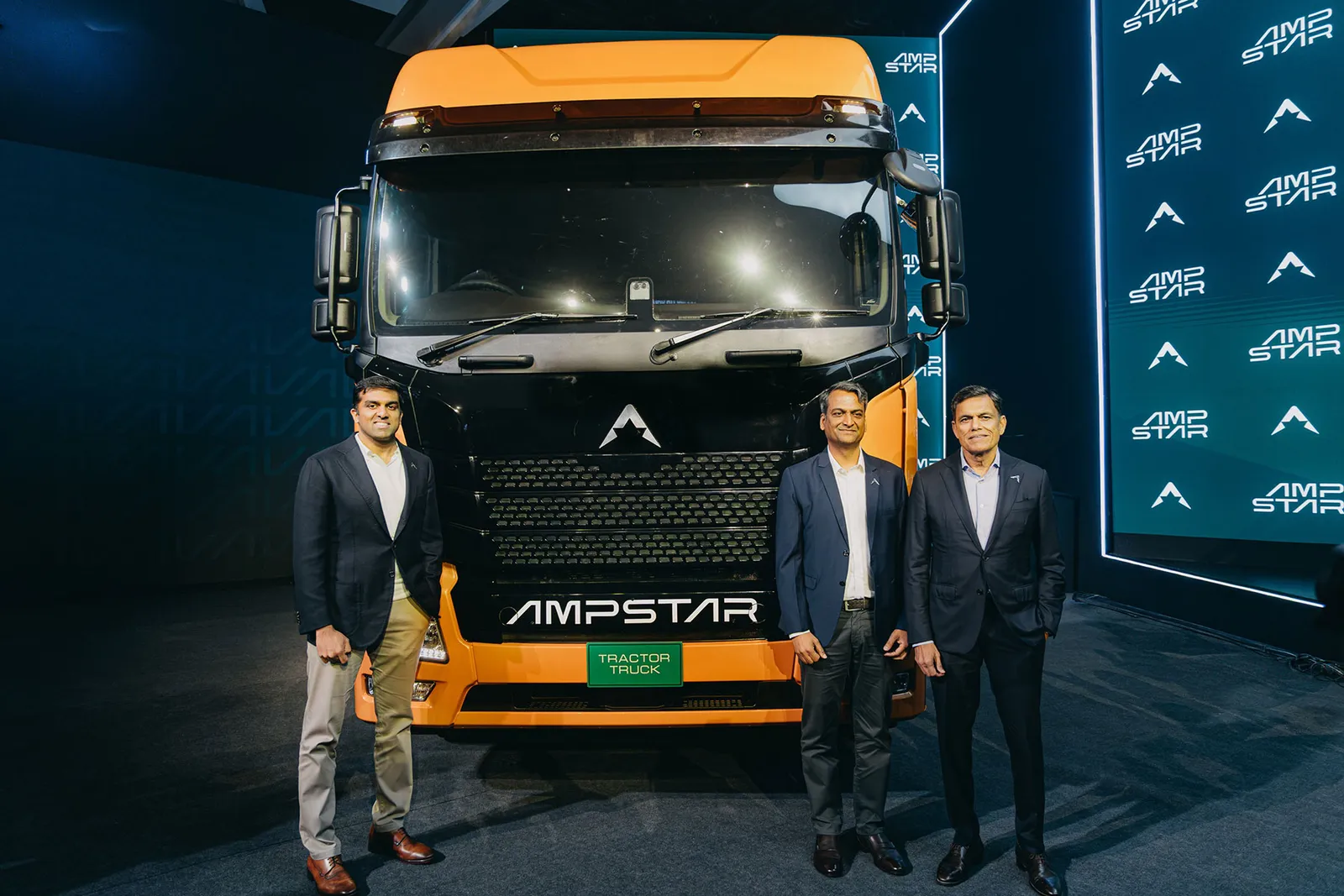
JSW Greentech, a subsidiary of the Indian conglomerate JSW Group, plans to manufacture up to 15,000 electric commercial vehicles annually in Maharashtra under the Ampstar brand. For this purpose, the JSW subsidiary has developed its own vehicle platform and initially introduced three bus models along with a 55-ton truck. This was learned by electrive correspondent Sagar Parikh at the corresponding launch event in India.
Image: JSW Group
JSW Greentech officially launched the Ampstar brand this week and outlined its activities and ambitions in the field of electric commercial vehicles on this occasion. The company has already built a new factory in Chhatrapati Sambhajinagar in India’s Maharashtra state, covering an area of about 36 hectares. The facility has an annual production capacity of 15,000 electric vehicles, including 10,000 buses and 5,000 trucks. However, the company can flexibly allocate this capacity between buses and trucks. The factory is set to be expanded when its utilization rate reaches 50 to 70 percent. According to JSW Greentech, the annual production capacity within the existing facility could easily be increased to 25,000 vehicles.
JSW Greentech states that it has invested 25 billion rupees (around 229 million euros) in its electric commercial vehicle business, with a significant portion going into in-house development. According to the company, it has developed the vehicle platform, the Vehicle Control Unit (VCU), and a four-in-one unit that integrates the Power Distribution Unit, DC/DC converter, inverter for the power steering pump, and inverter for the air compressor. In addition, it has created the basic structure, software, and algorithms for the entire electric powertrain.
CEO Sumit Mittal said at the brand launch this week that JSW Greentech aims for a 50 percent localization rate for its electric trucks within six months. This figure is expected to rise to around 75 percent within nine to twelve months — similar to the situation with electric buses. Parth Jindal, Managing Director of JSW Cement and JSW Paints, stated at the event that the commercial vehicle subsidiary will participate in government tenders for buses and will initially focus on B2B contracts for trucks.
For distribution, the company plans to offer several options. These include direct purchase, leasing, Battery-as-a-Service (BaaS), and usage-based pricing models. For trucks, charges will be based on tons, while for buses, they will be calculated per kilometer.
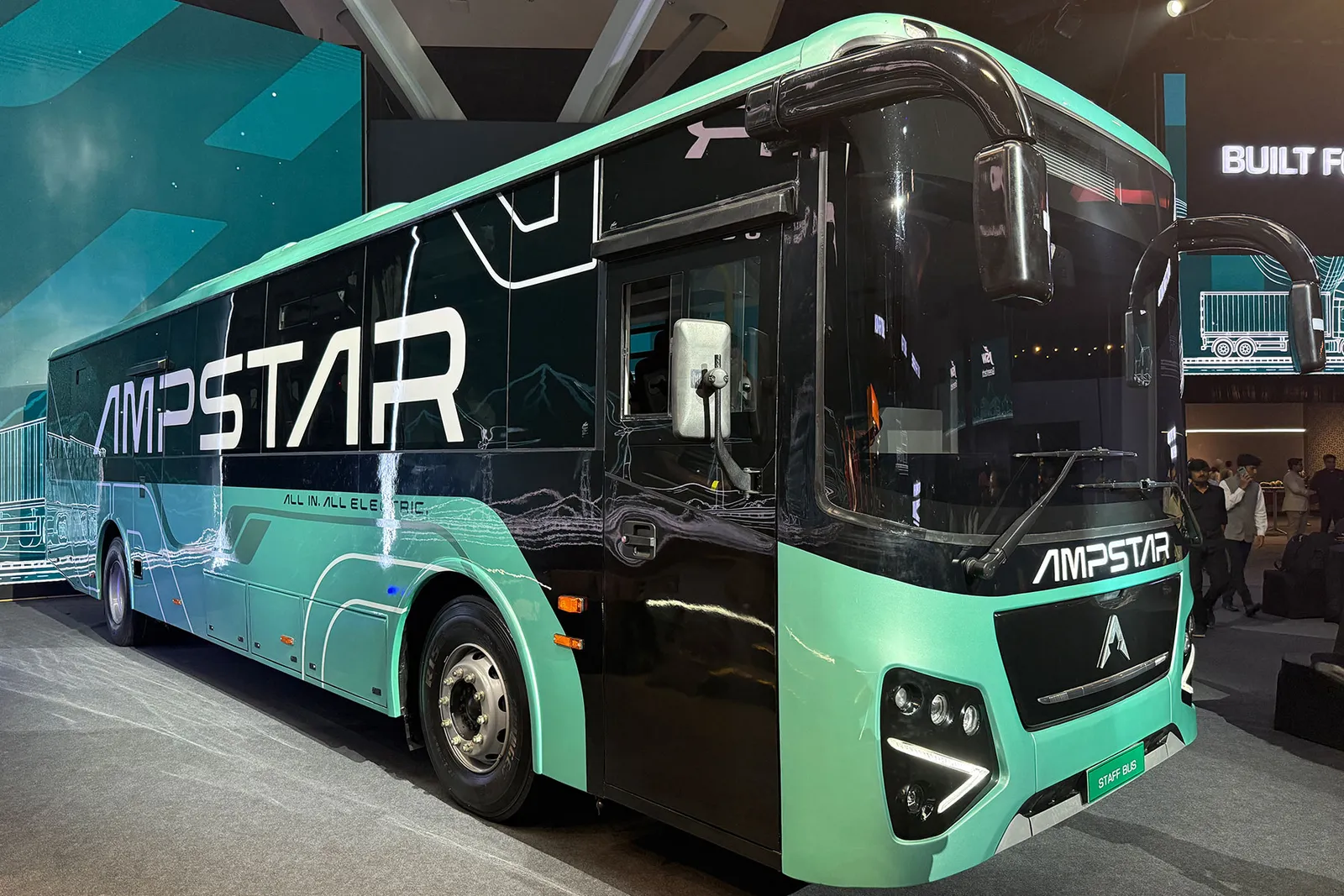
Image: Sagar Parikh
- 1/13
- 2/13
- 3/13
- 4/13
- 5/13
- 6/13
- 7/13
- 8/13
- 9/13
- 10/13
- 11/13
- 12/13
- 13/13
JSW Greentech also plans a wide range of electric bus models with lengths between seven and 18 meters for intercity travel as well as school, industrial, and urban use. Initially, the company has introduced a nine-meter-long city bus, a twelve-meter-long bus for industrial use, and another twelve-meter-long city bus.
The 12-meter-long work shuttle is equipped with a 302-kWh LFP battery that supports CCS charging via two ports and enables a range of 200 kilometers. According to the manufacturer, it can handle gradients up to 18 percent and reaches a top speed of 80 km/h. JSW Greentech offers this bus in two variants: one with 45 pushback seats or one with 52 seats featuring high headrests. Features include air suspension on both the front and rear axles, a 360-degree camera system, USB charging ports, and advanced driver assistance systems.
In the truck segment, JSW Greentech has introduced a model with a maximum gross weight of 55 tons. It is available as a 4×2 and 6×4 tractor-trailer, as well as a 6×4 and 8×4 dump truck. A 282-kWh LFP battery is used as the energy storage unit. Customers can choose between a permanently installed battery and a replaceable one. Under ideal conditions, the replacement battery should be able to be swapped out within seven minutes.
In a conversation with _electrive_ on the sidelines of the brand launch, Mittal explained that the company is working on a permanently installed 400-kWh battery. This is expected to be introduced in three to four years. With the 282-kWh battery, the truck is supposed to have a range of 140 to 150 kilometers. According to Mittal, the 400-kWh battery will later enable a range of around 200 kilometers per charge.
The 55-ton truck is also equipped with a 420-kW engine and an automated transmission with six or four gears. It is designed to handle gradients of up to 27 percent. For long-distance use, JSW Greentech has fitted the vehicle with a sleeping cabin. An air-suspended driver’s seat is also intended to enhance comfort.
In further talks with _electrive_, Mittal explained that JSW Greentech is still awaiting final approvals and aims to start production of both buses and trucks within a month. The company expects to deliver 500 to 2,000 electric vehicles between October 2026 and March 2027. According to Jindal, the new brand is set to have a substantial order backlog from day one. For example, several agreements totaling around 3,000 trucks are planned for the first day alone.
Source: _electrive on site_, jsw.in