
Imagry and UNVI are bringing an autonomous electric bus to Germany
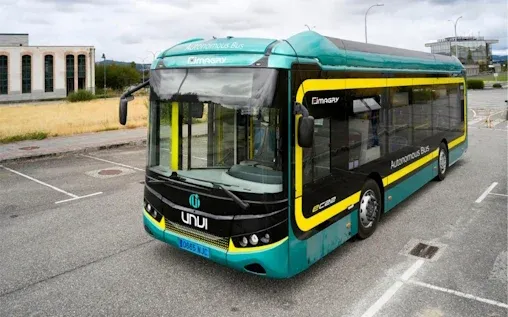
Software specialist Imagry and Spanish bus manufacturer UNVI are collaborating on the development of autonomous electric buses. The first vehicle designed together is set to be deployed in Germany by the third quarter of 2026.
The vehicle is a 10.3-meter-long M3-class electric bus that UNVI has equipped with Imagrys’ autonomous driving technology. According to the partners, it is already on its way to its deployment location in Germany. Imagry provides the software for perception, motion planning, and control. The system does not rely on high-resolution maps, instead using the vehicle’s sensors to navigate, which Imagry says is designed to simplify setting up new routes. This technology has already been tested in autonomous vehicles on public roads in Germany, the United States, Japan, and Israel.
The bus is prepared for European type approval WVTA in accordance with the safety requirements GSR2. The integration of the vehicle and driving system took less than three months, according to reports. Imagry and UNVI do not provide details on the battery, range, or charging capacity, nor do they specify where exactly the bus will be tested in Germany or whether it is intended to operate fully driverless or initially only in test operations. What is clear, however, is that UBSI serves as the third partner acting as a bridge between the manufacturer and technology provider, responsible for procurement, homologation, regulatory matters, as well as leasing and fleet management.
The partnership with Imagry is not intended to be limited to this model alone, but according to UNVI it should also apply to other vehicle configurations. In addition to traditional public transportation, the partners mention airports, universities, and hospitals as potential areas of use. Notably, the technology is not used in a small shuttle but rather in a full-sized M3-class bus. Imagry positions its system for Level-4 automation, where a vehicle can operate within a defined area without a human driver.
Whether and how quickly this will manifest in German projects also depends on approval processes and regulatory frameworks, not just on technology. There has been recent progress in this area: In mid-July, UNECE adopted for the first time an internationally harmonized legal framework for fully automated driving systems (ADS) at SAE Level 4, with support from the EU, USA, China, and Japan. It requires manufacturers to implement a Safety Management System and prove system performance through simulations and test drives, but it does not replace national approvals; instead, it provides a common basis for them. The bus now announced will initially operate under the existing WVTA and GSR2 regulations, but is likely to benefit from the new ADS framework in the medium term.