
Hyundai is starting Ioniq-3 production in Turkey
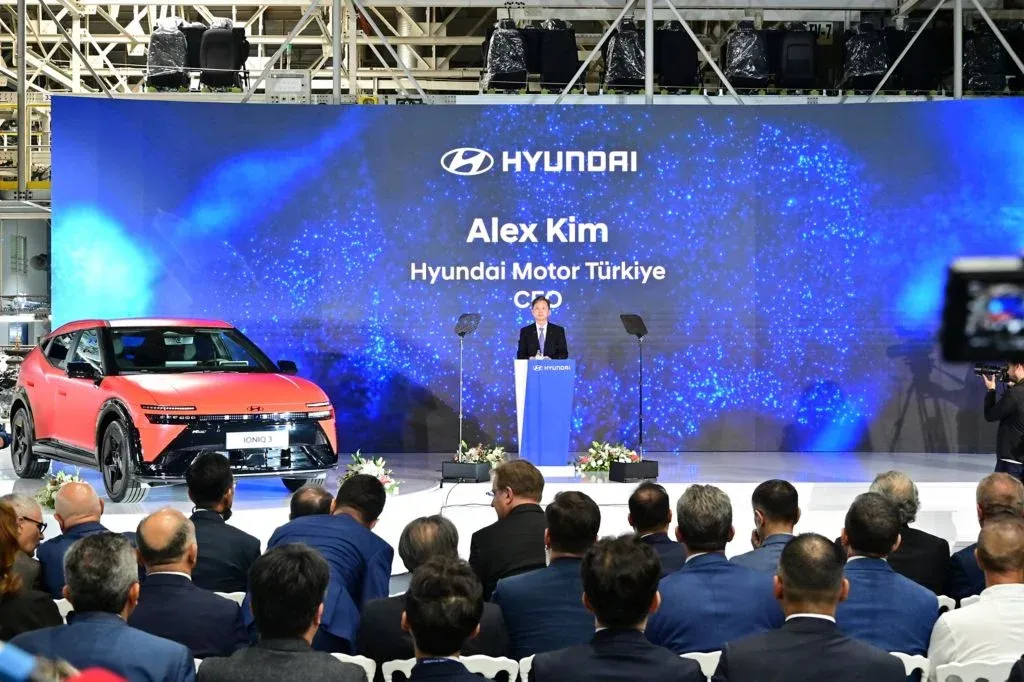
Hyundai has begun production of the all-electric Ioniq 3 at its İzmit plant in Turkey. The manufacturer invested 250 million euros to upgrade the facility. Initially, 30,000 units of this compact model developed for Europe are planned to be produced each year.
With the start of production, Hyundai’s Izmit plant is entering battery-electric vehicle manufacturing for the first time. Hyundai becomes the second automaker to produce electric cars in Turkey after the local manufacturer Togg, and according to the company, the first foreign manufacturer. The Ioniq 3 is scheduled to hit the market in October. Extensive renovations preceded the mass production phase. Over the past two years, Hyundai has modernized more than 50 percent of the plant, investing 250 million euros in the process. More than 1,000 employees have taken on new roles as part of this transformation, with Hyundai Motor Türkiye employing around 2,400 people in Izmit and at its headquarters in Istanbul.
Hyundai does not specify the planned production volume in its latest announcement. However, Turkish Industry and Technology Minister Mehmet Fatih Kacır initially cited 30,000 Ioniq 3 units per year for the start of production. As recently as June, figures of 27,000 vehicles for 2026 and over 40,000 units for the following year had been mentioned.
The Ioniq 3 was developed primarily for the European market and is based on the E-GMP platform with a 400-volt configuration. Hyundai refers to this compact model as an “Aero Hatch” due to its aerodynamic body design. It is available in two battery sizes of 42.2 and 61 kWh, enabling ranges of up to 344 or 496 kilometers according to WLTP standards. However, the final homologation for the German version has not yet been obtained.
Hyundai continues to expand its facility in Izmit
Alongside vehicle production, a battery assembly facility is being built on the factory site in partnership with Hyundai Mobis. As reported in June, Hyundai is investing 55 million euros in this facility covering approximately 30,000 square meters. Battery packs are set to be assembled automatically there using 27 robots. The battery assembly plant is part of a larger investment package totaling 715 million euros for the site.
Hyundai is now refining its plans for the facility. Starting in 2027, hybrid versions of the next generations of the Bayon and i20 are also set to be produced in Izmit, with the plant built jointly with Hyundai Mobis responsible for installing battery systems. This approach allows Hyundai to maintain a flexible powertrain strategy at this location. The plant opened in 1997 and is the Korean automaker’s first and longest-running overseas facility. Approximately 3.3 million vehicles have been manufactured there since production began, with Hyundai reporting total investments in the site at 1.185 billion euros.
"The start of production for the IONIQ 3 is a significant milestone for our plant in Izmit and for Hyundai in Europe," says Xavier Martinet, President and CEO of Hyundai Motor Europe. The production of the first electric vehicle at this site enhances manufacturing capabilities and increases flexibility to respond to changing demand in Europe. With the Ioniq 3, its own battery assembly facilities, and hybrid models planned for 2027, Izmit is gradually evolving from a production site for the i20 and Bayon into a more diversified facility for electrified vehicles.