
Hyundai Staria Electric: 9 seats, 800 volts, and over 400 km of range to win over families
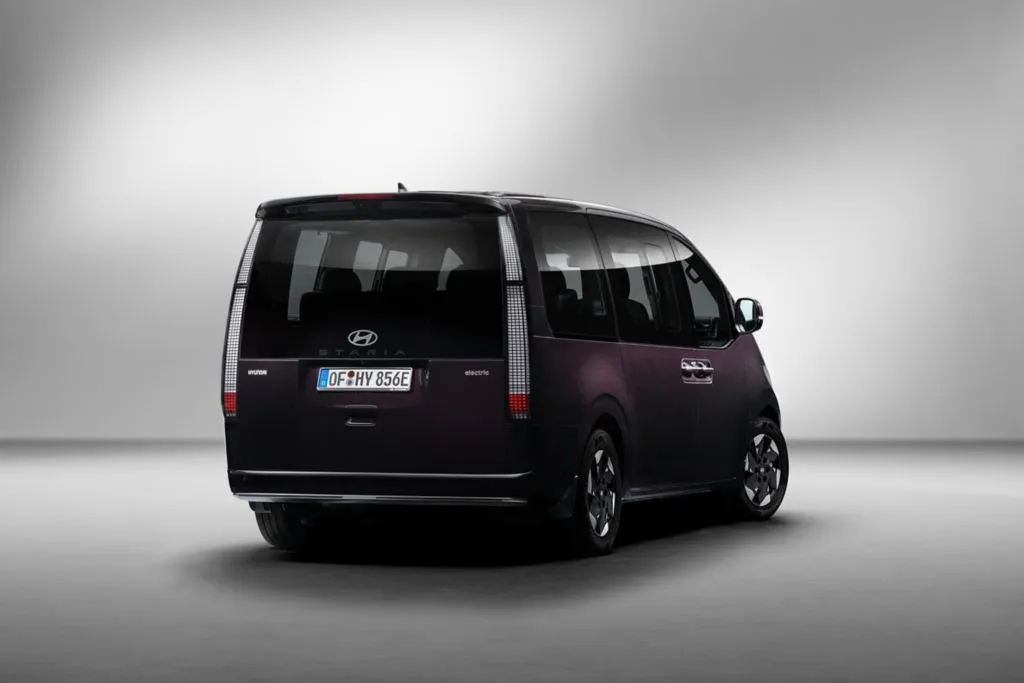
Hyundai already has an electric solution for those who need plenty of space without sacrificing emission-free commuting. The new Hyundai Staria Electric transforms the Korean minivan into a massive electric van capable of seating up to nine people, featuring charging technology that was previously more common in Ioniq series sedans.
On paper, the formula is quite simple: a body length of over five meters, an interior that can accommodate up to nine passengers, an 84 kWh battery, and an electric motor producing 218 horsepower. But there’s one element that makes the Staria particularly interesting compared to many of its rivals: an 800-volt electric architecture capable of restoring 10 to 80% of the battery’s charge in about 20 minutes.
Hyundai unveiled the Staria Electric at the beginning of 2026, and its sale in Europe has already begun. In fact, the brand is already offering it in Germany and has also added the model to its presence in Spain, although Hyundai Spain has not yet published an official price for the Iberian Peninsula. In the Canary Islands, there is even a promotion offering up to 13,500 euros in discounts, but no starting price for the model is listed.
Hyundai Staria Electric
Specifications
Length
5.25 m
Width
2.00 m
Height
1.99 m
Wheelbase
3.27 m
Seats
7 or 9
Power
218 HP
Maximum torque
350 Nm
Traction
Front-wheel drive
Battery
84 kWh
WLTP range
Up to 430 km
Rapid charging
10-80% in about 20 minutes
AC charging
11 kW
Trailer with brakes
Up to 2,000 kg
9-seater trunk
Up to 1,303 liters
Price in Germany
Starting at 57,450 euros
Price in Spain
Awaiting official rate
A 5.25-meter giant with up to nine seats
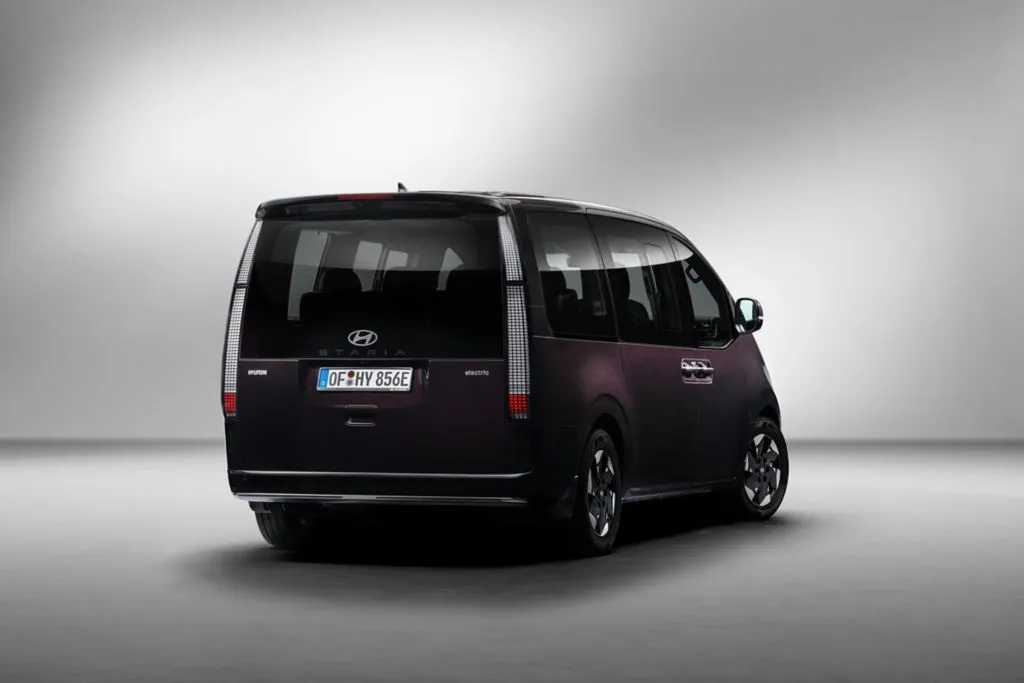
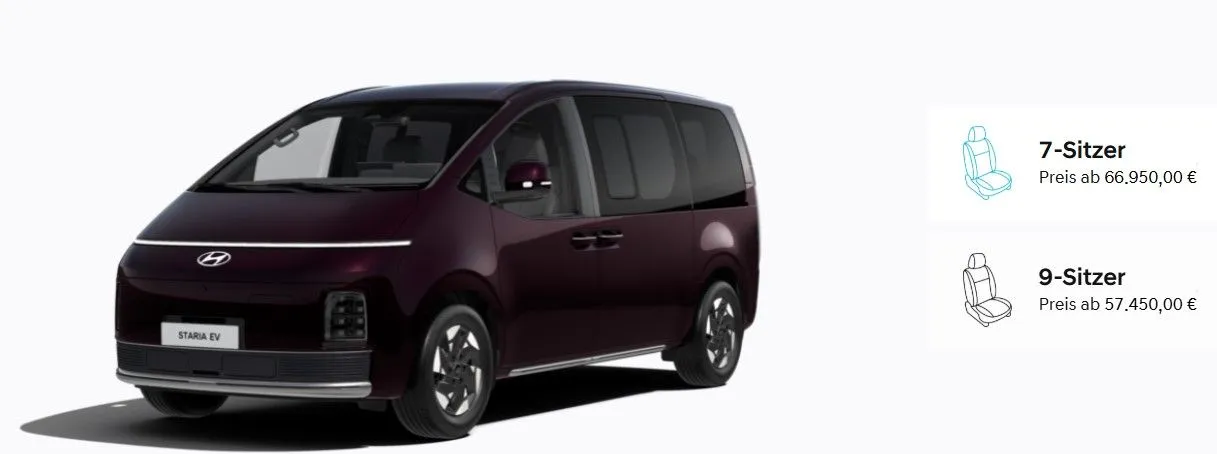
The exterior design hardly needs any introduction. The Staria retains that distinctive look that already set it apart from the conventional combustion engine model and the current hybrid version, featuring a very clean front end, a large glass surface, and a silhouette that seems more suited to a concept vehicle than a regular van. The electric version also includes specific details such as horizontal front lighting and 17-inch tires.
Its dimensions make it clear this is a large vehicle: it measures 5.25 meters in length, 2 meters in width, and 1.99 meters in height, with a wheelbase of 3.27 meters. The ground clearance is 18.6 centimeters, and the body design focuses on creating an exceptionally spacious interior.
The main advantage of the Staria Electric lies precisely in this aspect. Hyundai offers two configurations, with seven or nine seats, allowing buyers to choose between prioritizing passenger space or opting for a more comfort-focused interior. The Calligraphy trim uses seven seats, while Trend and Prime come with the nine-seat layout.
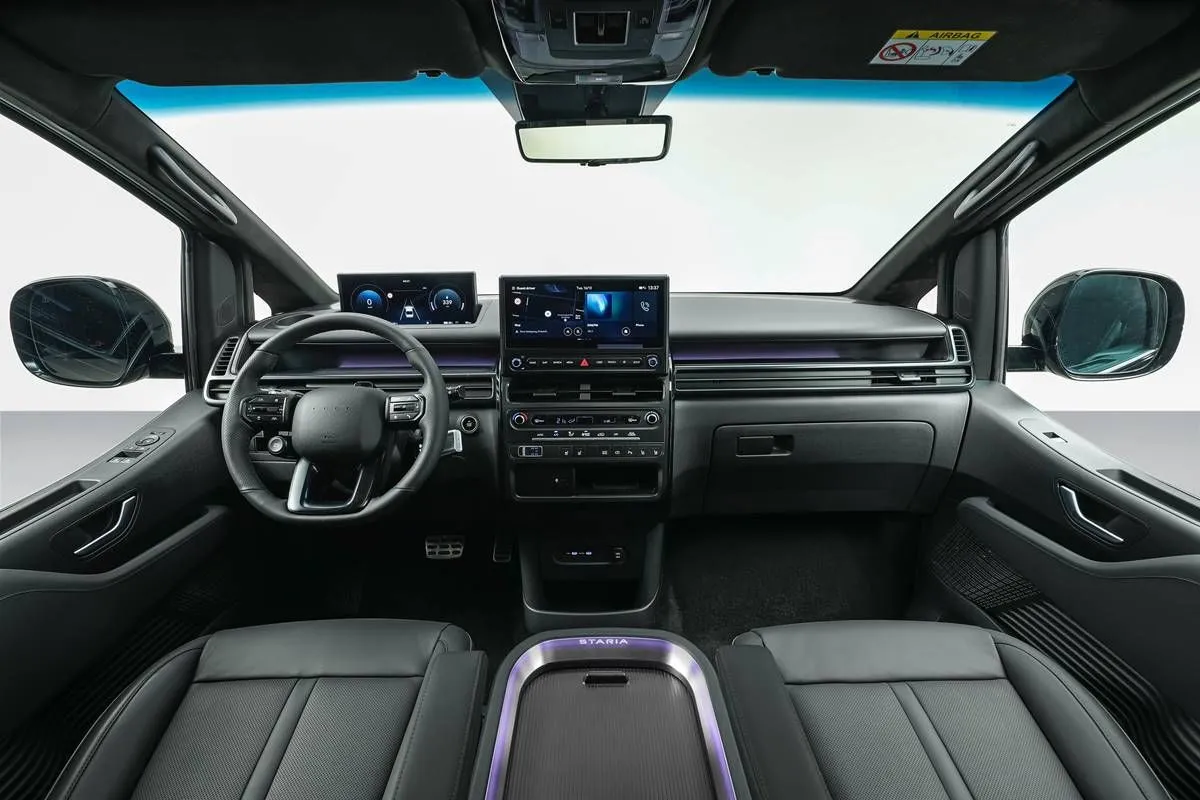
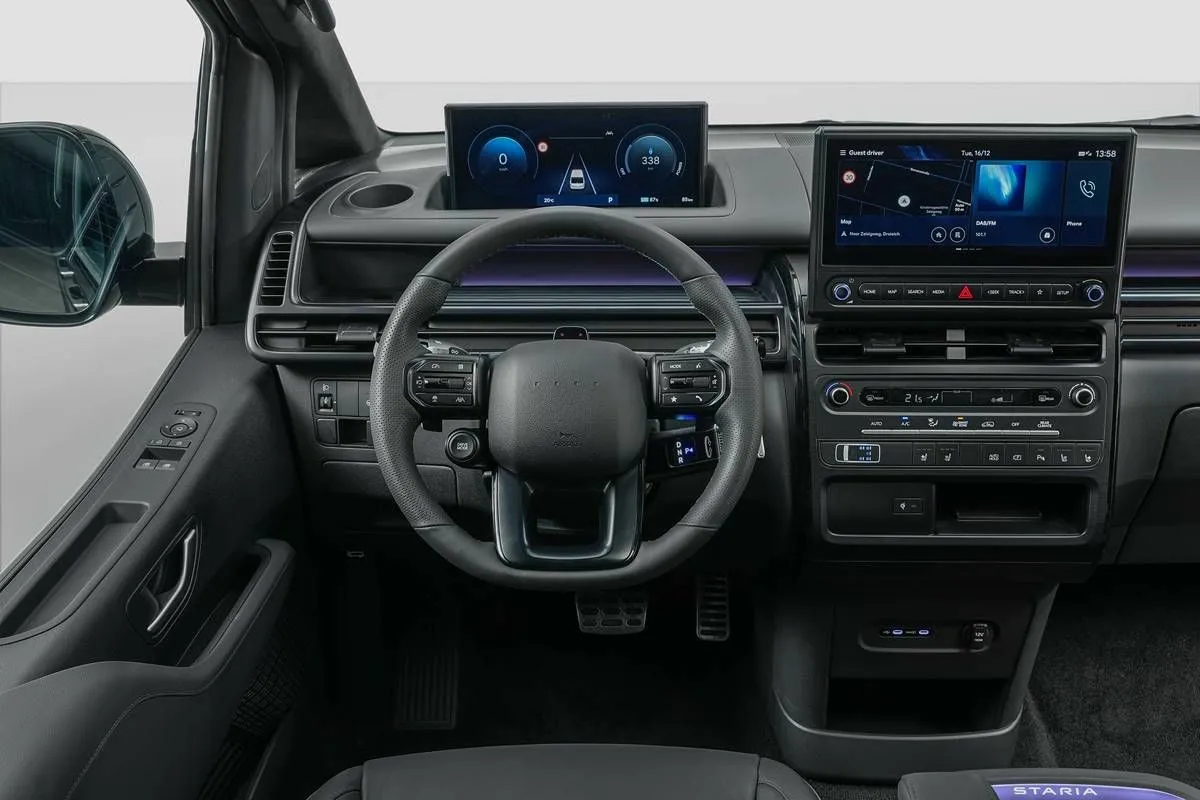
The interior retains the Staria’s philosophy, but the flat floor enabled by the electric drive system makes space utilization even more efficient. The driver has access to two 12.3-inch screens, and the standard equipment may include navigation, a 360-degree camera, a digital key, system updates, and driving assistants from Hyundai’s SmartSense family. There are also numerous USB-C ports, some capable of delivering up to 100 W of power.
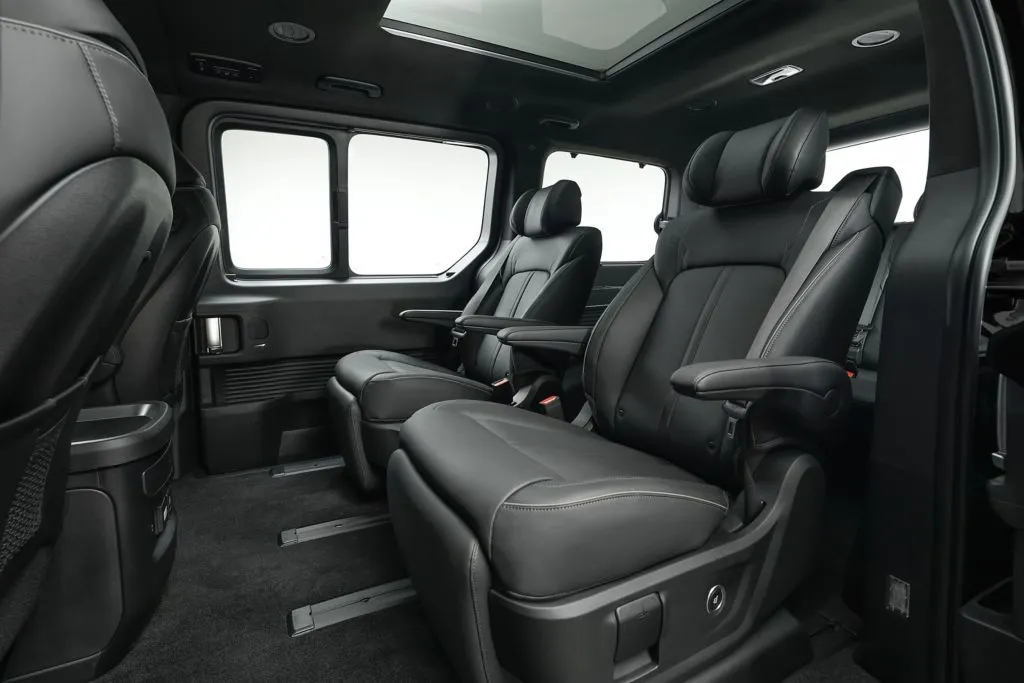
In the higher trims, leather upholstery and ventilated front seats are also available. The Calligraphy version features two large individual seats in the second row with electric adjustments, heating, ventilation, and a relaxation function. The Bose sound system and panoramic roof complete an interior setup that makes the Staria more akin to a mobile lounge than a conventional van.
The cargo capacity is also considerable. In the nine-seater Staria Electric, the space available behind the third row starts at 831 liters and can reach up to 1,303 liters, while the seven-seater Calligraphy offers between 117 and 431 liters depending on the configuration. Additionally, there is a small front area of 24 liters.
And here lies one of the features that can make this model particularly attractive for large families, transportation companies, or those who enjoy road trips: the V2L system. The Staria Electric can use the energy stored in its battery to power electrical devices both inside and outside, which works especially well with its spacious interior.
Beneath the floor lies an 84 kWh battery, paired with a 160 kW electric motor equivalent to 218 horsepower, which drives the front wheels and generates 350 Nm of torque. This isn’t a setup designed to turn the Staria into a sports car, but it’s more than sufficient to power a van of this size effortlessly. Hyundai claims an acceleration from 0 to 100 km/h in 9.5 seconds and a top speed of 184 km/h.
In addition, the Staria Electric maintains a towing capacity that many electric single-volume vehicles cannot offer. It can tow up to 2,000 kilograms with the brake engaged and 750 kilograms without it, a figure that is particularly impressive for a vehicle designed for both passenger transport and leisure or professional use. Hyundai has also worked on the system’s thermal management to maintain performance when driving with heavy loads or undergoing multiple rapid charges in succession.
And charging is precisely one of the strengths of this Hyundai. The Staria Electric uses an 800-volt architecture, a solution that is still rare among electric vans of this size. Under ideal conditions, it can go from 10% to 80% in about 20 minutes using a 350 kW fast charging station, while the AC charger provides 11 kW.
The certified range has also improved compared to the initial figures announced by Hyundai. While it was said to be around 400 kilometers at its launch, Hyundai Germany now reports a WLTP range of 430 kilometers. The certified consumption for the Trend version is 21.8 kWh/100 km. As always, these figures will depend significantly on the load carried, speed, and weather conditions.
For a van over five meters long, the combination of 84 kWh and 430 kilometers WLTP is reasonable, although the Staria Electric isn’t intended to compete with the most efficient electric sedans in terms of pure range. Its advantage lies elsewhere: carrying many people with plenty of space and being able to recover a significant portion of the battery during a relatively short stop.
In Germany, prices for Spain have not yet been announced. The range currently consists of three finishes. The nine-seater Staria Electric Trend starts at 57,450 euros, the nine-seater Prime goes up to 63,650 euros, and the top-of-the-line seven-seater Calligraphy reaches 66,950 euros. The base model already includes features such as LED headlights, 12.3-inch screens, a rear camera, parking sensors, heated front seats, a heat pump, and a battery heating system.
The Prime adds electric sliding doors, an electric rear gate, leather upholstery, ventilated front seats, navigation, a 360-degree camera, and additional assistants. Above that is the Calligraphy, which clearly focuses on luxury with Nappa leather, Bose audio system, ambient lighting, and the aforementioned individual seats in the second row.
With these specifications, the Hyundai Staria Electric finds itself in a challenging yet interesting market position. It is larger and more spacious than many current electric minivans, offering a seating capacity that the Volkswagen ID. Buzz cannot match in all its configurations. On the other hand, it is also a large and heavy vehicle with a price that puts it far above more affordable electric alternatives.
But Hyundai has gotten something right that can make a difference: it didn’t simply install a battery and an electric motor in an existing van. The brand equipped the Staria with an 800-volt architecture, an 84 kWh battery, fast charging in about 20 minutes, a heat pump, V2L functionality, and up to nine seats. For those who truly need space, it’s a much more serious offering than it might seem at first glance.
Key features of the Hyundai Staria Electric
Large electric van/minivan.
Up to 9 seats.
5.25 meters in length.
Front-mounted engine with 160 kW, equivalent to 218 horsepower.
350 Nm of torque.
Front-wheel drive.
84 kWh battery.
Up to 430 kilometers WLTP range.
800-volt electric architecture.
10% to 80% charging in about 20 minutes.
11 kW AC charger.
Up to 2,000 kg towing capacity with brakes.
Trunk space of up to 1,303 liters in the nine-seater version.
V2L for powering electrical devices.
Price in Germany starting at 57,450 euros.
Official price for Spain not yet released.