
Hyundai has started manufacturing the IONIQ 3 in Turkey. The electric hatchback, priced at around 112 thousand złoty, is targeted for the European market.
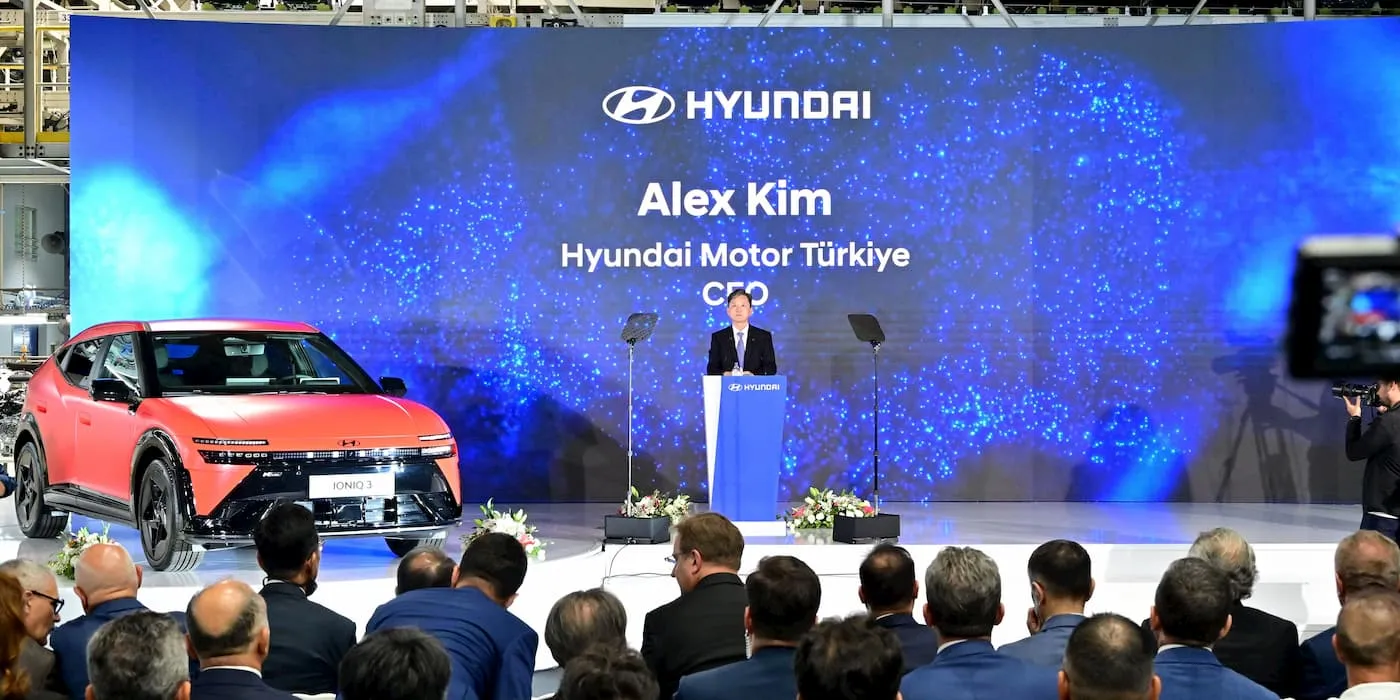
Hyundai has started production of the IONIQ 3 at its Izmit plant in Turkey, following a €250 million investment to adapt the factory for electric vehicles. Sales in Europe are set to begin in September 2026, and prices in the UK and Netherlands already indicate it will be one of the key players in the B-segment.
For Polish drivers, the message is clear: Hyundai is preparing a compact electric car that is expected to be cheaper than the Kia EV3, but it doesn’t seem like a budget vehicle.
30,000 cars per year and Hyundai’s ambitious goal
The IONIQ 3 is the first electric car produced at Hyundai’s Turkish factory. The company has modernized about 50% of the plant and plans to produce 30,000 cars annually at launch. By 2027, a new generation of the BAYON and i20 models are set to join production in Izmit.
The model is important for Hyundai because it targets the heart of the European market. The manufacturer itself notes that B-segment cars account for around 15% of car sales in Europe, with the share of electric vehicles in this segment set to rise from about 14% today to 65% by 2035.
Group chairman Chung Euisun visited the factory before mass production began and told employees outright that quality must be monitored from the start. He also mentioned safety and the ambition to have the car recognized as “the best vehicle in Europe.” A bold declaration. Nice on paper, but the market will verify it faster than the PR department.
Prices and specifications of IONIQ 3
In the United Kingdom, prices start at £22,245, which is approximately 112,000 zł. In the Netherlands, the base version costs €27,995, or about 120,000 zł. This price point positions the IONIQ 3 as a direct competitor to urban and compact electric vehicles such as the Volvo EX30, BYD Dolphin, or lower-trim versions of the Kia EV3.
The car will be available with two battery options: 42.2 kWh and 61 kWh. According to WLTP standards, the range is up to 344 km for the base version and up to 496 km for the Long Range variant. Hyundai highlights a drag coefficient of Cd 0.263, a 400 V architecture on the E-GMP platform, and DC fast charging that takes 29 minutes to reach 80% for the smaller battery and 30 minutes for the larger one. Optionally, it also includes AC charging at 22 kW. It’s a shame that with 400 V, it doesn’t promise record charging speeds like the IONIQ 5 or 6.
The powertrain is located at the front. It delivers 107.8 kW or 99.5 kW of power, with a torque of 250 Nm, and the top speed is 170 km/h. Interestingly, according to the given figures, the version with a smaller battery reaches 100 km/h faster, at 9.0 seconds compared to 9.6 seconds for the Long Range version.
The IONIQ 3 has a length of 4155 mm, a wheelbase of 2680 mm, and a trunk with a total capacity of 441 liters when including the additional Megabox storage. This is a very strong performance for a B-segment vehicle. Inside, there will be a new Pleos Connect system based on Android Automotive, 12.9 or 14.6 inch screens, an optional driver display, and the Gleo AI assistant. There are also SmartSense systems, including HDA2, RSPA, and a blind spot monitor.
Hyundai wants to sell us a small electric car “for Europe,” but what’s more interesting is this: in this class, price alone isn’t enough anymore, as Chinese manufacturers have long stopped giving away the market for free. How would you price the IONIQ 3 in Poland so it could compete with the Kia EV3 and BYD?
LovEV Newsletter
Want more content like this?
Sign up — we’ll send you a weekly summary once the newsletter starts.